
Living away from home fringe benefit overview
An employee is considered to be living away from his or her normal residence if they have to relocate to work temporarily for the employer at another locality. Whether someone is living away from home should be determined on a case by case basis.
Unless the employee works on a fly-in-fly-out or drive-in drive-out basis, the concessional tax treatment of LAFHAs and associated benefits provided to employees is limited to a maximum period of 12 months. The employee must:
- Maintain a home in Australia, at which they usually reside, for their immediate use and enjoyment while living away from that home for their work.
- Provide their employer with a declaration about living away from home.
The LAFHA workpaper provides assistance in identifying the declarations required for various date and LAFHA type situations.
Latest Information
See the ATO website for additional details and the most up to date information:
Foreign Employment Income and Section 23AG
Australian residents who work overseas on certain approved projects may be exempt from Australian income tax according to section 23AG. However, the s23AG exemption does not apply to most employees. Benefits provided to employees who are not eligible for the section 23AG exemption are potentially subject to FBT.
We recommend that you speak to your advisor for details. You can find more information on the ATO ;website here: www.ato.gov.au/Business/Engaging-a-worker/In-detail/Foreign-employment-income-and-section-23AG---employers/
12 Month Rule
If you have exceeded 12 months of LAFHA, and do not work on a fly-in-flyout or drive-in drive-out basis, you must break the calculation into two parts–concessional LAFHA and non-concessional LAFHA.
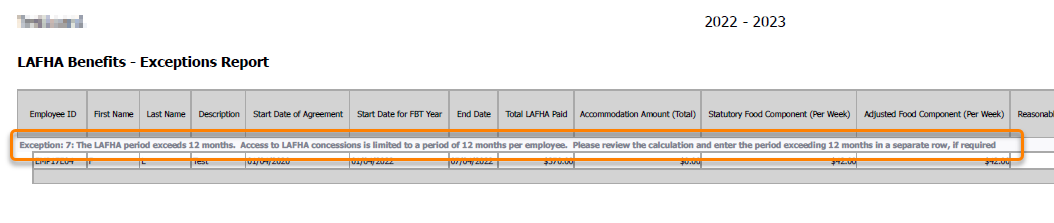
To find out if the 12 months has been exceeded, run the LAFHA Benefits Exception benefit report.
- SelectReports > ;Benefit Reports on the navigation bar.
- SelectLAFHA Benefits - Exceptions Reportin the list.
- Select theRun Selected Reportbutton.
- Use the dropdown to specify the file type and select theStart Exportbutton. After a few minutes, the generated report appears in your computer's downloads folder.
Exception 7 shows periods where the payment of a living away from home allowance has exceeded 12 months. These benefits need to be split.
How to split the period
The workpaper does not automate this split because the approach may differ for each organisation, depending on your policies and processes.
Once you identify that the benefit has exceeded the 12 months, you must correctly calculate the FBT payable for the concessional period (in other words, the 12 month period), and for the period where the LAFHA is fully taxable.
Example:
Phil has exceeded the 12 month period from 1 October 2019. In this case the total for Phil's accommodation ($12,000) and food allowance ($8,000) have been apportioned and the amounts paid from 1 October have been included in a separate line. For the period in excess of the 12 month concessional period, select
No
to in the Required Declarations Completed column
. This will ensure the LAFHA for this period is treated as fully taxable.Employee | Start date of agreement | Contract Variation date | Start date for FBT year | End Date | Days LAFHA paid | Required declarations completed? | No of Adults | Total LAFHA Paid | Accommodation Paid (Total) | Taxable Accommodation | Food Component Paid (Total) | Adjusted reasonable food compensation (per week) | Reasonable food compensation (total) | Gross Taxable Value | Value of Reductions | Taxable Value |
Phil Maglassop | 1-Oct-18 | 1-Oct-18 | 1-Apr-19 | 30-Sep-19 | 183 | Yes | 1 | $10,000.00 | $6,000.00 | $0.00 | $4,000.00 | $269.00 | $7,032.43 | $10,000.00 | $8,902.00¹ | $1,098.00 |
Phil Maglassop | 1-Oct-18 | 1-Oct-18 | 1-Oct-19 | 183 | No | 1 | $10,000.00 | $6,000.00 | $6,000.00 | $4,000.00 | $269.00 | $7,032.43 | $10,000.00 | $0.00 | $10,000.00 | |
Totals | $12,000.00 | $6,000.00 | $8,000.00 | $14,064.86 | $20,000.00 | $8,902.00 | $11,098.00 |
note
For the purposes of this example, the normal home food costs of $42 a week (total $1,098) are not part of the value of reductions. Transitional rules for reasonable food and drink are no longer applicable.
LAFHA Food Rates
To show the current table of reasonable food and drink amounts, select
ATO ;return
> ;FBT rates table
on the navigation bar. For help working out earlier rates and thresholds, see https://www.ato.gov.au/Rates/Fringe-benefits-tax---historical-rates-and-thresholds/.LAFHA Options
The employee can pay the normal home food costs themselves and have the employer pay the additional reasonable costs for food per week. Those normal home food costs are called the statutory food amounts. This is sometimes called paying LAFHA under the net method. Alternately, the employer can choose to pay additional food and drink costs as well as the statutory food total.
For example, in the case of an adult receiving a LAFHA in the FBT year ending 31 March 2023, the maximum reasonable food component is $289. The employee agrees to pay the statutory food component of $42 themselves. The employer could then pay them $247 ($289 - $42) per week and no FBT is payable on the $247 that the employer pays. The additional $247 per week is reasonable compensation for the extra cost of food while living away from home.
In ONESOURCE Fringe Benefit Tax you must select the option you want to use. Go to
Options > LAFHA
and select the appropriate method.Other considerations
Allowance as compensation
An employer may pay the employee an allowance as compensation for additional, non-deductible expenses if the expenses are a consequence of the employee being required to live away from their normal residence to perform their job duties. In this case, the allowance constitutes a benefit for FBT purposes.
A LAFHA that is a fringe benefit should be distinguished from a location allowance, which is assessable as ordinary income.
Third party arranger
If an associate or third party arranger pays an allowance for living away from home compensation, the allowance is assessable income of the employee. An associate could provide living away from home accommodation benefits or an accommodation expense payment benefit that is exempt from FBT.
Location allowance
Location allowances are customarily paid to attract employees to live in, or continue to live in, a particular (usually remote) location. The allowance is usually paid to all employees and is calculated without reference to any additional expenses expected to be incurred as a result of living at that location. Certain location or isolation allowances may be considered LAFHAs if the allowance is paid to compensate employees for the additional cost of accommodation or food associated with living away from their normal residence.
Work site camping allowance
A work site camping allowance paid as compensation for additional expenses and other disadvantages an employee incurs while living away from their normal residence is generally a LAFHA. However, any part of a camping allowance paid to cover additional deductible expenses is not a LAFHA. In this case the allowance is assessable as ordinary income.
Common examples of such additional (non-deductible) expenses include extra costs for food and accommodation that would not be incurred if the employee was not required to live away from home. Additional expenses do not include expenses that would normally be tax-deductible.
Oil rig workers
Generally, oil industry employees whose usual place of employment is on an oil rig or other petroleum or gas installation at sea would be regarded as living away from their normal residence. This is the case if the employee is provided with residential accommodation at or near his or her usual place of employment and the allowance represents compensation for disadvantages the employee suffers because of being required to live away from their normal place of residence. Such payments are treated as fringe benefits and are not assessable to the employee.
Expatriates
If an expatriate is posted to Australia, or an Australian resident is posted overseas for an appointment of finite duration, they will generally be living away from their normal residence, as long as they are expected to return to the same city or district in their home country at the end of their posting. This would also apply to an employee who is transferred to another location in Australia, provided the permanent job location does not change. There must be an intention for the employee to return to the former locality on completion of the transfer.
Fly-in Fly-out (FIFO) and Drive-in Drive-Out (DIDO) employees
Special rules apply for FIFO and DIDO employees who work in remote locations on a regular and rotational basis for a number of days and have a number of days off. They are provided with residential accommodation at or near their usual place of employment. On completion of the working days they travel from their usual place of employment to their normal residence, and on completion of the days off return to their usual place of employment. These employees are not required to maintain a home in Australia and the twelve-month limit on concessional tax treatment does not apply. Substantiation requirements still apply to them.
Declaration
An employee who lives away from his/her normal residence during an FBT year must give a declaration to their employer by the date of lodgment of the FBT return. Amongst other items, the declaration must indicate the following:
- The employee's normal residence
- The place at which the employee resided during the period they received the LAFHA
Employees are also required to complete a declaration showing the accommodation expenses incurred and food and drink expenses that are not considered reasonable.
When the employee provides a declaration, they must retain the relevant documents for five years from the declaration date.
Declarations are available under
Administration
in ONESOURCE Fringe Benefit Tax. Substantiation
The accommodation expenses an employee incurs while living away from home must be substantiated in full. However, substantiation of food or drink expenses is only required when the expenses incurred exceed the reasonable amount. If the expenses exceed the reasonable amount, the full amount of the expenses incurred must be substantiated, not just the excess amount. ;
The substantiation requirements are satisfied if the employee gives documentary evidence of the expense before the declaration date for the relevant FBT year. Documentary evidence includes the actual receipt or other evidence as appropriate (for example, credit card or bank statements), or a copy of these documents.