
U.S. Section 301 Tariffs
The Section 301 China Tariffs, introduced in 2018, were a response to policies and practices in China considered discriminatory against U.S. trade.
These tariffs impact a broad range of products and have been implemented in four stages, referred to as "Lists." These lists collectively cover approximately $550 billion worth of goods imported annually from China.
To track products subject to Section 301 duties, the government created separate HS numbers under Chapter 99. The duty rates for each list are assigned to specific HS Headings, as detailed in U.S. Note 20 for Chapter 99.
List | U.S. Note | HS Heading | Duty Rate |
|---|---|---|---|
List 1 | 20 (a), (b) | 9903.88.01 | 25% |
List 2 | 20 (c), (d) | 9903.88.02 | 25% |
List 3, parts I and II | 20 (e), (f) | 9903.88.03 | 25% |
20 (g) | 9903.88.04 | ||
List 4 part I | 20 (r), (s) | 9903.88.15 | 7.5% |
In Content, the Duty Rates specified above are identified as the Main Duty Rates applicable to the HS Headings listed under U.S. Notes 20 (a), (c), (e), (g), and (r).
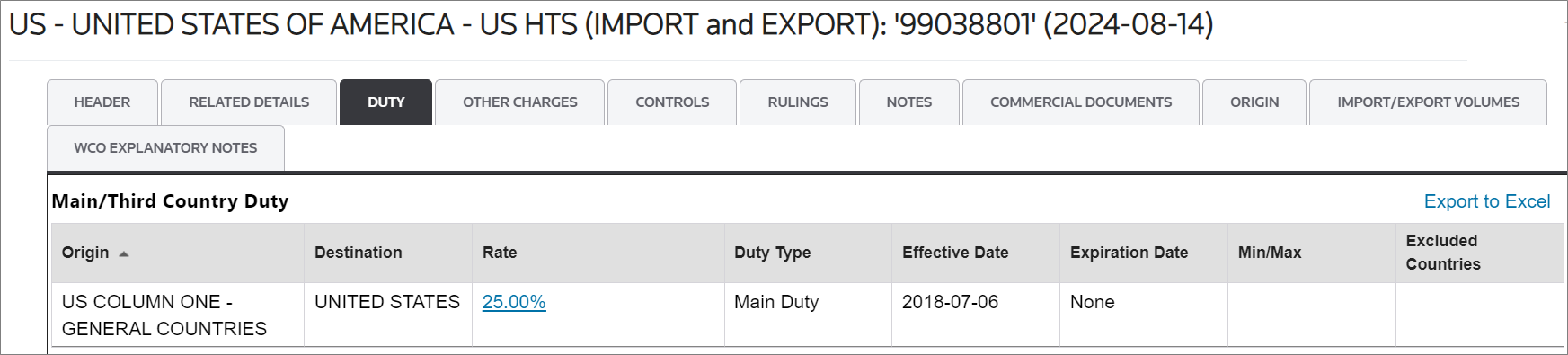


U.S. Notes 20 (b), (d), (f), and (s) extend the application of each heading to all products from China that fall under the specified 8-digit subheadings for each note, except for those products that have been granted an exclusion by the U.S.
For example, if U.S. Note 20 (a) assigns an Additional Duty Rate of 25% to HS Heading
9903.88.01
, then U.S. Note 20 (b) will apply this heading and its duty rate to other HS Subheadings, such as 8703.32.01
. Consequently, any Custom Declarable HS Number originating from this subheading will incur an import charge for China at a 25% duty rate under the Other Duty
section. This rate applies to all HS Headings included in U.S. Note (b) as well.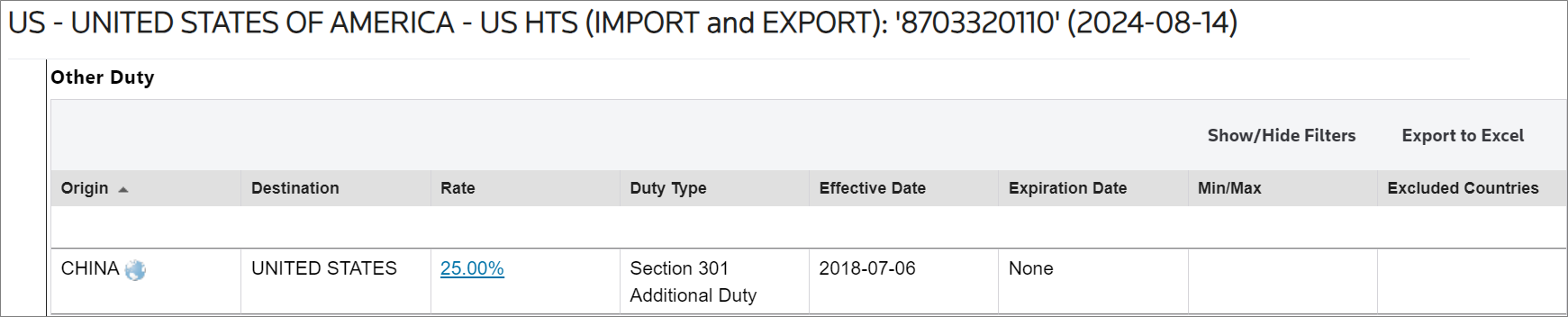
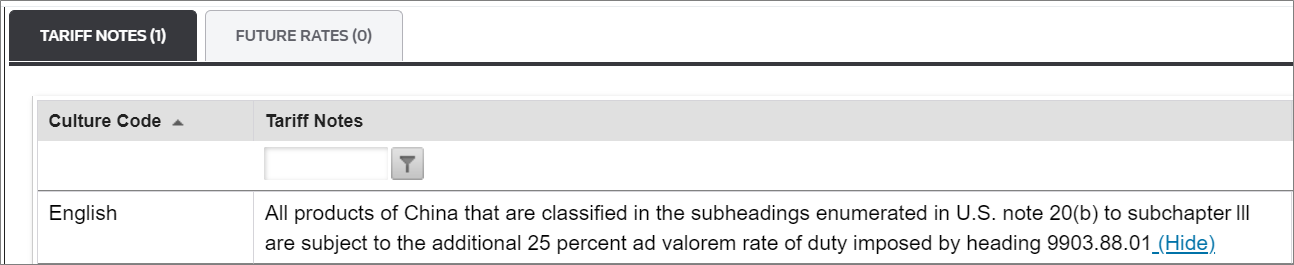
Further details regarding the origin of the charge will be included, first in the form of a
Tariff Note
.
Then as a
Control
, under the Controls > Import Controls
tab, user will find an HS Level Control that also references the origin of the charge.
Lastly, as a
Related HS Control
, user can access this by clicking on the Related Details > Related HS Controls
tab. Please note that the detailed Related HS Number corresponds to the HS Headings listed under U.S. Note 20 (a). The specific HS Heading will vary depending on the "List" to which it belongs.
Please note that specific
ChargeDetailTypeCodes
have been created for these Lists. They are constructed by combining the ISO Code "US" with the HS Heading mentioned in U.S. Note 20 (a). This format is consistent across each List and corresponds to each applicable heading. For further reference, please refer to the table below.List | HS Heading | ChargeDetailTypeCode | Charge Description |
|---|---|---|---|
List 1 | 9903.88.01 | US99038801 | Section 301 Additional Duty |
List 2 | 9903.88.02 | US99038802 | Section 301 Additional Duty - Second List |
List 3 | 9903.88.03 | US99038803 | Section 301 Additional Duty - Third List - Part I |
9903.88.04 | US99038804 | Section 301 Additional Duty - Third List - Part II | |
List 4 | 9903.88.15 | US99038815 | Section 301 Additional Duty - Fourth List - Part I |
Exemptions are also considered by Customs Authorities and are included in Content using the same framework previously explained. They will have the same applicability, ChargeDetailTypeCodes, Tariff Notes, Controls and Related HS Controls structure as other cases, but these exemptions will be assigned a 0% duty rate.

Further details for these cases will also be included in the form of Tariff Notes. Firstly, a note will reference the original List in which the HS Number was included, and a second note will provide details about the exemption.

In the
Controls > Import Controls
tab, you will find an HS Level control that references the origin of the charge and a control detailing the origin for the exemptions.
Finally, under the
Related Details > Related HS Controls
tab, user will find two Related HS Numbers. The first HS number will reference the origin of the charge based on the list in which it was initially included. The second HS number will provide specifics about the exemptions.
Please note that the Related HS Number will reference the subheading to which the exemption was originally applied.
Related Content
-
Harmonized System (HS)
Format: Article