
EU announces new import surveillance tool
Date of Publication: June 17, 2025
On June 4, 2025, the European Commission (EC) announced it has set up a new surveillance tool to help protect the European Union (EU) against sudden and potentially disruptive surges in imports.
With the increase of EU trading partners imposing an increasing number of restrictive measures on global trade (e.g., tariffs), the EU is seeing an increased risk of goods originally destined for non-EU markets being redirected to the EU internal market. This increase in diversion of goods to the EU – potentially at very low-price levels – could be detrimental to the EU and the internal EU market. As a result, on 7 April 2025, European Commission President Ursula von der Leyen announced the creation of an import surveillance task force. The purpose of this task force is to inform decisions and actions to protect the EU internal market. The surveillance tool is one of the outcomes of this task force to assist it in making informed decisions on safeguarding European economic interests.
Overview of the surveillance tool
The Surveillance system is used, in line with Article 55 of Implementing Regulation (EU) 2015/2447 (UCC IA), for monitoring purposes. Economic operators (EOs) enter data in the Member States National customs declaration systems. The data elements are collected in these systems and transmitted to the Surveillance system. The Surveillance system contains an automated dashboard based on data from the customs surveillance system to monitor the import trends. The dashboard is updated monthly. The task force will complement these findings with relevant information received from EU industry, Member States, and other experts.
The objective of the dashboard is to identify product codes (by 8-digit combined nomenclature codes, or CN codes) where a potentially harmful increase of imports can be observed since January 1, 2025. The results will be published regularly online.
Dashboard methodology and results
The tool monitors imports from all origins outside the EU, based on the customs surveillance system. The results include import data up to one month before their publication.
The dashboard results list indicates customs codes (HTS/CN codes), their description, a percentage increase in import volume, and a percentage decrease in price. A product code is considered a ‘hit’ and appears in the results list if, compared to the same period of the previous year, imports under the code from all origins into the EU:
- show an increase in quantity;
- a decrease in the average import price over the same period, and;
- the product is also produced in the EU.

The Surveillance Tool also includes a heat map. The heat map highlights instances where import quantities have risen while the average import price has fallen during the same period, focusing attention on industry sectors and (groups of) origins where such potentially concerning import increases occur most often. It shows how often these cases, or ‘hits,’ happen, organized by industry sector (according to NACE classification) and by (groups of) origins.
Due to technical constraints, the EC had to limit the number of countries or regions shown by default. Therefore, the EU’s main trading partners were selected, and certain country groups were included. The (groups of) origins displayed are ASEAN, Canada, China, EFTA, India, Japan, Mercosur, Mexico, Russia, South Korea, Türkiye, Taiwan, the United Kingdom, and the United States. Imports from the rest of the world are grouped under the designation 'RoW'. Imports from the whole world, for which detailed data are presented in the results list, are grouped under the designation 'WW'.
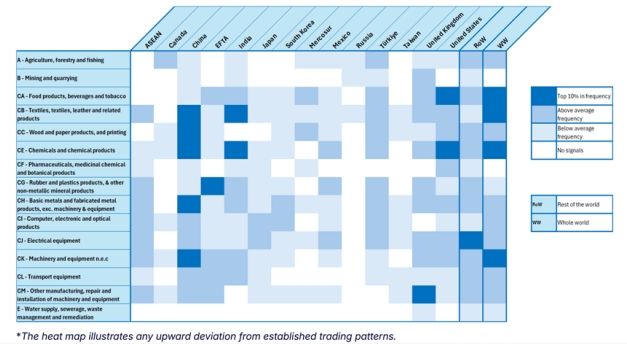
Frequency indicates how often hits are detected within a given industry sector. The higher the share of hits within the sector, the higher the frequency.
Results are grouped in four categories of increasing prevalence of hits. The darkest category is that of the combinations of sector and origin that score the highest frequencies of hits, followed by those that have above-average frequency and those that have below-average frequency. Finally, combinations with no hits are left white.
The EC will engage the EU industry concerned (via input collected through questionnaires sent to TRADE-IMPORT-MONITORING@ec.europa.eu), to further refine its analysis for the product codes that appear to be most diverted.
Will the EC engage with third countries on trade diversion?
Where appropriate, the EC will engage in discussions with trading partners on issues identified. This includes dialogue with China that was agreed on 8 April 2025, where both sides will exchange information aimed at detecting and avoiding trade diversion caused by tariffs, and ensure that any developments are duly addressed.
Although the EU is on high alert for trade diversions, sector-wide remedies are unlikely. However, protective measures can be imposed regarding specific products and will only cover products that are also produced in the EU.
What conditions must be met for safeguards to be enacted?
A safeguard measure can be taken where there is evidence of (1) an increase in imports which (2) causes (or threatens to cause) serious injury to EU producers of products directly competing with those imports. Both the increase in imports and the (threat of) serious injury must be substantiated by evidence, including reliable statistical data.
Once the necessary evidence is available, an investigation can be initiated within a month – at the request of one or more Member States. The EC can decide to take provisional measures while the investigation takes place, up to a maximum of two hundred days. Definitive measures would normally be imposed within nine months after initiation (can be extended to 11 months).
Safeguards typically apply to goods from all origins, can take various forms (e.g., tariffs), and must be supported by all Member States. EU and WTO law limits them to a maximum of eight years.
The EC could also consider anti-dumping or anti-subsidy measures where EU producers have evidence that a product is being imported into the EU in increased quantities, and sold below the price on the domestic market of the exporting country or below the cost of production, or benefits from unfair subsidies. These measures take longer to implement but also offer protection beyond the eight-year limit imposed with safeguards. They can also be targeted at one or several specific countries as opposed to imports from all origins in the case of a safeguard.
Conclusion
Given the current geopolitical climate and the ongoing chaotic activity surrounding application of tariffs, both by the US and countries taking retaliatory measures, it is expected that ongoing monitoring of a country’s imports will be a common activity. Data analysis allowing countries to take timely action to avoid economic risk to their own internal markets will be imperative.
Making a subset of this data available publicly will allow global companies to monitor markets that may be planning to take trade remedy action against their products and plan strategies to avoid negative impacts.
To learn more about how the ONESOURCE Global Trade suite of tools and services can help businesses analyze potential impacts, explore alternative sourcing options, and optimize their trade operations to mitigate risks and capitalize on potential advantages, please contact your Account Manager or Customer Success Manager.