
Amended Japan-Indonesia Economic Partnership Agreement enters into force
Date of publication: August 12, 2026.
On August 1, 2026, the Protocol Amending the Agreement between Japan and the Republic of Indonesia for an Economic Partnership entered into force, formally amending the Japan-Indonesia Economic Partnership Agreement (JIEPA). Signed on August 8, 2024, the protocol was brought into force after Japan and Indonesia exchanged diplomatic notes in Jakarta on June 26, 2026 - confirming that both governments had completed the domestic legal procedures required for the amendment to take effect. In line with the amendment, Japan Customs has published the revised preferential tariff schedule, reflecting the updated duty treatment now in effect for eligible imports from Indonesia.
Key changes
Japan has implemented a significant revision to its preferential tariff schedule under JIEPA. Per the amended JIEPA staging schedule, more than 100 HS tariff lines are affected - and the changes aren't spread evenly. They cluster almost entirely in food and beverage categories.
Nine chapters absorb the bulk of the revision:
- Chapter 03- Fish and crustaceans, molluscs and other aquatic invertebrates
- Chapter 13- Lac; gums, resins and other vegetable saps and extracts
- Chapter 15- Animal, vegetable or microbial fats and oils and their cleavage products; prepared edible fats; animal or vegetable waxes
- Chapter 16- Preparations of meat, of fish, crustaceans, molluscs or other aquatic invertebrates, or of insects
- Chapter 18- Cocoa and cocoa preparations
- Chapter 19- Preparations of cereals, flour, starch or milk; pastrycooks' products
- Chapter 20- Preparations of vegetables, fruit, nuts or other parts of plants
- Chapter 21- Miscellaneous edible preparations
- Chapter 22- Beverages, spirits and vinegar
Together, these nine chapters carry most of the revised concessions. The core shift is that tariff lines previously not covered by JIEPA tariff commitments, and therefore not eligible for preferential treatment, now carry an actual preferential duty rate, either immediately reduced to 0% or subject to a staged reduction schedule. For Indonesian exporters holding origin under JIEPA, that reclassification opens up duty reductions and market access on food, beverage, and related product lines that were off the table until now.
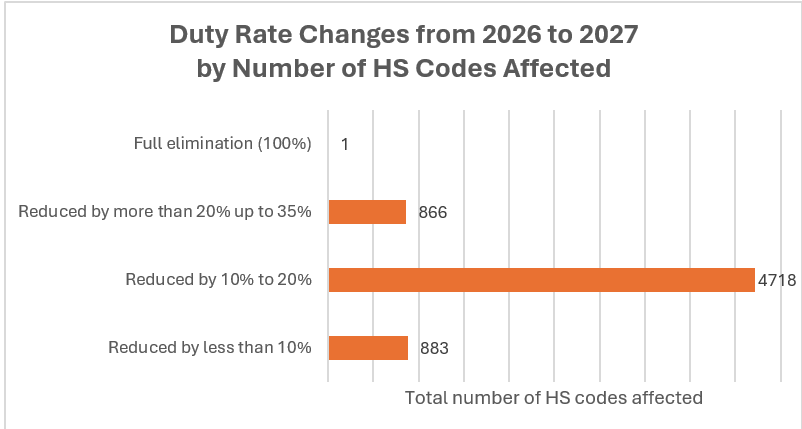
Note: The amendments affect
111 HS codes
in total. However, the number of affected tariff lines is higher because certain HS codes were subdivided into multiple tariff lines through the introduction of more specific product descriptions.Conclusion
The amended JIEPA marks a meaningful step forward in Japan-Indonesia economic cooperation, expanding preferential market access and modernizing the bilateral trade framework. Its most significant customs and tariff impacts stem from revised duty concessions, updated tariff staging commitments, and related rules of origin provisions. With 111 HS tariff lines affected, businesses trading under JIEPA should review the updated agreement materials and confirm whether their products qualify for preferential treatment from 1 August 2026 - ensuring they capture any new duty-saving opportunities the revised agreement makes available.
These changes have been updated in ONESOURCE Global Trade Content.
For more information on how ONESOURCE Global Trade solutions can assist you in managing tariff classification and duty optimization, please contact your Account Manager or Customer Success Manager.