
India-United Kingdom Comprehensive Economic and Trade Agreement
Date of publication: July 21, 2026.
The India-United Kingdom Comprehensive Economic and Trade Agreement, signed on July 24, 2025 and entered into force on July 15, 2026, commonly referred to as the India-UK CETA, marks a major milestone in the economic partnership between two of the world's important trading economies. The agreement is designed to strengthen bilateral trade and investment by reducing tariffs, improving market access, simplifying customs procedures, and creating a more predictable framework for businesses in both countries.
For India, the agreement is expected to provide significant opportunities for export-oriented sectors such as textiles, apparel, leather, footwear, gems and jewelry, marine products, engineering goods, and other labor-intensive industries. For the United Kingdom, it opens improved access to India's fast-growing consumer and industrial markets, particularly for products such as whisky, gin, automobiles, cosmetics, machinery, medical devices, and processed foods.
Key measures
- Tariff liberalization: Reduction or elimination of customs duties on eligible goods, supported by product-wise tariff schedules.
- Rules of origin: Clear criteria to ensure only qualifying Indian-origin and UK-origin goods receive preferential tariff benefits.
- Customs facilitation: Simplified customs procedures, transparency measures and provisions on fees, temporary admission, repair and alteration.
- Services and mobility: Market access commitments in key services sectors and provisions for temporary movement of business visitors and professionals.
- Standards and regulatory cooperation: Rules on food safety, plant and animal health, technical standards, testing and conformity assessment.
- Digital trade, IP and sustainability: Support for paperless trade, electronic contracts, intellectual property protection, SMEs, labor and environmental cooperation.
Trade in goods: Market access commitments
UK's offer to India
The UK's offer to India is mainly focused on wider market access for Indian goods and services. The UK has offered
duty-free access for about 99% of Indian exports
, covering nearly 100% of India's export value to the UK. Many of these products will get zero-duty access from day one
, improving India's competitiveness in the UK market.The deal is also expected to support bilateral trade, which was already around
£48 billion in 2025
, and the UK projects will increase overall UK-India trade annually by about £25.5 billion by 2040
. In services, the UK has offered improved access and mobility opportunities for Indian professionals in sectors such as IT, business services, finance, education and professional services
.Key Indian products benefiting from preferential access into UK

India's offer to UK
India's offer to the UK under the India-UK agreement mainly focuses on
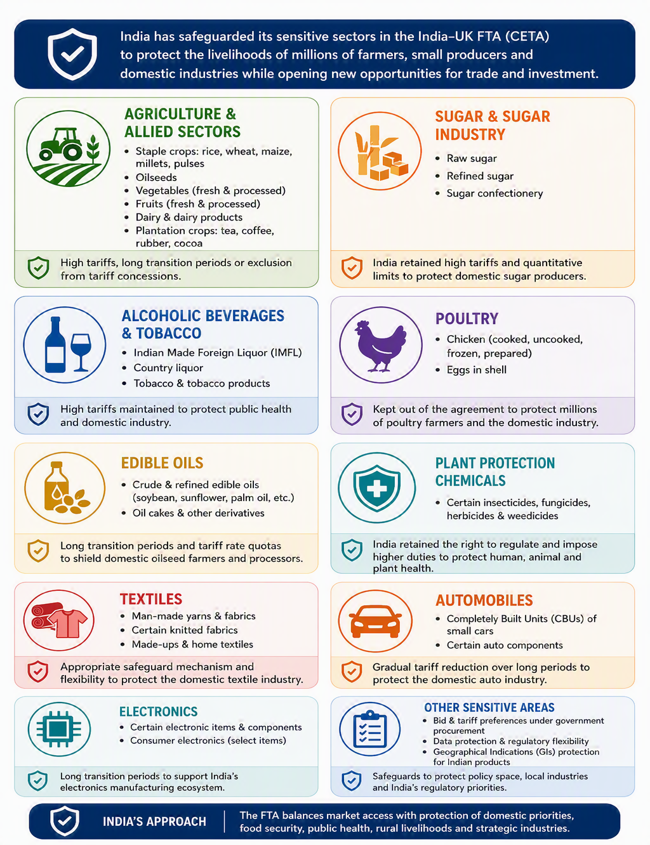
phased market access for UK goods, services and investment
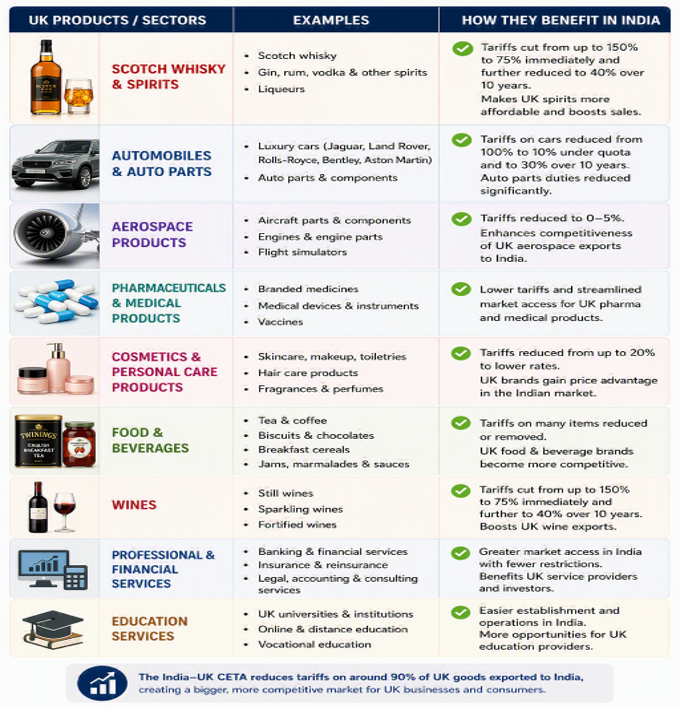
while protecting sensitive Indian sectors. India will reduce or eliminate tariffs on about 89.5% of tariff lines
, covering around 91% of existing UK goods exports to India
.India has also offered improved access in
services, government procurement and business mobility
, including opportunities for UK firms in professional services, financial services, telecom, construction and selected public procurement markets.Key UK products benefiting from preferential access into India
Sensitive sectors protected by India
Conclusion
Overall, the India-UK CETA is expected to create a more balanced and predictable trade relationship by opening markets on both sides while protecting sensitive domestic interests. For India, lower UK tariffs can help expand exports in labor-intensive sectors such as textiles, apparel, leather, footwear, marine products and engineering goods, supporting employment, manufacturing growth and greater integration into global value chains. For the UK, improved access to India's large and fast-growing consumer market can boost exports of premium goods such as whisky, gin, automobiles, medical devices, cosmetics, machinery and food products, while also creating opportunities in services and investment.
Beyond tariff reductions, the agreement can deepen cooperation in services, technology, innovation, investment and professional mobility. This makes the CETA not just a goods-trade agreement, but a platform for long-term economic partnership. If implemented effectively, it can increase bilateral trade volumes, diversify supply chains, attract investment, support job creation and strengthen the strategic economic relationship between India and the UK.
These changes have been updated in ONESOURCE Global Trade Content. For more information on how ONESOURCE Global Trade solutions can assist you in managing supply chain risk, tariff challenges and regulatory compliance, please contact your Account Manager or Customer Success Manager.