
Chain transactions
Also called ABC Contracts or Drop Shipment, are a series of sales where the goods get shipped from the first seller to the final customer.
Triangulation
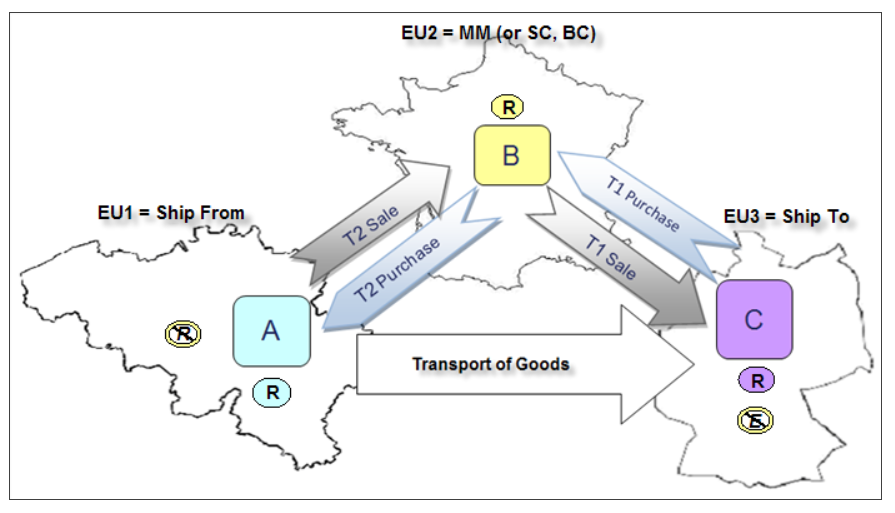
Chain transaction is a broader term that includes triangulation. Triangulation's a special regime in the EU that applies to qualifying chain transactions. In triangulation, all countries in the transaction are different EU member states, registered in their own country.
Triangulation's defined as:
- A sale of goods.
- 3 taxable persons (ABC) in 3 different EU member states.
- All transactions take place in the EU.
- There are 2 sale transactions: A to B (T2) and B to C (T1).
- 1 transport's directly from A to C, either ship or pickup.
- Establishment of Middleman in the Ship To location (C) depends on the authority option (country specific rule.)
Regulations governing triangulation simplification
Each EU member state ensures that VAT isn't charged on the intra-community acquisition of goods within its territory.
These conditions must be met:
- The acquisition of goods gets made by a taxable person who isn't established in the concerned member state but is identified for VAT purposes in a different member state.
- The acquisition of goods gets made for the purposes of the subsequent supply of these goods, in the concerned member state, by the taxable person in A.
- The goods acquired by the taxable person are directly dispatched or transported from a member state other than that in which he's identified for VAT purposes.
- The person to whom the goods are supplied is another taxable person, or a non-taxable legal person, who's identified for VAT purposes in the concerned member state.
- The person to whom the goods are supplied has been designated as liable for payment of the VAT due on the supply carried out by a taxable person who's not established in the member state where tax is due.
For example, there are 3 countries: A, B, and C. Country A sells to country B. Country B sells to country C. Country A transports good to country C.
Type | All member states | Country-specific conditions |
|---|---|---|
Registration / establishment | Each company uses a registration in a different EU country: A in EU1, B in EU2, and C in EU3 | Option 1: B mustn't be established in EU3 or B mustn't be registered in EU1 or
|
Transportation | Goods must be transported directly from EU1 to EU3 | A or B must arrange transport or
|
R = Registration, E = Establishment, and T = Transaction
Evaluating triangulation simplification
This table explains how triangulation simplification's evaluated using the Middleman role, compared to Seller and Buyer. When using Seller and Buyer role, the assumption's that the first seller's (Warehouse A) registered in the Ship From location, which is a condition for simplification.
Example 1 | Role | Registration |
|---|---|---|
Sales Unit (B) | Middleman | MM (SF, ST) |
End Customer (C) | Buyer | ST |
Warehouse (A) | Seller | SF |
Example 2 | Role | Registration |
|---|---|---|
Sales Unit (B) | Seller | SP (SF, ST) |
End Customer (C) | Buyer | ST |
Warehouse (A) | N/A | Assumed to be registered in SF |
Example 1 | Role | Registration |
|---|---|---|
Sales Unit (B) | Middleman | MM (SF, ST) |
End Customer (C) | Buyer | ST |
Warehouse (A) | Seller | SF |
Example 2 | Role | Registration |
|---|---|---|
Sales Unit (B) | Buyer | BP (SF, ST) |
End Customer (C) | N/A | Assumed to be registered in ST |
Warehouse (A) | Seller | SF |