
Version 19 - May 2025 (template XBRL release)
Template release pack
This release focuses on the legislative content changes and XBRL updates for the period ending March 2025. The template is available on platform 6.28.9259, 6.29.9459, 6.30.9574, 6.31.9627, and 6.32.9713.
Release notes
- Period end: March 2025
- Update type: Major (Legislative and XBRL).
Overview
This is a major update that includes key legislative changes, aligns with IFRS, and incorporates XBRL.
The key legislative updates will take effect for annual periods starting March 2025. These updates include:
- Electricity Distribution (Accounts and Additional Disclosure) Rules, 2024
- Study - Analysis of royalty payments by listed companies to related parties
- SEBI (Listing Obligations and Disclosure Requirements) (Third Amendment) Regulations, 2024
- Industry Standards on Reporting of BRSR Core
- Timeline for review of ESG rating pursuant to occurrence of ‘Material Events’
- National Financial Reporting Authority (NFRA)
- Circular for implementation of recommendations of the expert committee for facilitating ease of doing business for listed entities
- Guidance on non-compliances observed by Quality Review Board (QRB) during quality reviews
- Central Board of Direct Taxes (CBDT) - Income Tax Bill, 2025
- Study on Compliance of Financial Reporting Requirements (Ind AS Framework) Volume III
- Technical Guide on Accounting for Expenditure on Corporate Social Responsibility Activities (Revised January 2025 Edition)
- Educational Material on ICAI Valuation Standard 302 - Intangible Asset
- Industry Standards on “Minimum information to be provided for review of the audit committee and shareholders for approval of a related party transaction" - SEBI
- Frequently Asked Questions on Securities and Exchange Board of India (Listing Obligations and Disclosure Requirements) Regulations, 2015 (Revised January 2025 Edition)
- Master circular for compliance with the provisions of the SEBI (Listing Obligations and Disclosure Requirements) Regulations, 2015 by listed entities and Master circular for issue of capital and disclosure requirement
Version 19 is available on platforms 6.28.9259, 6.29.9459, 6.30.9574, 6.31.9627, and 6.32.9713. This includes an XBRL release with fixes and improvements based on the updated IND-AS Taxonomy from the Ministry of Corporate Affairs.
Legislative updates
Refer to the
Content Changes List
PDF in the release pack for detailed information.Accounting Reference Number | Details |
|---|---|
IFSCA | Electricity Distribution (Accounts and Additional Disclosure) Rules, 2024 The IFSCA has issued a circular on “The Ministry of Power (MoP) has notified Electricity Distribution (Accounts and Additional Disclosure) Rules, 2024. These rules address key areas such as recognition of revenue, minimum provisioning requirement for trade receivables, content and form of additional disclosure statements and statements of compliance by the entities specified in the rules. Regarding revenue recognition, the rules specify that any sum not provided in the tariff orders will not be recognized as revenue or as income recoverable from future tariff in the Financial Statements. The rules came into force from the date of their publication in the Official Gazette, i.e., 24 October 2024. |
SEBI | Study - Analysis of royalty payments by listed companies to related parties SEBI has published a study to analyze royalty payments made by listed companies to their related parties (RPs). This analysis is based on annual, company level information, in respect of many listed companies across sectors in India during the 10-year period from FY 2013-14 to FY 2022-23. Key findings of the study are as below:
For around 40% of instances, listed companies that paid royalty to RPs did not pay dividend or paid more royalty than dividend. Among other matters, it is highlighted that appropriate disclosures with respect to the rationale and rate of royalty payments are not provided by listed companies in their Annual Reports. |
SEBI (Third Amendment) Regulations, 2024 | SEBI (Listing Obligations and Disclosure Requirements) (Third Amendment) Regulations, 2024 SEBI has notified SEBI (Listing Obligations and Disclosure Requirements) (Third Amendment) Regulations, 2024. Key amendments include change in definition of material subsidiary, removal of requirement of audit committee approval for remuneration and sitting fees paid by the listed entity or its subsidiary to its director, key managerial personnel or senior management, provided they are not part of promoter or promoter group and the same is not material, process relating to ratification of related party transactions, provision relating to Secretarial Audit, etc. These regulations came into force with immediate effect except sub-regulations VI and XX of regulation 3 of these amendment regulations, which will come into force w.e.f 31 December 2024. |
BRSR Core under Regulation 34(2)(f) | Industry Standards on Reporting of BRSR Core In order to facilitate ease of doing business and to bring about standardization in implementation, the Industry Standards Forum (ISF) has formulated industry standards, which are published on their websites, for effective implementation of the requirement to disclose Business Responsibility and Sustainability Report (BRSR) Core under Regulation 34(2)(f) SEBI (Listing Obligations and Disclosure Requirements) Regulations, 2015 read with Chapter IV-B of SEBI master circular for compliance with the provisions of the LODR Regulations dated 11 November 2024. This circular shall be applicable to FY 2024-25 and onwards. |
SEBI | Timeline for review of ESG rating pursuant to occurrence of ‘Material Events’ SEBI has issued a circular providing relaxation in the timeline for the review of Environmental, Social and Governance (ESG) ratings following the publication of the Business Responsibility and Sustainability Reporting (BRSR). Presently, ESG Rating Providers (ERPs) were required to review ESG ratings within 10 days of material developments. The 10-day timeline for material developments remains unchanged. However, SEBI has now relaxed the timeline for ESG ratings reviews pursuant to publication of the BRSR, stating that the review must be carried out within 45 days of the publication of the BRSR. This circular came into effect on 17 January 2025. |
Ind AS 37, 108, 109 | National Financial Reporting Authority (NFRA) Auditor-Audit Committee Interaction Series 1: Audit of Accounting Estimates and Judgments – Part 1: Expected Credit Losses – Ind AS 109 The NFRA has released the first in the series of its Auditor-Audit Committee Interactions, titled, Audit of Accounting Estimates and Judgments – Part 1: Expected Credit Losses (ECL) under Ind AS 109. This Auditor-Audit Committee Interactions Series 1 draws the attention of the auditors to the potential questions the Audit Committees/ Board of Directors may ask them in respect of accounting estimates and judgments. Within that, this communication being the first in this series, includes aspects pertaining to the audit of Expected Credit Losses (ECL) for financial assets and other items as required by Ind AS 109, Financial Instruments. There were many NFRA observations with regards to Ind AS 37, 108, 109, 115, etc. Further BFRA provided an insight on disaggregation of revenue as per Ind AS 115. As per Ind AS 115.114, an entity shall disaggregate revenue recognised from contracts with customers into categories that depict how the nature, amount, timing and uncertainty of revenue and cash flows are affected by economic factors, and it shall apply the guidance in para B87–B89 when selecting the categories to use to disaggregate revenue. NFRA observed that a company engaged in project-based construction activities has disclosed the disaggregation of revenue from contracts with customers by geographical area only. The Company should consider disaggregating revenue based on market or type of customer (for example, government and non-government customers), type of contract (for example, fixed-price and time-and-materials contracts) and contract duration (for example, short-term and long-term contracts). |
SEBI 10(1A) | Circular for implementation of recommendations of the expert committee for facilitating ease of doing business for listed entities In order to facilitate ease of filing and compliance for listed entities, SEBI has decided to introduce Integrated Filing, in terms of regulation 10(1A) of the LODR Regulations, for some of the Governance and Financial related periodic filings required under the LODR (e.g. disclosure of related party transactions (RPTs), financial results, etc.), which shall be applicable for the filings to be done for the quarter ending 31st December 2024 and thereafter. The format of quarterly integrated filing is given in this circular. The circular also outlines new guidelines for secretarial auditors and the disclosure of employee benefit scheme related documents. Consequential changes have also been made to the provisions of SEBI Master circular dated 11 November 2024 on compliance with the LODR Regulations by listed entities. |
AASB – Vol 3 | Guidance on non-compliances observed by Quality Review Board (QRB) during quality reviews The Auditing and Assurance Standards Board (AASB) of the ICAI had previously released Volume 1 and Volume 2 of the Guidance on Non-Compliances Observed by the Quality Review Board during quality reviews. Now, they have released Volume 3 of the said publication, which contains observations related to Engagement and Quality Control Standards, as well as Internal Financial Controls. |
CBDT – 536 Section | Central Board of Direct Taxes (CBDT)- Income Tax Bill, 2025 The CBDT has proposed the Income Tax Bill, 2025, which consists of 536 sections, spreading over 23 chapters and 16 schedules. The proposed Income Tax Bill, 2025 aims to replace the old Income Tax Act, 1961 and once passed, will be known as the Income Tax Act, 2025. It is proposed to be effective from 1 April 2026. |
FRRB – Ind AS Framework - Vol III | Study on Compliance of Financial Reporting Requirements (Ind AS Framework) Volume III The Financial Reporting Review Board (FRRB) of the ICAI has released a publication, ‘Study on Compliance of Financial Reporting Requirements (Ind AS Framework) – Volume III’. This publication incorporates the instances of non-compliances identified in Ind AS based Financial Statements relating to Ind AS, Schedule III of the Companies Act, 2013, Standards on Auditing (SAs) and Companies Auditors Report Order (CARO), along with detailed explanations for each observation. |
CL & CGC | Technical Guide on Accounting for Expenditure on Corporate Social Responsibility Activities (Revised January 2025 Edition) The Corporate Laws & Corporate Governance Committee (CL&CGC) of the ICAI has released the revised edition of the publication “Technical Guide on Accounting for Expenditure on Corporate Social Responsibility Activities”, considering enforcement of various provisions of the Companies (Amendment) Act, 2019, the Companies (Amendment) Act, 2020 read with the Companies (Corporate Social Responsibility Policy) Amendment Rules, 2021 and the amendments to Schedule III on 24 March 2021. The publication aims to provide comprehensive and clear guidance on the accounting treatment of CSR expenditures and their proper presentation in financial statements, in line with the requirements set forth in the Companies Act, 2013 and other related regulations. |
ICAI – Valuation Standard 302 | Educational Material on ICAI Valuation Standard 302- Intangible Asset This Educational Material contains a summary of ICAI Valuation Standard- 302 discussing key requirements of the Standard in brief, Case Studies, Illustrations and the Frequently Asked Questions (FAQs) covering the issues, which are expected to be encountered frequently while implementing this Standard. It provides clarity and guidance for valuers in understanding the intricacies involved in the valuation of intangible assets, which is often a complex area. |
SEBI | Industry Standards on “Minimum information to be provided for review of the audit committee and shareholders for approval of a related party transaction - SEBI In order to facilitate a uniform approach and assist listed entities, the Industry Standards Forum (ISF) has formulated industry standards, in consultation with SEBI, for minimum information to be provided for review of the audit committee and shareholders for approval of related party transactions (RPTs). The industry associations which are part of ISF (ASSOCHAM, FICCI, and CII) and the stock exchanges (NSE & BSE) shall publish the industry standards on their websites. |
SEBI - LODR | Frequently Asked Questions on Securities and Exchange Board of India (Listing Obligations and Disclosure Requirements) Regulations, 2015 (Revised January 2025 Edition) The CL&CGC of the ICAI has released the revised edition of the publication “Frequently Asked Questions on SEBI (Listing Obligations and Disclosure Requirements) Regulations, 2015.” The publication covers all amendments to the SEBI (LODR) Regulations up to 30 December 2024. The revised publication is structured into two main parts for comprehensive understanding. Part A, which provides a detailed explanation of the regulations and schedules, covering key aspects such as corporate governance, disclosures, and related party transactions and Part B includes a newly added chapter “Compliance Calendar”, which will assist professionals in tracking key deadlines and ensuring timely compliance with the regulations. |
SEBI - LODR | Master circular for compliance with the provisions of the SEBI (Listing Obligations and Disclosure Requirements) Regulations, 2015 by listed entities & Master circular for issue of capital and disclosure requirement In order to enable the users to have access to the provisions of the applicable circulars at one place, SEBI has issued an updated Master circular for compliance with the provisions of the LODR Regulations by listed entities by consolidating all relevant circulars issued on or before 30 September 2024. The instant master circular supersedes the master circular dated 11 July 2023. In order to enable stakeholders to access all applicable regulatory requirements in one place, SEBI has issued an updated Master circular on SEBI (Issue of Capital and Disclosure Requirements) Regulations, 2018 that includes all relevant circulars issued on or before 30 September 2024. The updated master circular supersedes the master circular dated 21 June 2023. |
Corrections
There are no corrections included in this release.
Features
There are no new features.
Content changes
Item ID | Title | Details and Limitations |
|---|---|---|
2856960 | Financial statements |
|
2856968 | Note 1 - Corporate Information Note 2 - Material Accounting Policies Note 3 - Property Plant & Equipment | Updated text in paragraphs as per legislative changes. |
2856973 | Note 6 - Impairment Testing Note 9 - Trade Receivables Note 12 - Other Equity | Updated text in paragraphs as per legislative changes. |
2856977 | Note 13 - Distribution made and proposed Note 14 - Borrowings Note 17 - Government grants | Updated text in paragraphs as per legislative changes. |
2856987 | Note 19 - Income tax Note 20 - Trade and other payables Note 21 - Discontinued operations | Updated text in paragraphs and tables as per legislative changes. |
2856990 | Note 22 - Revenue from contracts | Updated text in paragraphs and tables as per legislative changes. |
2856992 | Note 28 - Other expense Note 33 - Earnings per share (EPS) Note 34 - Significant accounting judgements, estimates and assumptions | Updated text in paragraphs and tables as per legislative changes. |
2856995 | Note 37 - Material partly - owned subsidiaries Note 43 - Commitments and contingencies Note 45 - Related party transactions | Updated text in paragraphs and tables as per legislative changes. |
2856996 | Note 49 - Fair value hierarchy Note 51 - Capital management | Updated text in paragraphs as per legislative changes. |
XBRL changes
note
If you aren't hosted by Thomson Reuters, contact the Support Desk to obtain the new taxonomy package or for assistance with mapping the new taxonomy.
Item ID | Title | Details and limitations |
|---|---|---|
2878629 | XBRL Tagging | Tagging updated for the text and tables added in the content changes and checked all mandatory items as per MCA XBRL. |
2878793 | XBRL validation on MCA tool | Successfully validated XBRL instance file with help of MCA tool from provided by govt MCA website. |
To download the XBRL taxonomy, visit the official government website, where you can find the latest versions available for download. The following taxonomy references can be loaded into the application via Manage XBRL Taxonomies on the ONESOURCE Accounts Production Platform.
Additional information
Item ID | Details and Limitations |
|---|---|
1 | We have replaced the hyphen (-) in the edit style number settings with a zero (0). This change improves clarity and reliability of data parsing through automated systems, reducing potential errors in financial reporting while validating the MCA XBRL Validation tool. 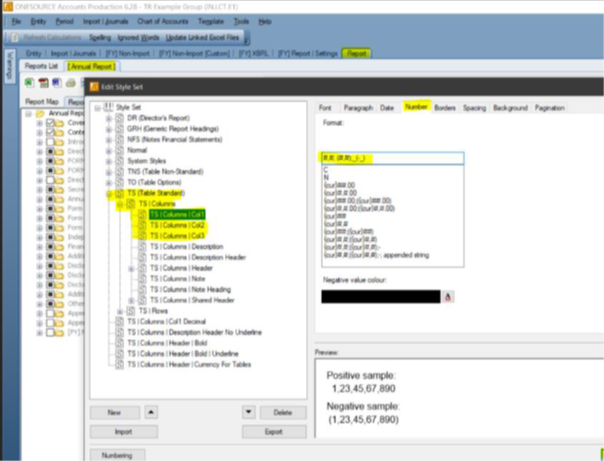 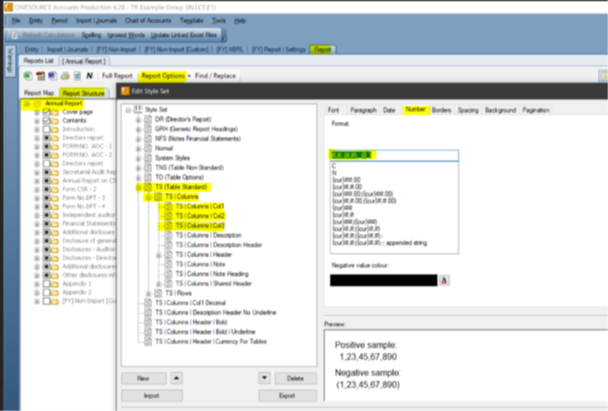 |
2 | Additional folders have been created to store dated content at the bottom of each folder level of the annual report, as well as within the category structure. Please review these elements and create duplicates to retain them if needed. |
Impact on existing clients
There are no impacts identified for this release.
Deviations from standard configuration
There are no deviations identified for this release.
Appendix
There are no appendix items for this release.
Known issues
Item ID | Details and Limitations |
|---|---|
1 | The illustrative model content in this template does not include all the available concepts in the taxonomies. Therefore, the onus will be on users to create and tag any additional content required to produce a valid XBRL file. |
2 | Value errors from MCA validation were forcefully cleared in the XBRL instance document by replacing all values with zero. This cleared all validation errors resulting from calculation relationships between tagged values in the XBRL instance document. Users of the template are required to source and clear their value errors derived from entity-specific values from their use of the template. |
3 | Users of the template are required to source and clear their pre-scrutiny errors derived from entity-specific values from their use of the template. |
4 | It is a known Platform 6.29.9459 issue that any report elements with the display setting never show in the report when viewing the parent folder in isolation using either Design, Preview, or Edit XBRL mode. |
5 | There is a character limitation in the grid column heading. Headers can take up to 60 characters only. |
6 | For XBRL templates we are not changing the display conditions of sections from 'Always' to 'conditional' & for totals from 'Always' to 'AsRequired' as it might throw an XBRL validation error. This might result in an unforeseen situation making changes every time, so to avoid confusion we are suggesting users make their display conditional choice in their entity. |
Related Content
-
India AS
Format: Article