
Version 14 - December 2024 (CUD release)
Content update
This CUD release focuses on the legislative content changes for the period ending December 2024.
- Financial period type: 12-Months (Annual)
- Target industry type: Manufacturing, Services, and Generic (excluding Financial Services)
Legislative updates
- International tax reform – Pillar Two model rules – amendments to IAS 12
- Classification of liabilities as Current or Non-current and Non-current Liabilities with Covenants – amendments to IAS 1
- Lease liability in a sale and leaseback – amendments to IFRS 16
- Disclosures: Supplier Finance Agreements – amendments to IAS 7 and IFRS 7
- Lack of exchangeability – amendments to IAS 21
- Sale or contribution of assets between an investor and its associate or joint venture – amendments to IFRS 10 and IAS 28
- Classification and measurement of financial instruments - amendments to IFRS 9 and IFRS 7
- IFRS 18 – presentation and disclosure in financial statements
- IFRS 19 - subsidiaries without public accountability: disclosures
Early adoption for accounting standards
- The amendments take effect immediately, but some disclosure requirements will take effect later. Entities must immediately and retrospectively apply the temporary exception for recognizing and disclosing information about deferred taxes, as well as disclose the use of this exception.Entities must disclose the current tax expense related to Pillar Two income taxes and information for periods before the legislation becomes effective for annual reporting periods starting on or after 1 January 2023. However, these disclosures are not required for interim periods ending on or before 31 December 2023.While International Tax Reform applies to the Good Group, it was not within the scope for this specific entity and was disclosed accordingly. An example of this disclosure will be included in the Appendix.
- The amendments are effective for annual periods starting on or after 1 January 2024, and must be applied retrospectively. Early application is allowed, but it must be disclosed. If an entity wants to apply the 2020 amendments early, it must also apply the 2022 amendments early, and vice versa.The Final Good Group for 2024 is still in progress, and the final scope will be defined later. However, it is likely that these changes will impact all entities.
- A seller-lessee must apply the amendment starting from annual reporting periods beginning on or after 1 January 2024. If they want to apply it earlier, they must disclose this decision.The amendment is applied retrospectively, according to IAS 8, to sale and leaseback transactions that occur after the initial application date. This means the amendment doesn’t apply to transactions made before the initial application date. The initial application date is the start of the annual reporting period when the entity first implemented IFRS 16.While the Final Good Group for 2024 is still in progress and the final scope will be defined later, it is unlikely that these changes will be included within the Good Group.
- The amendments will take effect for annual reporting periods starting on or after 1 January 2024. Early adoption is allowed, but it must be disclosed. These amendments offer some transition reliefs concerning comparative and quantitative information as of the beginning of the annual reporting period, as well as interim disclosures.While the Final Good Group for 2024 is still in progress and the final scope will be defined later, it is likely that these changes will impact all entities within the scope.
- The amendments will take effect for annual reporting periods starting on or after 1 January 2025. Early adoption is permitted, but it must be disclosed. When applying these amendments, an entity is not allowed to restate comparative information.While this change is applicable as of 1 January 2025 and no early adoption, it won’t be in the scope of the Final Good Group for 2024.
- In December 2015, the IASB decided to postpone the effective date of the amendments until it completes any changes arising from its research project on the equity method. Early application of the amendments is still allowed, but must be disclosed. The amendments must be applied prospectively.This change won't be in scope of the Final Good Group for 2024.
- In May 2024, the Board issued amendments to the Classification and Measurement of Financial Instruments for IFRS 9 and IFRS 7. These amendments will be effective for annual reporting periods beginning on or after 1 January 2026. Entities have the option to early adopt the amendments concerning the classification of financial assets and the related disclosures, while applying the other amendments later.While the Final Good Group for 2024 is still in progress, the final scope will be defined later.
- IFRS 18, along with amendments to other accounting standards, is effective for reporting periods beginning on or after 1 January 2027, and will be applied retrospectively. Early adoption is permitted, but it must be disclosed.While the Final Good Group for 2024 is still in progress, the final scope will be defined later.
- IFRS 19 is effective for reporting periods beginning on or after 1 January 2027. Earlier adoption is permitted, and if an eligible entity wants to apply the standard earlier, it must disclose this fact.While the Final Good Group for 2024 is still in progress, the final scope will be defined later.
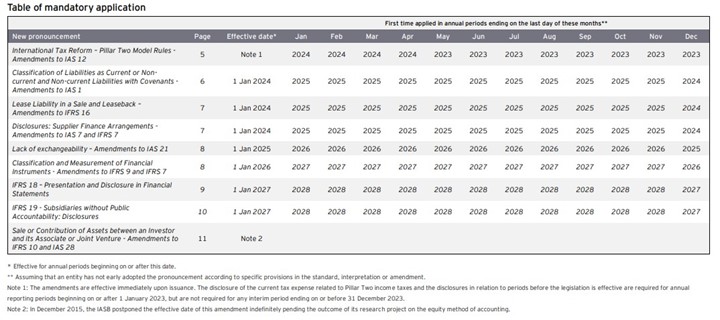
note
- This overview includes year-end reporting until 31 December 2024. It also covers pronouncements effective from 1 January 2024, as these apply for the 1st time to the financial years ending, for example, on 31 January 2024.
- If companies first apply this in the annual periods ending in December 2024, a company with a year ending 31 December 2023, will apply this standard for the period ending 31 December 2024. This means it applies to the reporting period from 1 January 2024, to 31 December 2024.
Related Content
-
South Korea
Format: Article