Thomson Reuters Labs
Focused on the research, development, and application of AI and emerging technologies
What Labs does
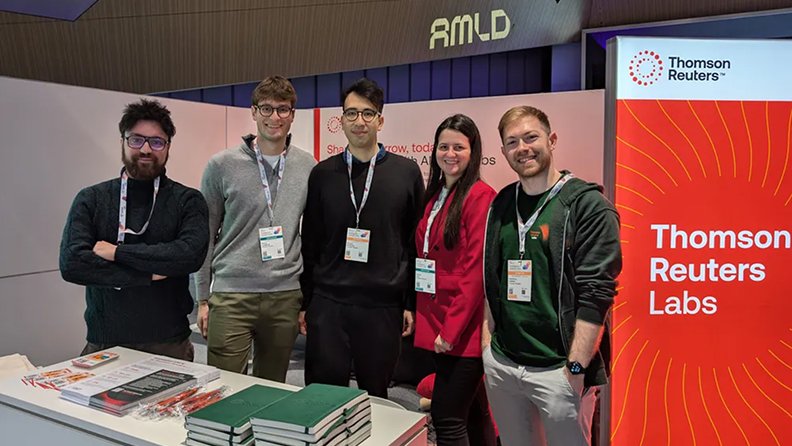
Advanced research team
Thomson Reuters Labs is the global research and development division of Thomson Reuters. We bring together scientists, engineers, and domain experts to explore emerging technologies and develop compelling new AI products.
From research and prototyping to customer success, our work bridges frontier science with practical application. Our innovations help professionals make better decisions, faster —for example, with intelligent legal assistants, automated compliance workflows, or agentic tax engines.
We are always looking for creative highly adaptable scientists and engineers, who enjoy solving hard problems that matter.
Explore career opportunities
The types of research we do
Our team bridges frontier research with practical application and shares findings at venues such as NeurIPS, ICML, ACL, and EMNLP. Our scientists and engineers:
- Design and develop domain-specific language models, multi-agent systems, novel algorithms, and robust evaluation methods.
- Turn technical breakthroughs into specialized AI systems for knowledge-intensive workflows.
- Productionize innovations to Thomson Reuters products ensuring trust, explainability, and enterprise-grade reliability.
- Openly share results and collaborate with research labs across academia and industry.

- Drafting
- Evaluation
- LLM training
- Information retrieval
- Agentic AI
- Document understanding
Drafting
Legal text carries illocutionary force: a clause creates obligations, a brief persuades a tribunal, an opinion binds future courts. Output that is fluent and faithful to a prompt is not necessarily output that does the right thing in the legal sense. Moreover, legal documents are stress tested by counterparties, skeptical judges, and opposing counsel whose job it is to exploit every weakness.
Transactional drafting is an iterative negotiation. A draft encodes a position; terms are redlined, then finalized through multiple rounds of debate. Market conventions vary by deal size, geography, and industry. The technical challenges include long-document coherence under continuous edits, negotiation-state modeling, and benchmarking what’s market across both private and public deal data.
Litigation drafting is constrained on three axes simultaneously — exhaustive recall of relevant authority, faithfulness of factual claims against the record, and doctrinally sound argumentation. Authority modeling operates over jurisdictionally aware citator graphs. Adversarial multi-agent architectures surface missing authority and likely objections. Beyond measuring factual grounding and argument validity, we build simulators that model how users actually engage with drafted content.
Evaluation
How do you measure the quality of work product when the problems are non-trivial, even for experts to verify? Correctness is rarely a simple yes or no. A model can cite a real case for the wrong point or write something plausible that overlooks authority the court might rely on. Most model benchmarks don't capture real world tasks or the nuanced ways they fail.
Thomson Reuters Labs endeavors to measure accuracy and overall efficacy of end-to-end workflows the way our customers experience them in the product. We work closely with teams of experienced lawyers, accountants, and domain experts to measure response quality, domain-specific error types, and dimensions of utility. We track when and how new models meaningfully improve on hard, in-domain tasks. We build test sets, evaluation methods, and grading systems with the statistical rigor needed to separate signal from noise. We treat evaluation as a research problem focused on scaling human judgment, with the next phase leaning into user simulations and reward models that approximate user experience.
LLM training
Thomson Reuters has decades of proprietary legal, tax, and regulatory content, which it serves through products where inference cost, latency, and consistency all matter. That combination makes custom model training a particular point of leverage. On targeted tasks, specialized language models trained on Thomson Reuters content have been shown to match or exceed the quality of much larger models, at a fraction of the cost.
Training data strategies integrate structured knowledge and domain expertise to tackle problems that remain challenging for general purpose agents. Specialized models become expert at following reasoning chains over vast corpora of complex documents. We derive training signals from expert annotations, as well as synthetic data generation grounded in editorial knowledge. AI-assisted annotation creates a flywheel for model training and evaluation, which we direct at the downstream tasks in customer workflows where specialized models are most advantaged.
Information retrieval
For human researchers on a deadline, a well-designed search interface can greatly reduce the burden of exhaustive recall. For agents processing much higher volumes — jurisdictional coverage, relational data, and efficient traversal become the limiting factors for performance. Applied research in this space focuses on knowledge representation, neuro-symbolic reasoning, and the fusion of structural signals with conceptual relevance. We leverage decades of editorially curated citation networks, taxonomies, and annotations to make reasoning over complex documents tractable. To meet the expectations of legal and tax professionals, Thomson Reuters Labs innovates discovery and retrieval algorithms for each domain and the specific information needs of both users and agents.
Agentic AI
At Thomson Reuters Labs, we build production grade agentic systems for long‑horizon professional work such as legal drafting, transactional analysis, and tax reasoning. These agents must plan, adapt, and act reliably across complex tool and data ecosystems. They operate in domains with deep structure and evolving state, under real constraints of latency, cost, and transparency. We design for the moment when a lawyer, accountable to a court or a client, asks the agent, "Why did you recommend this?"
The bridge from bleeding edge to production at scale is a common thread across AI development in Thomson Reuters Labs. We combine state-of-the-art methods — custom LLMs, advanced reasoning strategies, multi-agent collaboration — with robust safeguards, evaluation, and human-centric design. Hard constraints, including privacy and compliance requirements, are built into agent architectures from the ground up. The result is AI systems that are carefully aligned with practical needs in professional domains.
Document understanding
Off-the-shelf optical character recognition (OCR) pipelines and general-purpose LLMs often break down on real legal and financial documents, introducing segmentation errors, losing context via chunking, or failing on noisy scans and complex layouts. The result is semantic drift. Key clauses or facts get split apart or misinterpreted, which in turn undermines downstream retrieval, analysis, or drafting tasks.
We build domain-aware document parsing that preserves meaningful structure from the start. This task involves specialized models to recognize relevant structural cues and enrich the semantic markup for downstream retrieval and reasoning. Examples include discourse-aware argument extraction, entity recognition and linking, multimodal processing, and taxonomy induction over customer content. We’re also exploring a variety of techniques for scalable synthetic data generation for training and evaluation.
News and publications
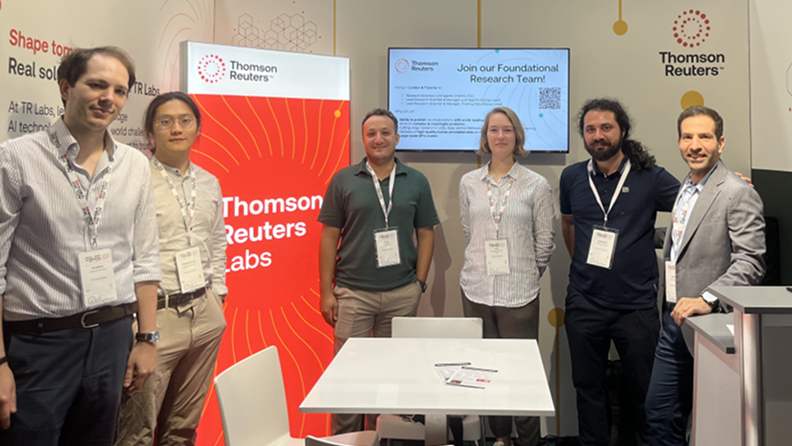
What Labs is doing in 2026
In 2026, Labs strengthens its leadership in information retrieval, evaluation, and document understanding through high‑impact research in areas such as legal reasoning, LLM training, and context‑aware evaluation. Our work advances trustworthy, well‑governed AI, underscored by our leadership role in the Trust in AI Alliance. We actively share research findings at major scientific conferences and industry events, reinforcing Labs’ influence across the global research community while delivering transparent, reliable AI for high‑stakes professional domains.
News
Thomson Reuters Labs maintains an active blog on Medium, covering the latest technology trends, events we attend, and talks we present.
Publication
The Batching Trick for Highly Effective LLM Relevance Judgments
Publication
Can AI Models Appreciate Document Aesthetics? An Exploration of Legibility and Layout Quality in Relation to Prediction Confidence
Upcoming events
Thomson Reuters Labs regularly publishes and presents at top conferences, you can find us at the upcoming events below.
June 7-9, 2026
BerlinBuzzwords
June 10, 2026
Swisstext
July 13-19, 2026
SciPy
Sept 28 - Oct 2, 2026
RecSys
Oct 24-29, 2026
EMNLP 2026
History of artificial intelligence at Thomson Reuters

Our AI timeline
Thomson Reuters has been innovating for its customers from day one — which for some customer segments goes as far back as the 1800's. Initially, technology was used to collect, organize, and enhance information for its customers. Later, it would employ artificial intelligence (AI) to improve the customer's ability to find the information they needed. Today, we use AI to better understand our customers and surface information and insights they need when they need it. Thomson Reuters, through its different businesses, has had a formal applied research and development group since 1992.
View our AI timeline
Working at Labs

From internships to careers
We’ve designed our internship program to bring highly motivated and talented students and recent graduates into Thomson Reuters Labs. We offer the opportunity to work on revolutionary technology problems in the areas of legal, tax and accounting, media, risk, fraud, and compliance. Our internships provide a unique chance to gain invaluable experience in research, development, and delivery of AI and emerging technologies solutions.
We announce open internship positions throughout the year. They typically last around six months with flexible start and end dates at Thomson Reuters Labs locations in Toronto, Minneapolis-St. Paul, London, Zug, and Bangalore. We offer internships in applied research, engineering, and design. If you are interested in the Thomson Reuters Labs internship program, check the link below for open roles.
Explore career opportunities
Working with Labs
At Thomson Reuters, we’re not riding the AI wave — we’re reshaping the future of professional work across law, tax, compliance, and journalism. Here, you will collaborate with smart, ambitious people who thrive on solving complex problems, delivering market-leading solutions, and innovating with curiosity and care. We act fast. We learn fast. We make a real impact.
Reasons our team loves it here:
- Investment of over $200 million per year in AI growth and development. Through CoCounsel, our professional-grade GenAI assistant, we’re helping our customers work more efficiently, positioning them to deliver greater value to their organizations.
- Access to world-leading data and enterprise expertise
- Learn and collaborate with a global team of talented colleagues
- Opportunity for mentorship and career growth
- World-class well-being benefits and resources
- Access to industry-leading learning tools and resources
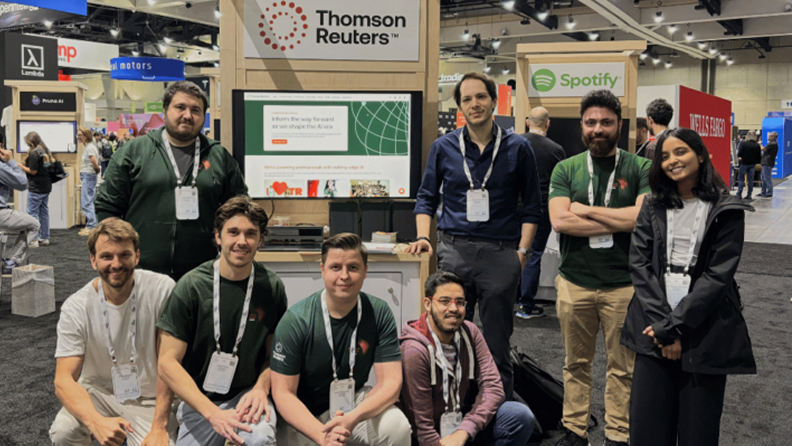
Former Labs' interns turned employees
“My internship at TR Labs was truly enjoyable. The environment is completely international, and the diverse backgrounds of the researchers and engineers make every day stimulating. You have the chance to tackle real-world problems alongside top-tier professionals, and there are plenty of opportunities to learn beyond your main projects through workshops, reading groups, and hackathons.”
Guglielmo
Previous Applied Research Intern
“It's been exciting to work with TR Labs. From RAG to Agentic AI, the challenges we tackle are cutting-edge problems that don't yet have established solutions. You get to be proactive in addressing these problems while having access to diverse resources and knowledge-sharing pipelines to support you.”
Joshua
Previous Applied Research Intern
“The opportunity to work with cutting-edge research and apply it to solve real-world challenges is precisely the kind of impactful, innovative work that initially drew me to this environment.”
Pavlos
Previous Applied Research Intern