
General Message Flows
important
The below message process flows are taken from Custom scenario message flow document
Standard Declaration Export
DMS accepts the export declaration and does not select the goods for control. Final release follows.

Control Export Process
DMS accepts the export declaration and selects the goods for a release-blocking * control and sends a communication with the control decision (IE560). ** The customs officer can request additional documents from the declarant, which are required for the execution of the control (also with IE560). If documents are requested with the message IE560, a timer will start. After the term has expired, DMS sends one or more reminders (configurable). The Declarant provides the requested documents (NLPRD). *** Customs terminates the control without changes (No verification results that deviate from the entries in the initial declaration) and issue a final release (IE529 - CLE).
* Release-blocking checks are physical checks, but also document checks that customs must perform before they can release the goods. The latter is possible, for example, when checking documents relating to prohibitions and restrictions.
** In case of reselection (s), multiple IE560's can follow with a control decision.
***The Declarant can submit multiple NLPRD’s if needed.

DMS accepts the export declaration and selects the goods for a non-release blocking * control and sends a notification with the control decision (IE560) ** and releases the goods (IE529 - ROG). The customs officer can request additional documents from the declarant, which are required for the execution of the check (also with IE560). If documents are requested with the message IE560, a timer will start. After the deadline, DMS sends one or more reminders (configurable). The Declarant provides the requested documents (NLPRD). *** Customs terminates the control without changes (No verification results that deviate from the entries in the initial declaration) and issue a final release (IE529 - CLE).
* Non-release blocking checks are always document checks, never physical checks.
** In case of reselection (s), multiple IE560's can follow with a control decision.
***The Declarant can submit multiple NLPRD’s if needed.

DMS accepts the export declaration and selects the goods for a release-blocking control and sends a notification with the control decision (IE560). The customs officer can request additional documents from the declarant, which are required for the execution of the check (also with IE560). If documents are requested with the message IE560, a timer will start. After the deadline, DMS sends one or multiple reminders (configurable). The Declarant provides the requested documents (NLPRD). ***
Customs will release the goods in advance pending the control results (IE529 - ROG), for example in the case where samples of goods have been sent to the customs laboratory for analysis and there is no reason to hold the goods longer. After receiving the results from the laboratory, Customs terminates the control with changes (verification results that deviate from the entries in the initial declaration) and issue a final release (IE529 - CLE). The changes are included in the NLAMD message.
***The Declarant can submit multiple NLPRD’s if needed.

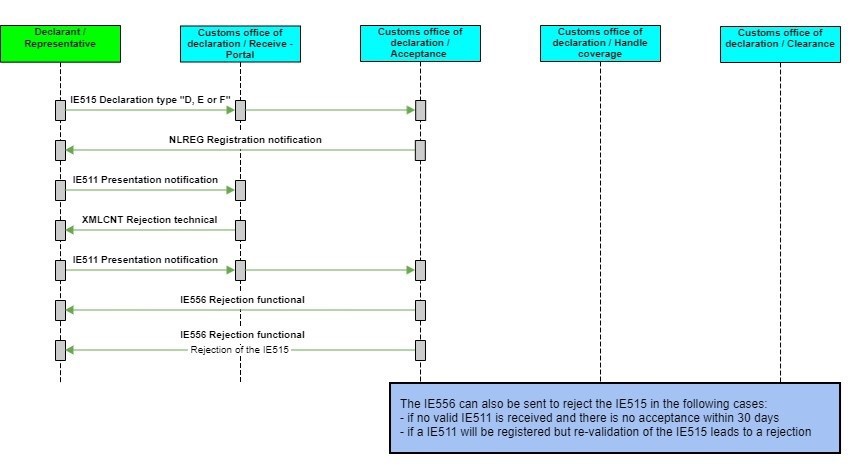
DMS accepts the advance declaration and selects the goods for a release-blocking control and sends a communication with the inspection decision (IE560) prior to acceptance of the declaration if the declarant has an AEO authorisation. After submitting the Presentation Notification (IE511), DMS accepts the declaration. .
In case of reselection (s), multiple IE560's can follow with a control decision. In addition, the customs officer can request additional documents from the declarant, which are required for the execution of the check (also with IE560). If documents are requested with the message IE560, a timer will start. At the end of the period, DMS sends one or more reminders (configurable). The Declarant provides the requested documents (NLPRD). ***
Customs terminates the control without changes (No verification results that deviate from the entries in the initial declaration) and issue a final release (IE529 - CLE).
***The Declarant can submit multiple NLPRD’s if needed.

DMS accepts the advance declaration and selects the goods for a release-blocking control and does not send a notification with the control decision (IE560) prior to acceptance of the declaration, because in this example scenario the declarant does not have an AEO authorisation. After submitting the Presentation Notification (IE511), DMS accepts the declarationBased on the selected goods, DMS sends a notification with the control decision (IE560). In case of reselection (s), multiple IE560's can follow with a control decision. In addition, the customs officer can request additional documents from the declarant, which are required for the execution of the check (also with IE560). If documents are requested with the message IE560, a timer will start. After the term has expired, DMS sends one or more reminders (configurable).
Customs terminates the control without changes (No verification results that deviate from the entries in the initial declaration) and issue a final release (IE529 - CLE).

DMS accepts the export declaration and selects the goods for a release blocking control and sends a notification with the control decision (IE560). The customs officer can request additional documents from the declarant, which are required for the execution of the check (also with IE560). If documents are requested with the message IE560, a timer will start. After the deadline, DMS sends one or multiple reminders (configurable). The Declarant provides the requested documents (NLPRD). ***
Customs records its control results and requests information from the declarant (NLRFI). The NLRFI will also be used as a reminder if the declarant did not provide the requested information with the NLCRE. After that, the declarant delivers invalid information (NLCRE) and receives an IE556 with an error message. The declarant corrects the error and then provides valid information and receives an NLRCV.
Customs assesses the information provided and terminates the control with changes verification results that deviate from the statements in the initial declaration). DMS issues a final release (IE529 - CLE). The changes are included in the NLAMD message.
***The Declarant can submit multiple NLPRD’s if needed.
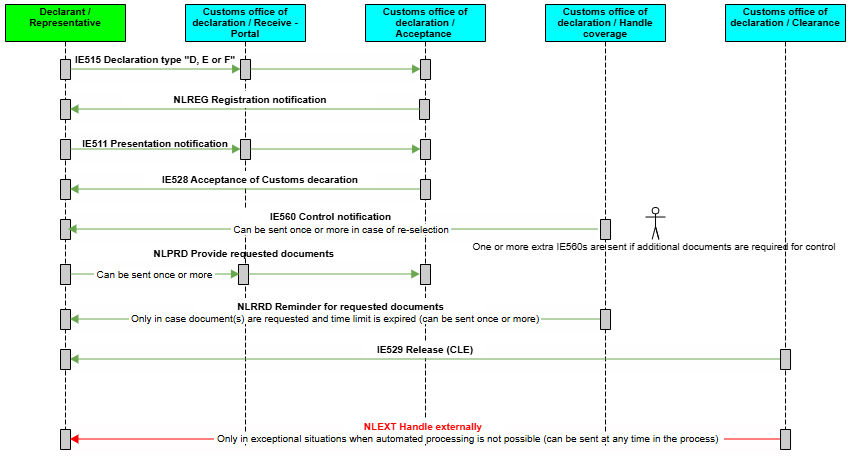
DMS accepts the export declaration and selects the goods for a release-blocking control and sends a notification with the control decision (IE560). The customs officer can request additional documents from the declarant, which are required for the execution of the check (also with IE560). If documents are requested with the message IE560, a timer will start. After the deadline, DMS sends one or multiple reminders (configurable). The Declarant provides the requested documents (NLPRD). ***
Customs will release the goods in advance of the inspection results (IE529 - ROG), for example in the event that samples of goods have been sent to the customs laboratory for analysis and there is no reason to delay the goods.
After receiving the results from the laboratory, customs records its control findings and requests information from the declarant (NLRFI). The declarant then provides valid information with a NLCRE and receives an NLRCV. Customs assesses the information provided and terminates the control with changes (verification results that deviate from the statements in the initial declaration). DMS issues a final release (IE529 - CLE). The changes are included in the NLAMD message.
***The Declarant can submit multiple NLPRD’s if needed.

DMS accepts the export declaration and selects the goods for a release blocking control and sends a notification with the control decision (IE560). The customs officer can request additional documents from the declarant, which are required for the execution of the check (also with IE560). If documents are requested with the message IE560, a timer will start. After the deadline, DMS sends one or multiple reminders (configurable). The Declarant provides the requested documents (NLPRD). ***
Customs records the provisional control findings and requests information from the declarant (NLRFI). The declarant then provides valid information with a NLCRE and receives an NLRCV. Customs assesses the information provided and provisionally terminates the control with changes (verification results that deviate from the statements in the initial declaration). DMS issues a provisional release (IE529 - ROG) pending final control results. The changes are included in the NLAMD message.
After receipt of the final results (for example of the laboratory examination), the customs records its control findings and again requests information from the declarant (NLRFI). The declarant then provides valid information with a NLCRE and receives an NLRCV. Customs assesses the information provided and terminates the control with changes (verification results that deviate from the statements in the initial declaration). DMS issues a final release (IE529 - CLE). The changes are included in the NLAMD message.
***The Declarant can submit multiple NLPRD’s if needed.
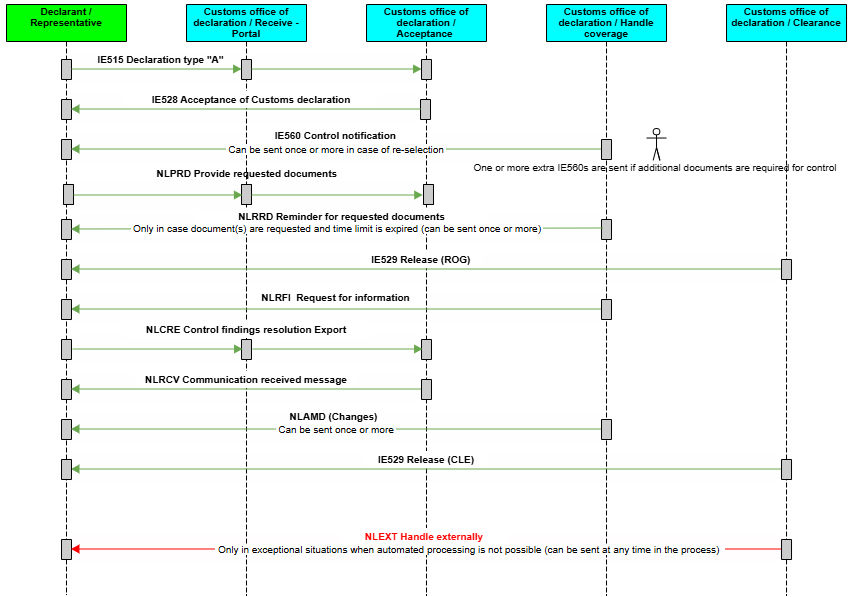
DMS accepts the export declaration and selects the goods for a release blocking control and sends a notification with the control decision (IE560). The customs officer can request additional documents from the declarant, which are required for the execution of the check (also with IE560). If documents are requested with the message IE560, a timer will start. After the deadline, DMS sends one or multiple reminders (configurable). The Declarant provides the requested documents (NLPRD). ***
Customs records its control results and requests information from the declarant (NLRFI). The declarant does not provide the information on time. Customs terminates the control with changes (verification results that deviate from the entries in the initial declaration). DMS issues a final release (IE529 - CLE). The changes are included in the NLAMD message.
***The Declarant can submit multiple NLPRD’s if needed.
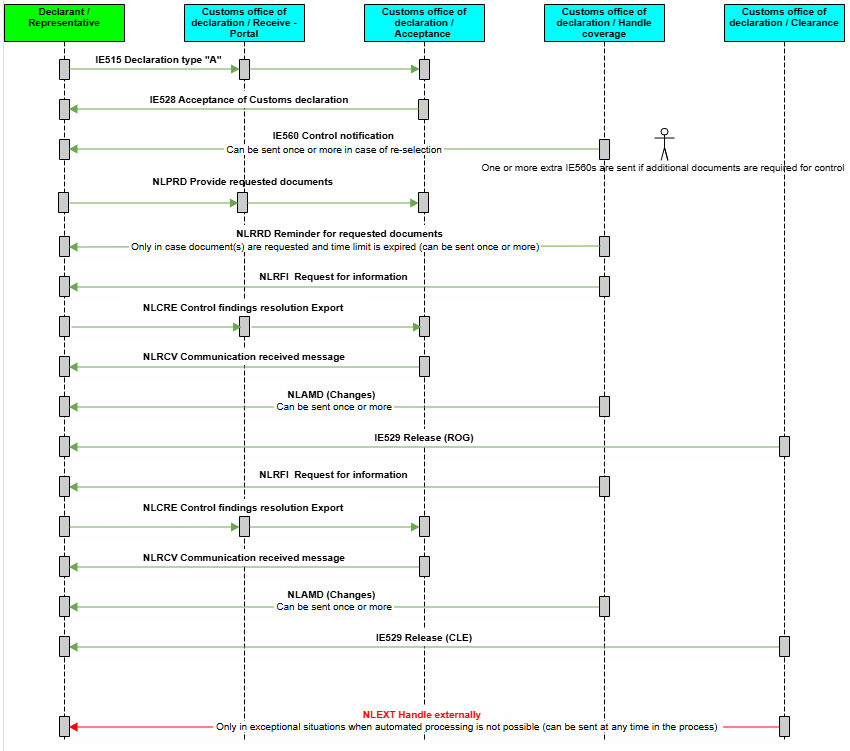
DMS accepts the export declaration and selects the goods for a release blocking control and sends a notification with the control decision (IE560). The customs officer can request additional documents from the declarant, which are required for the execution of the check (also with IE560). If documents are requested with the message IE560, a timer will start. After the deadline, DMS sends one or multiple reminders (configurable). The Declarant provides the requested documents (NLPRD). ***
Customs records its control results and requests information from the declarant (NLRFI). The declarant does not provide the information on time. Customs terminates the control with changes (verification results that deviate from the entries in the initial declaration). DMS issues a final release (IE529 - CLE). The changes are included in the NLAMD message.
***The Declarant can submit multiple NLPRD’s if needed.
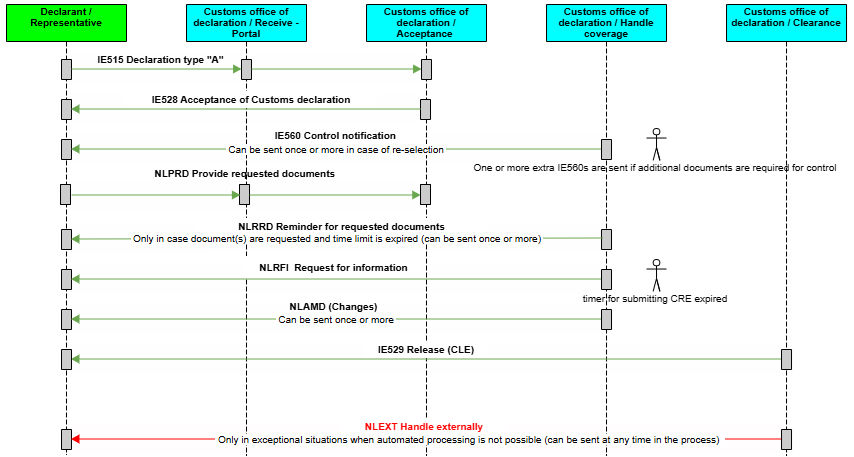
DMS accepts the export declaration and selects the goods for a release-blocking control and sends a notification with the control decision (IE560). The customs officer can request additional documents from the declarant, which are required for the execution of the check (also with IE560). If documents are requested with the message IE560, a timer will start. After the deadline, DMS sends one or multiple reminders (configurable). The Declarant provides the requested documents (NLPRD). ***
In case of blocking control results (for example in connection with prohibitions and restrictions, or in the absence of documents required for placing or release for the customs procedure), the customs will not release the goods. In this case DMS sends an IE551.
***The Declarant can submit multiple NLPRD’s if needed.

Advance Declaration Export

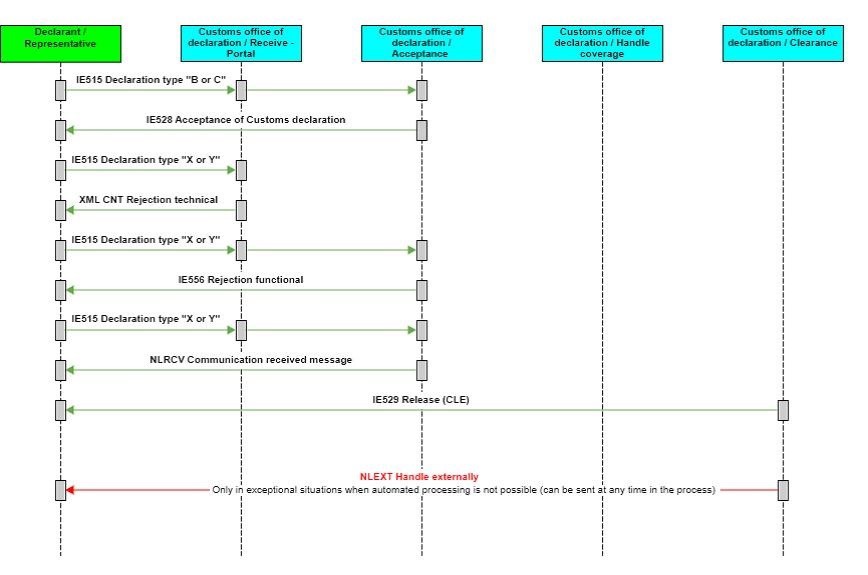
Supplementary Declaration Export
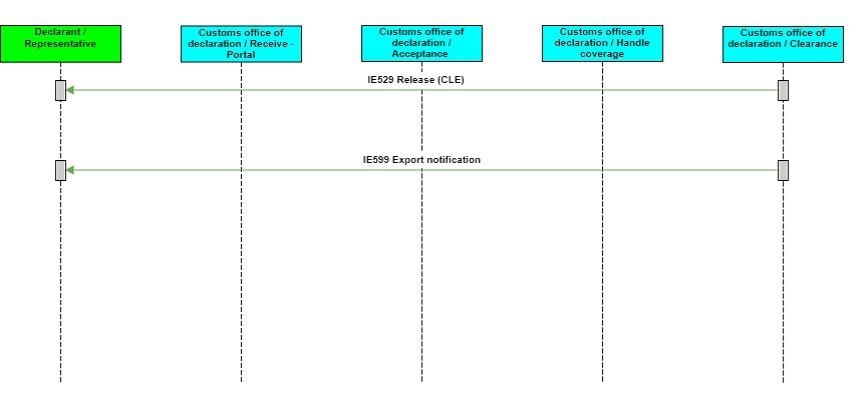
Exit Process
After the goods have been released (with an IE529 - ROG or CLE), the declarant receives an IE599 message as soon as the goods have left the EU.
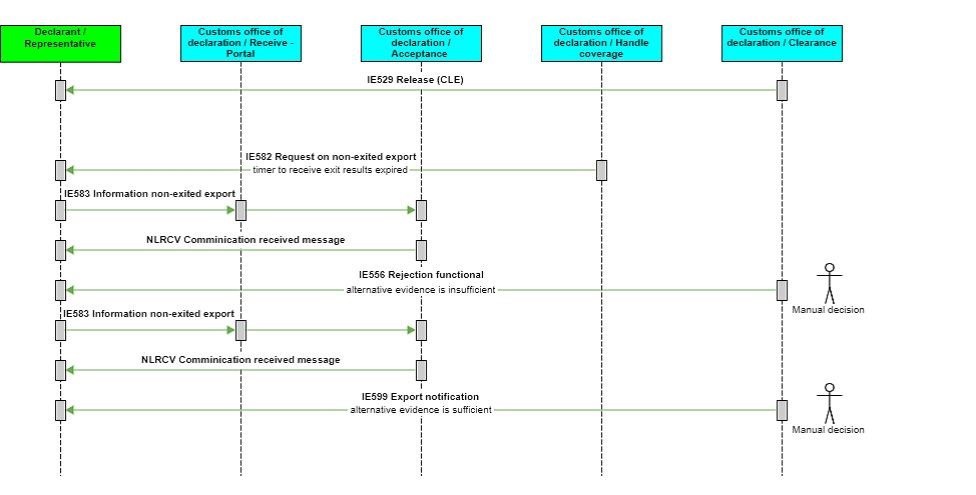
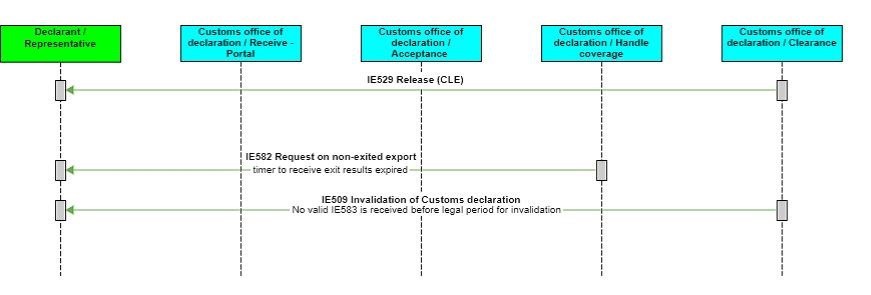
If no confirmation of the exit of the goods has been received from the office of exit within the time limit, customs will request the declarant to provide an alternative evidence of exit (IE582). The declarant then provides a technically valid alternative evidence (IE583)*, which is registered by customs (NLRCV). Customs do not agree with the alternative evidence (IE556).
After that, the declarant sends another alternative evidence (IE583) and customs has approved the alternative evidence. Finally DMS sends an IE599 message.
*According to Article 335(2) UCC-IA it is also possible to send an IE583 by the declarant on his / her own initiative before the IE582 is sent by Customs.
The declarant does not provide alternative evidence or does not provide valid alternative evidence in time. Finally, DMS sends an invalidation of the declaration with an IE509 message.
Invalidation Process Export

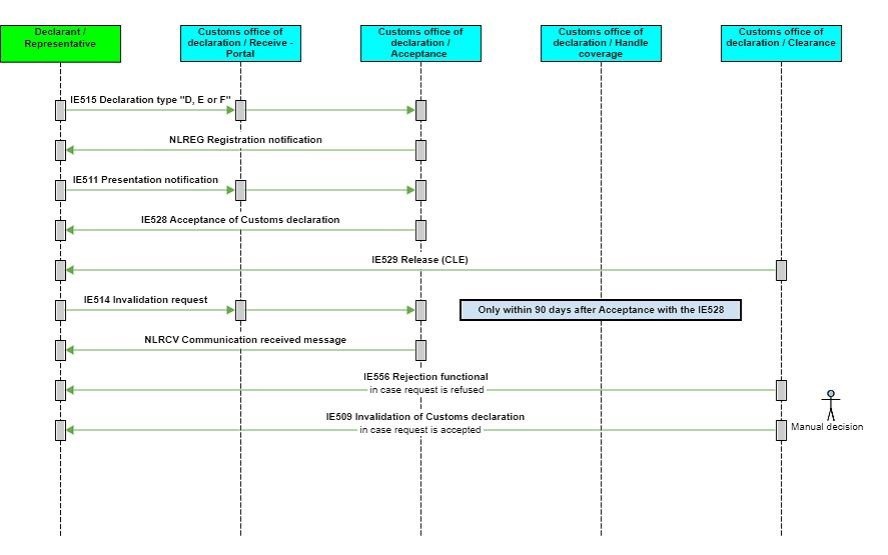
DMS accepts advance declaration* and does not select the goods for control. After submitting the Presentation Notification (IE511), DMS accepts the declaration and again does not select the goods for control. Final release follows.
After a valid message with the request to invalidate the declaration has been received within the period (configurable), DMS sends an NLRCV. Customs can then take two positions on the request:
- If the request is rejected, the declarant will receive an IE556.
- When granting a request, the declarant receives an IE509.
*This scenario is the same for the standard declaration from acceptance.
Change Declaration Export
DMS accepts advance declaration and does not select the goods for control. After receiving a valid message with the request to change the declaration, DMS sends an NLRCV. Customs can then take two positions on the request:
- If the request is rejected, the declarant will receive an IE556.
- When granting a request, the declarant receives an IE504 and an NLAMD with confirmation of the changes.

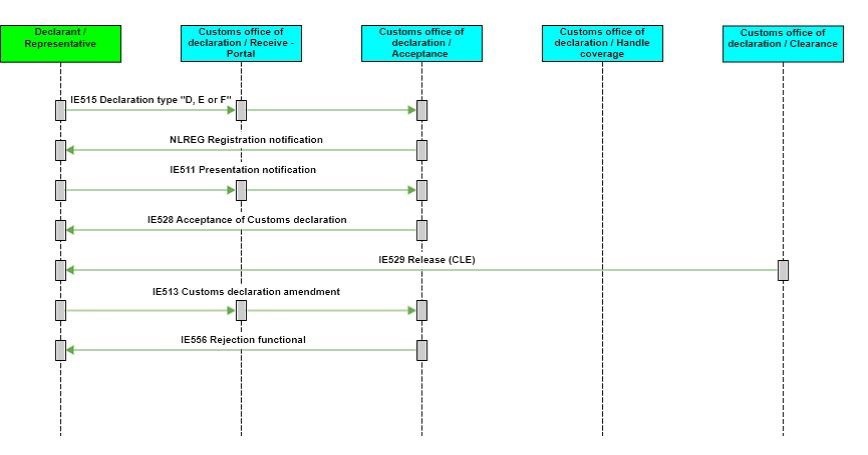
DMS accepts advance declaration* and does not select the goods for control. After submitting the Presentation Notification (IE511), DMS accepts the declaration and again does not select the goods for control. Final release follows. In DMS it is not possible to submit a request to change the declaration after the goods have been released.
* This scenario is the same for the standard declaration after acceptance of the declaration.
Related Content
-
NL Declaration Management System (DMS) 4 Export
Format: Article