
AI success is more than implementing the technology — it requires careful planning that includes understanding how advanced technologies and innovation fits within your legal department
Key insights:
Successful AI implementation requires a solid foundation — Strategy, leadership, and the impact on operations and individual users are key elements to any successful implementation. AI success is a skills strategy, not a technology strategy — AI creates a whole new set of skills that are required for both legal department attorneys and department leadership. AI changes how legal work is conducted — If implemented correctly, AI not only improves the end work product, but it also changes how lawyers perform their jobs.
Successful AI implementation requires a solid foundation — Strategy, leadership, and the impact on operations and individual users are key elements to any successful implementation.
AI success is a skills strategy, not a technology strategy — AI creates a whole new set of skills that are required for both legal department attorneys and department leadership.
AI changes how legal work is conducted — If implemented correctly, AI not only improves the end work product, but it also changes how lawyers perform their jobs.
Corporate legal departments are already experiencing the benefits of AI, including improved productivity, and reduced costs and errors, the Thomson Reuters Institute’s recent 2026 State of the Corporate Law Department Report shows. So it’s not surprising that AI is increasingly becoming a strategic priority for general counsel (GCs).
The report cautioned, however, that success with AI is not a given. AI is not a silver bullet which guarantees improvements across the department. Instead, AI adoption and implementation must be carefully planned in order to realize those benefits.
Crucially, successful AI implementation is not simply about the technology; rather, it’s a reflection of the department itself and often can signal whether the department has the right elements in place to enable that success.
AI enhances successful legal departments — it does not create them
AI implementation is like any other law department strategy — it does not live on its own but instead advances as a direct result of everything that has come before it, including the work of the department’s attorneys and professionals, its daily operations and processes, and the GCs who are guiding the overall vision.
Overall, it’s about having a solid foundation upon which to build AI adoption and implementation.
The Pyramid of AI Success
AI may be one of the most impactful and transformational technologies to come on the scene in recent years, but it’s important to remember that it is still simply one tool among many. And its ultimate success will be determined not only by its capabilities, but by how it integrates with and augments the work that corporate legal department attorneys perform daily.
The technology itself does not perform the work — it enables more efficient work. This means that the rise of AI creates a whole new set of necessary skills for both legal department attorneys and department leadership.
With that in mind, GCs should focus on a few key areas to improve their department’s chances of AI success. The essential steps can be viewed as a pyramid — every step that you take builds, each upon another, creating a solid foundation. Establishing a top-level AI strategy means setting the tone from leadership, which then permeates down through operations and ultimately transforms how individual users work every day.
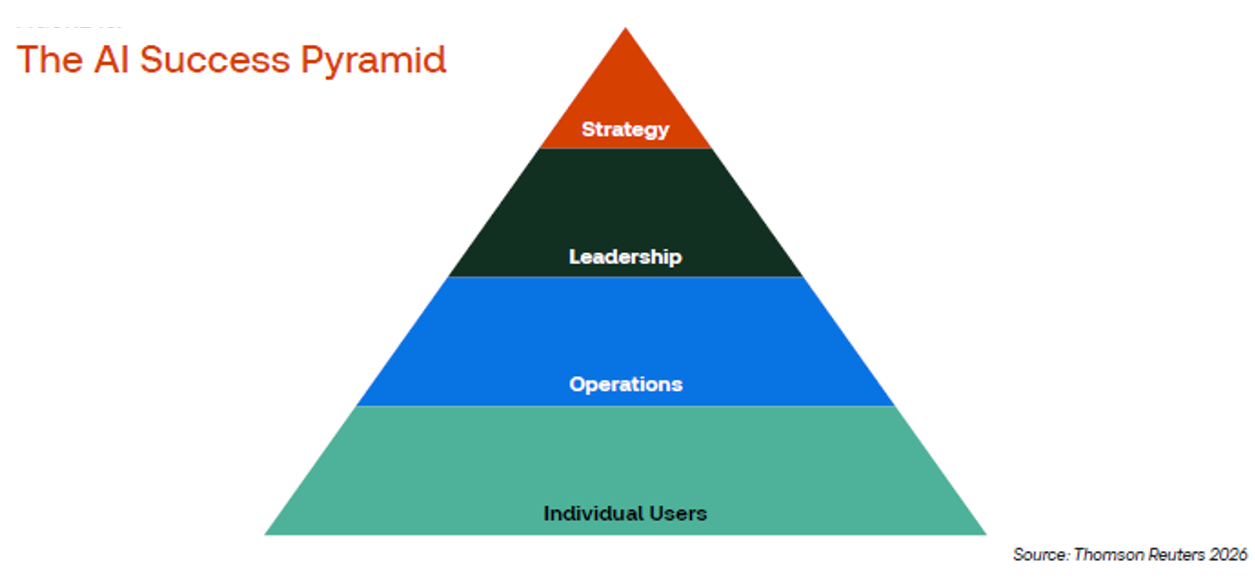
Learning — Most departments have a basic AI understanding and a culture to encourage change, but they often do not have the depth of understanding to move from AI literacy to AI fluency . Be sure to determine where your team is on this learning curve. Empowerment — Empowering your professionals is crucial to drive experimentation and identify new use cases. Ask yourself, does my team feel encouraged to explore new ways of working and empowered to make changes? Ownership — The legal team should feel they have significant input into how AI will be used in the department and throughout the organization. AI can be a major transition, and team members should feel that they can freely share ideas, concerns, and insights. Accountability — Team members with personal goals that are linked to AI adoption are more likely to become top learners and regular users, our research shows, and this leads to greater overall benefits for the department. Usage — Regular use drives adoption, so you should build AI into your team’s daily habits, monitor how many legal team members have tried AI, and how many are using it regularly. Expectations — Balance encouraging uptake with clear expectations around adoption. Offering open encouragement along with access to tools and training to build momentum can be key first steps. As team members become more proficient, set formal expectations around AI usage. Be clear that when targets are set, usage will be tracked and individuals will be held accountable. Then, follow up with low- or no-usage individuals to determine causes, such as difficulty with training.
Learning — Most departments have a basic AI understanding and a culture to encourage change, but they often do not have the depth of understanding to move from AI literacy to AI fluency . Be sure to determine where your team is on this learning curve.
Empowerment — Empowering your professionals is crucial to drive experimentation and identify new use cases. Ask yourself, does my team feel encouraged to explore new ways of working and empowered to make changes?
Ownership — The legal team should feel they have significant input into how AI will be used in the department and throughout the organization. AI can be a major transition, and team members should feel that they can freely share ideas, concerns, and insights.
Accountability — Team members with personal goals that are linked to AI adoption are more likely to become top learners and regular users, our research shows, and this leads to greater overall benefits for the department.
Usage — Regular use drives adoption, so you should build AI into your team’s daily habits, monitor how many legal team members have tried AI, and how many are using it regularly.
Expectations — Balance encouraging uptake with clear expectations around adoption. Offering open encouragement along with access to tools and training to build momentum can be key first steps. As team members become more proficient, set formal expectations around AI usage. Be clear that when targets are set, usage will be tracked and individuals will be held accountable. Then, follow up with low- or no-usage individuals to determine causes, such as difficulty with training.
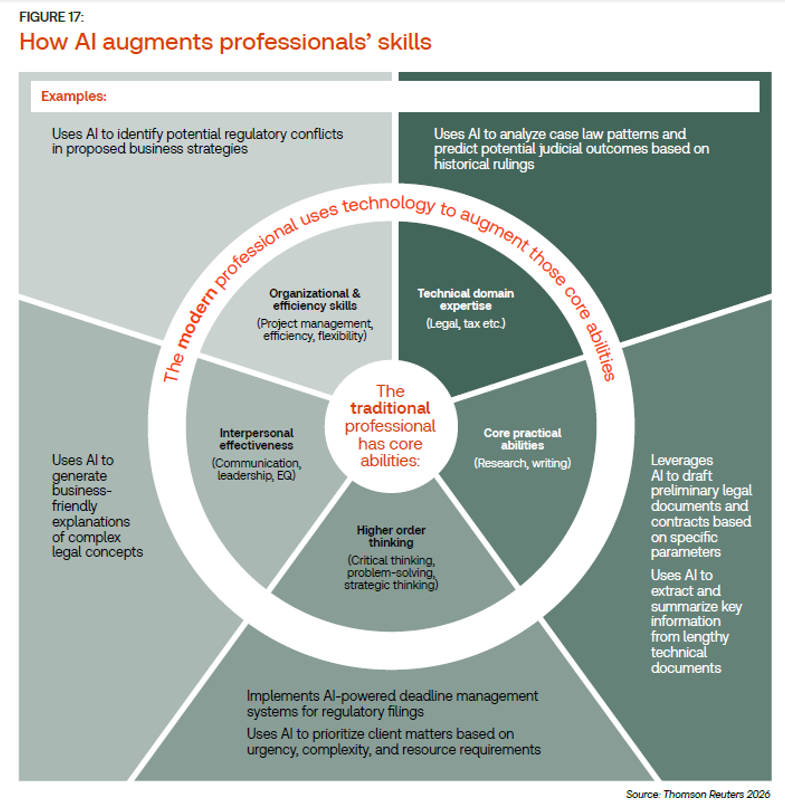
For GCs, today’s top challenge is how the department can develop needed AI skills in a way that will best augment how lawyers work. If implemented correctly, AI will not only improve the end work product, but it will also better enable lawyers to perform the work they do best.
AI success with outside counsel
The same principles of strategy and leadership that contribute to AI success within the department also extend to working with outside counsel. Currently, more than half of corporate counsel say they believe their outside law firms should be using AI, according to the report; however, two-thirds also say they do not know how their outside firms are approaching their use of AI.
This creates a communication gap, in which some GCs attribute to hesitance or caution. “We do not ask and they are shy to provide answers because they are already under a lot of pressure because their rates are so high,” reports one GC.
About three-quarters of corporate counsel also say they expect their outside law firms to take the lead in AI conversations between the department and the firm. However, that does not mean that GCs should simply accept a lack of conversation if firms are not forthcoming. Those GCs that want their outside firms to embrace AI should be open and transparent, conveying that they believe AI can assist firms with most work tasks, while placing a strong emphasis on output verification and the authority of attorney expertise. Indeed, GCs need to understand how their outside firms are using AI, especially how and when it is being applied, how it’s being supervised, and, perhaps most importantly, how it impacts fees.
Without detailed and regular discussions, GCs could develop a blind spot in this area. “Conversation has been only high level,” another GC explains. “We generally know what AI they are using but not how they are using it.” What’s surprising, the GC adds, is that “the billing has remained the same as it did before — so either they are not using AI tools efficiently, or they are just doing double work.”
You can download a fully copy of the 2026 State of the Corporate Law Department Report , from the Thomson Reuters Institute here
Follow us on social
Topics
Have questions?

