
As UK general counsel place greater value on business enablement, sector knowledge, and commercial advice, law firms that move beyond technical legal expertise can strengthen client relationships and stand out in an AI-driven market
Key insights:
GCs place increased importance on commerciality — Business enablement is becoming the fastest-growing priority for corporate legal general counsel, creating an opportunity for UK law firms to not only provide legal advice, but to help GCs demonstrate business value to their C-Suite.
Business savviness serves as a differentiator — When asked why they would select one law firm over another, the proportion of UK GCs mentioning business-savvy saw a marked increase in our latest report, as did the concepts of commerciality, knowledge of the client’s business, and knowledge of the client’s sector.
Understanding the business is critical in an AI world — Clients are largely ahead of their outside firms on AI usage and sentiment. As AI automates more routine legal work, successful UK law firms can provide additional value above AI output by translating legal advice into practical business guidance and better commercial outcomes.
The definition of what it means to be a successful law firm in the United Kingdom is expanding. No longer is it enough to simply provide subject matter expertise for clients, with good lawyering becoming table stakes to even be considered for a panel. Neither is it enough to provide this expertise in a cost-saving and time-efficient manner, as clients are increasingly expecting of all firms.
Today, clients are expecting their outside UK law firms to go further into truly understanding the client’s business proposition, according to the recent 2026 State of the UK Legal Market Report from the Thomson Reuters Institute (TRI). And while efficiency and expertise remain top priorities, more corporate general counsel than ever before are rating business savviness and commerciality as key areas of focus. Clearly, GCs don’t just want legal advice from their outside firms, they want positive business outcomes.
Rather than provide an additional imposition on firms, however, forward-thinking law firm leaders in the UK will view this as an opportunity to stand out. Particularly in an AI-driven age in which low-level work continues to be automated, leaning into commerciality can offer lawyers a way to showcase their value while providing the positive business outcomes that clients truly desire.
Increased focus on enabling business processes
Client needs for outside counsel have evolved in recent years, simply because the corporate legal department itself has evolved. Business pressure has demanded that GCs turn their departments into a business enabler, rather than a cost center. And now corporate executives are measuring legal department success on how well it supports the rest of the organization.
Amid this pressure, GCs have seen mixed results. They have instituted a number of changes to their departments in recent years, leading to the development of corporate legal operations teams and an increased focus on success metrics that tie back to the rest of the business. And while 86% of global GCs say they believe their legal department is a significant contributor to organizational objectives, according to TRI interviews, only 17% of C-Suite executives agree. GCs are doing the work, but corporate executives aren’t seeing their preferred results.
In order to close that expectation gap, it’s unsurprising that GCs are doubling down on business enablement at the top of their agenda. When asked about their strategic priorities over the coming year, efficiency remained the primary focus for most GCs. However, business enablement represented the fastest growing priority, doubling its share of mentions to 27% of GCs in our latest research.

The definition of what it means to enable the business varies depending on the GC, of course. Some mentioned the need to enable business initiatives, others mentioned support specifically for M&A activities, while still others pointed to the imperative to meet changing business needs such as business innovation.
As a result, GCs are now increasingly turning their attention towards how their outside law firms can help with business enablement, and in doing so they’re shifting their criteria for choosing outside firms in the UK. When asked what drives favorability when selecting one firm over another, the proportion of GCs mentioning business-savvy rose to 37% in our most recent survey, compared to 31% from the year prior. Diving deeper into more specific sub-themes, the concepts of commerciality, knowledge of the client’s business, and knowledge of the client’s sector all saw increases in the portion of respondents mentioning those factors.
As the report notes, under real pressure to demonstrate their strategic value upwards, GCs are looking for external advisors that can help them meet their commercial goals. Those UK lawyers who want to stand out can begin by not only providing legal advice, but much-desired business advice as well.
The impact of commercial focus
Law firm leadership and partners in the UK have long said that they’re happy as long as their clients are happy. However, what does it mean for clients to truly be happy? That definition has shifted over time, and even has different permutations based on clients’ industry and geographic location.
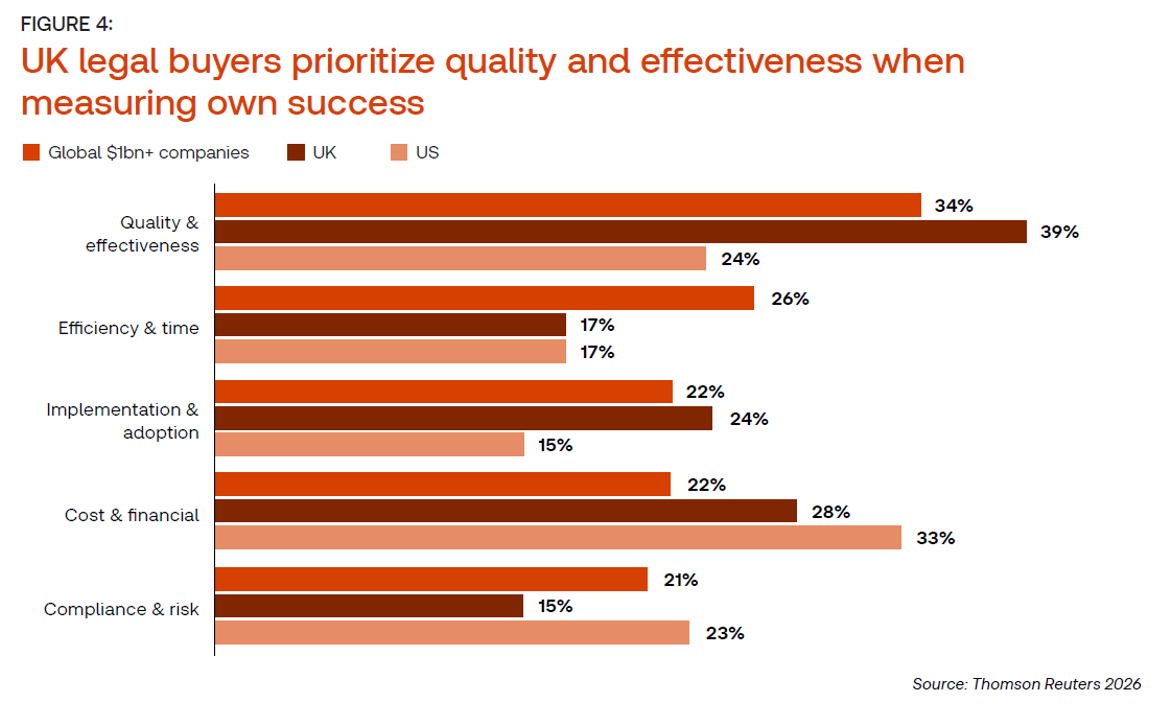
When measuring their own success, UK general counsel place less emphasis on compliance & risk compared with their global counterparts, and less emphasis on cost & financial outcomes than do GCs based in the United States. Instead, UK GCs are heavily focused on quality & effectiveness, getting to the best outcome possible regardless of what it takes to get there.
UK law firms should be measuring their own success similarly. As the report notes, the ability to understand a client’s industry, strategic priorities, and risk tolerance — and then to translate legal advice into practical guidance for decision-making — has become central to how today’s clients select their outside counsel. Although work is cost-sensitive to a degree, law firms will ultimately be judged on their ability to deliver on high-stakes, bet-the-company matters, in which superior outcomes will outweigh marginal cost savings.
This is particularly true in an AI-centric environment. Previously, law firms were more readily able to compete on price for some low-level, repeatable work. Now, however, that work is increasingly being automated away. Clients are largely ahead of their outside law firms in both AI usage and sentiment towards AI’s impact on the legal industry, the UK report shows.
As the report notes, the ability to understand a client’s industry, strategic priorities, and risk tolerance — and then to translate legal advice into practical guidance for decision-making — has become central to how today’s clients select their outside counsel.
What’s more, corporate legal departments are becoming unafraid to use AI in those situations in which it makes cost-efficient sense with little legal risk. This means that law firms need to stand out not only from one another, but from the output that internal AI tools can provide.
Understanding the client’s business context can help provide this additional value, the report notes. That does not mean every lawyer needs to become a business consultant; but it does mean that firms must embed commercial understanding into the way they advise clients, staff matters, manage relationships, and measure success. Lawyers who can connect legal risk to business consequence will be better positioned to earn client trust, strengthen panel relationships, and demonstrate value in ways that AI tools cannot easily replicate.
As corporate legal departments in the Uk and elsewhere continue on their own path to become business enablers, they will increasingly expect their outside counsel to evolve with them. Those firms that thrive will be those that understand not only the law, but the client’s market, pressures, priorities, and definition of success.
In the UK legal market of 2026 and beyond, commerciality is not simply an added benefit — it is becoming central to what clients believe good lawyering looks like.
You can download a full copy of the Thomson Reuters Institute’s recent 2026 State of the UK Legal Market Report here
Follow us on social
Topics
Have questions?

