
As AI accelerates organizational decision-making, infrastructure modernization is no longer enough.
Key insights:
- Cloud modernization is not enterprise transformation — Competitive advantage will come from architectures that produce measurable economic outcomes, not just scalable infrastructure or faster deployment.
- AI success depends on data and governance architecture — Fragmented data, inconsistent definitions, and weak governance will cause AI to scale instability instead of intelligence.
- “Federated coherence” is the new organizational survival model — Organizations must balance local agility with shared semantics, governance, interoperability, and economic measurement to compete in the AI era.
In this two-part blog series about the current state of cloud architecture, we previously looked into where this architecture has failed and now, into what the possible remedies might be.
As we noted previously, the argument is not that the cloud failed. The cloud delivered exactly what it promised: scalability, resiliency, and access to computational capability at speeds previously unattainable. The failures emerged downstream — as implications.
Organizations mistook infrastructure modernization for operational transformation. They accelerated systems without redesigning the economic and data architectures underneath them.
So, that means that the next phase of enterprise survival will not be determined by which organizations possess the most advanced infrastructure, the largest models, or the fastest deployment pipelines. It will be determined by which organizations can produce consistent, measurable, and economically aligned outcomes from fragmented environments that are increasingly dominated by AI-driven decision-making.
This is the point at which the market is beginning to separate into two categories — those organizations that are scaling capability, on the one hand; and those organizations that are scaling coherence, on the other. The difference between the two will define the next decade.
The shift from systems to economic architecture
For decades, organizational architecture centered on systems. Applications were mapped, integrations were documented, and governance was organized around technical domains. Even data architecture frequently existed downstream from software implementation rather than preceding it. That sequence is now economically inverted.
AI, regulatory transparency, real-time operations, and autonomous decision-making require organizations to engineer their architecture around outcomes first, data second, and systems third. The ordering is no longer optional today because AI amplifies architectural conditions already present inside the organization.
If fragmentation exists, AI operationalizes fragmentation faster. If duplication exists, AI scales duplication. If governance is inconsistent, AI accelerates inconsistent decisions.
The result is that organizations can no longer treat architecture as a technical discipline separated from operational economics. Indeed, architecture has become a measurable business competency that’s directly tied to the ability to make decisions quickly, respond to regulatory mandates, adapt operations, improve efficiency in the workforce, and enable success financial outcomes.
This is the emergence of what can bedefined as AXTent— an operational model in which systems, governance, and data structures are explicitly engineered around measurable economic outcomes rather than technology deployment alone.
Table 1: Legacy architecture versus survival architecture

The distinction between traditional and AXTent architectures appears subtle, but it is not. Traditional architecture asked, “How should systems connect?” AXTent asks, “How should the organization economically behave under constant change?” That shift fundamentally changes design priorities.
The collapse of compartmentalized operating models
One of the least discussed consequences of the cloud era is the normalization of compartmentalized enterprise design. Departments optimized locally, applications proliferated independently, and data pipelines were built for immediate consumption rather than reusable enterprise value.
For a period of time, this appeared economically rational. Cloud economics rewarded speed, experimentation, and decentralized deployment. The hidden assumption, however, was that interoperability could eventually be solved later — today, with AI, later is now.
Organizations are discovering that independently optimized environments create organization-wide penalties, such as duplication of governance efforts, inconsistent reporting, conflicting analytics, rising costs for storage and processing, and delayed operational response times.
So, the problem is no longer technological debt alone; rather, it is interoperability debt that compounds economically.
Every duplicated data pipeline, inconsistent business definition, or isolated AI deployment can and likely does increase organizational friction. Over time, the organization becomes operationally dense — not because capability is lacking, but because coherence has deteriorated.
Table 2: The economics of architectural fragmentation
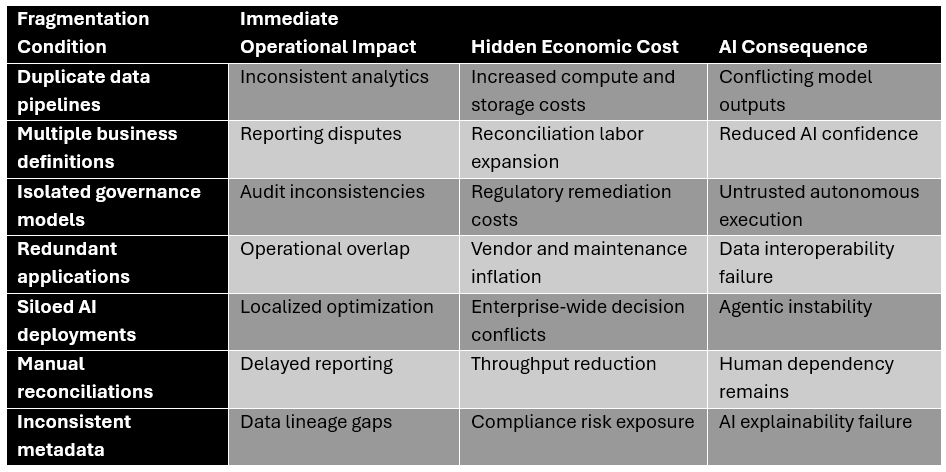
This is why many organizations now experience an architectural paradox — as technology capability increases, operational agility declines.
The new core competency: "Federated coherence”
The surviving organizations of the next decade will not centralize everything, nor will they allow unrestricted decentralization because both models fail under modern conditions. Instead, organizations are moving towards “federated coherence”, an operating principle that recognizes the reality that domains must retain operational flexibility, business units require localized agility, and regulatory requirements can differ by function and geography. However, overarching all this, federated coherence recognizes that enterprise semantics, governance, and economic measurement must remain interoperable.
This is the architectural middle ground most organizations have failed to achieve. Federated coherence is not simply a governance model, rather it is an economic design principle that allows organizations to reuse trusted data assets, standardize critical business definitions, reduce reconciliation overhead, accelerate AI deployment confidence, and respond to regulatory changes without widespread disruption.
The key insight is that interoperability is no longer a technical convenience — it is now a survivability multiplier. Organizations capable of adaptive interoperability will outperform those pursuing isolated optimization.
The measurement failure executives must address
One of the largest barriers to transformation is that most organizations still measure their technology capabilities incorrectly. Traditional metrics remain dominated by such concepts as speed of deployment, size of the infrastructure, utilization, and project delivery times.
These indicators measure activity, but they do not measure organizational improvement.
Table 3: Activity metrics versus economic outcome metrics
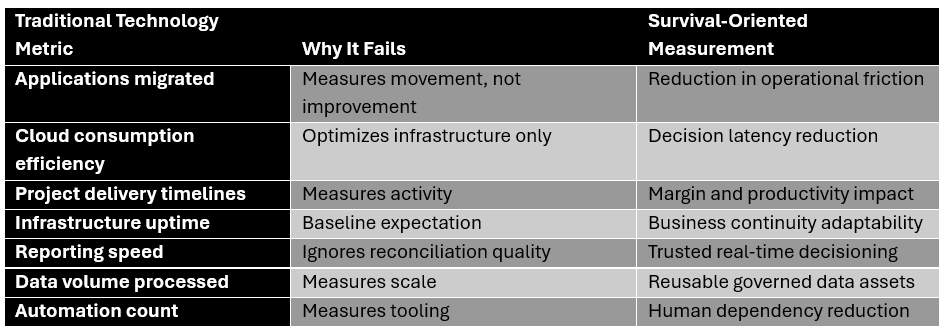
The next generation of architectural leadership will require direct alignment between technology and operational economics, including a reduction in decision times, decrease in reconciliation efforts, and an acceleration of regulatory response times. This next gen architecture will also measure reusable data, gains in process flow, and measurable margin improvement.
Without these measurements, organizations will continue operating within what can only be described as modernization theater that features visible technological movement with little to no structural economic advancement.
This is why so many corporate boards and executive teams increasingly struggle to articulate the return on investment for their spending on AI and the cloud. The investments are real and the infrastructure exists, but the measurement systems remain disconnected from economics. Architecture without measurable economic alignment simply becomes overhead.
Those organizations most likely to survive the next economic and technological cycle will not necessarily be the largest or the fastest adopters of AI. They will be the organizations that are most able to reduce complexity while increasing adaptability, govern their data without slowing operations, scale intelligence without scaling fragmentation, and align their architecture directly to measurable business outcomes.
In this environment, enterprise architecture now returns, but not as documentation, committees, or abstract frameworks disconnected from execution. It returns as an operational survival discipline. And those organizations emerging from this transition will increasingly resemble adaptive economic systems rather than static technical stacks.
Table 4: Characteristics of the adaptive organization
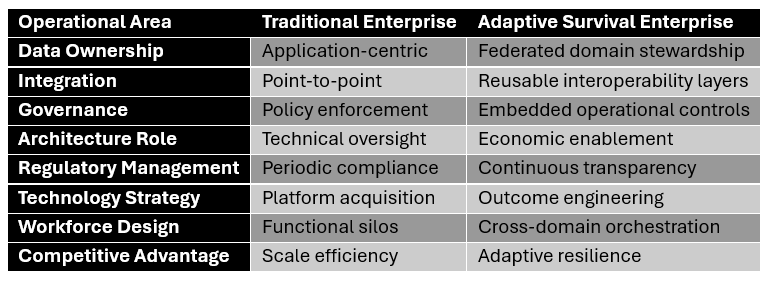
The implication is difficult but unavoidable. The future competitive advantage for many organizations will not be determined by what technologies they acquire, but by whether their underlying architecture can absorb continuous change without collapsing into operational friction.
That is the real challenge now unfolding beneath the modernization of the AI process. Moreover, it is why the next era of organizational modernization will not belong to those that simply automate faster; rather it will belong to those that finally learn how to architect survival.
You can find more blog posts by this author here
Follow us on social
Topics
Have questions?

