
Law firms are regularly pitching AI accessibility to those conducting low-level, repeatable work, but new data from the “2026 Future of Professionals Report” shows that it's crucial decision-makers who see AI impacting their careers
Key insights:
- AI decision-makers are the real recruiting flight risk, not junior associates —While law firms often assume AI investment mainly attracts tech-savvy junior lawyers, the data shows it's senior lawyers with AI purchasing authority who are most likely to leave a firm over inadequate AI tools, and they’re the hardest to replace if they do.
- AI decision-makers report significantly more career upside from AI than their peers — These decision-makers are overall more bullish on AI's impact with 32% saying they are more confident in AI having a positive impact on their long-term trajectory, while just 16% are less confident — a pattern that also holds for compensation and how their expertise is valued by clients and their firm.
- Professional-grade AI access is now a hiring deal-breaker for top talent — About one-third or professionals claim they would not accept a job offer from an organization without professional-grade AI access, and an additional one-third say the lack of professional-grade AI access would be a factor in their decision-making, and that means firms risk losing top lateral recruits if they can't speak credibly about their AI strategy when recruiting.
Since the introduction of AI into the legal world, law firms have tried to make its use a differentiating factor — for business development with clients, of course, but also within hiring. The general wisdom holds that junior lawyers tend to be more technologically savvy, more familiar with AI and other new tools, and more eager to join firms that are similarly invested in an AI future. AI investment, therefore, is supposed to have an outsized impact on young associates and new attorney recruiting.
While that may be true for some junior associates, new data from Thomson Reuters’ Future of Professionals Report reveals that the true impact of AI on hiring may actually occur further up the seniority ladder.
Lawyers surveyed for the report who are decision-makers for AI-related purchases at their firm say they are feeling more confident that AI will have a positive impact on long-term career trajectory and compensation, as well as their expertise being valued by their organization and clients. Further, this group is more likely to say they would not accept a job from an organization that did not have professional-grade AI.
Generally, the more decision-making authority around AI a lawyer has, the more likely they are to have experienced AI having a positive impact on their career. This would seem to track naturally — those selecting the tools believe it has a higher impact — but it also reveals important information for law firm hiring.
These decision-making professionals are crucial for turning AI investment into tangible outcome, a strategy goal now found at the majority of law firms. But if leadership does not establish proper AI strategy and implementation, these decision-makers are more apt to jump ship to a firm that is willing to back their recommendations. Further, a firm that doesn't have the right tools isn't going to easily attract equivalent replacements.
Clearly, that makes AI selection more than just a workflow question. It’s also increasingly a personnel issue.
By the numbers
Despite being a relatively new phenomenon within many law firms, AI has already had a tangible impact on lawyer careers. For instance, about half of all firm lawyers say AI has had an impact on their long-term career trajectory, with more than one-quarter (27%) saying AI has helped them be more confident in their careers. A smaller portion (19%) say AI has made them feel less confident in their careers. Similar proportions report AI having an impact on their compensation and on their expertise being valued by their organization or clients.
However, these numbers vary depending on whether the lawyer says they are a decision-maker around AI at their firm, have some input into decisions, or have no decision-making authority. These decision-makers are overall more bullish on AI’s impact with 32% saying they are more confident in AI having a positive impact on their long-term trajectory, while just 16% are less confident.
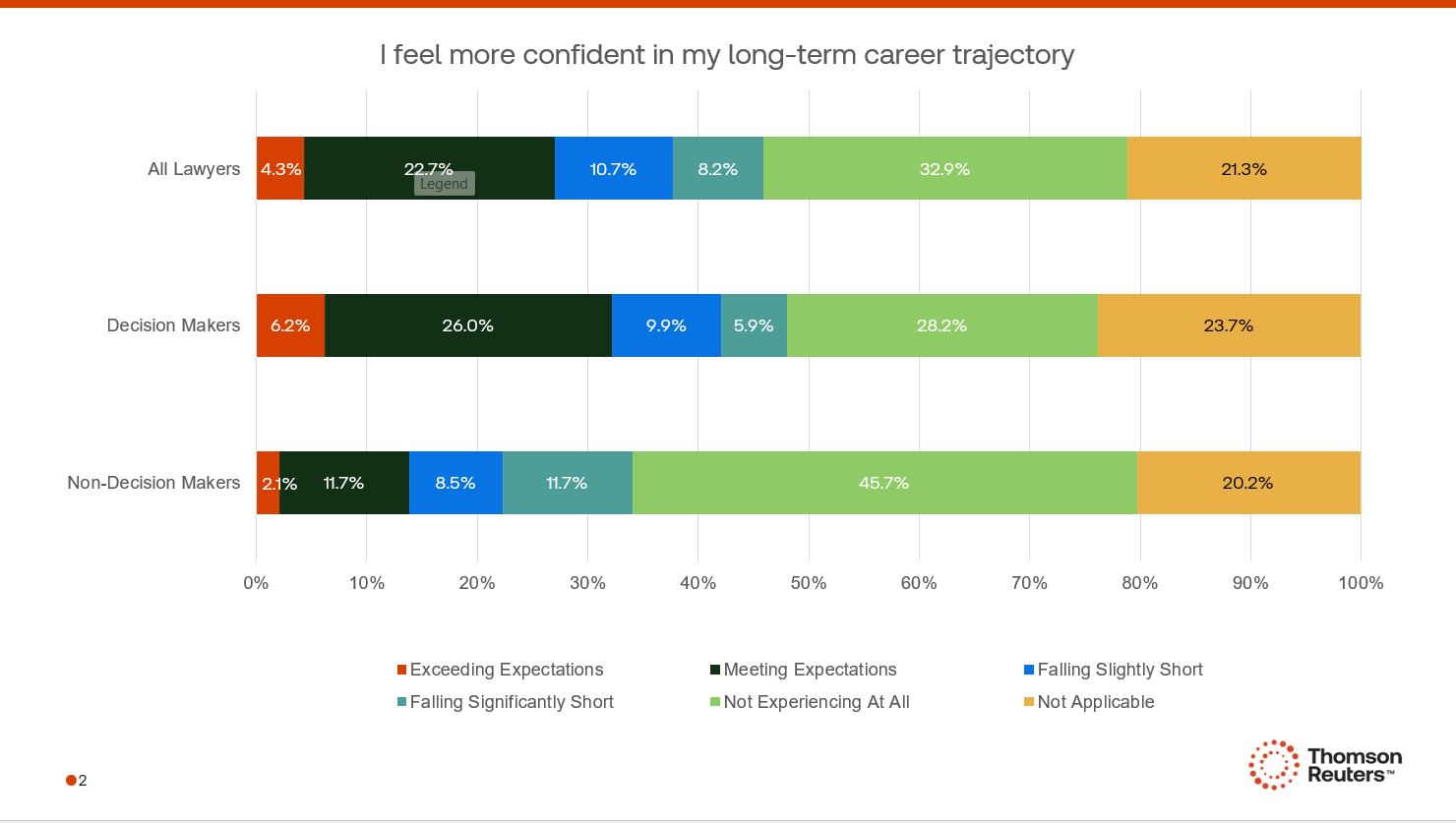
Similar trends occur when asked about AI’s impact on compensation and on whether the respondent’s expertise is valued by their organization. In both cases, more AI decision-makers are saying they see the tool’s upside in these areas, while those without decision-making authority either see their expectations falling short or are not experiencing any impact at all.
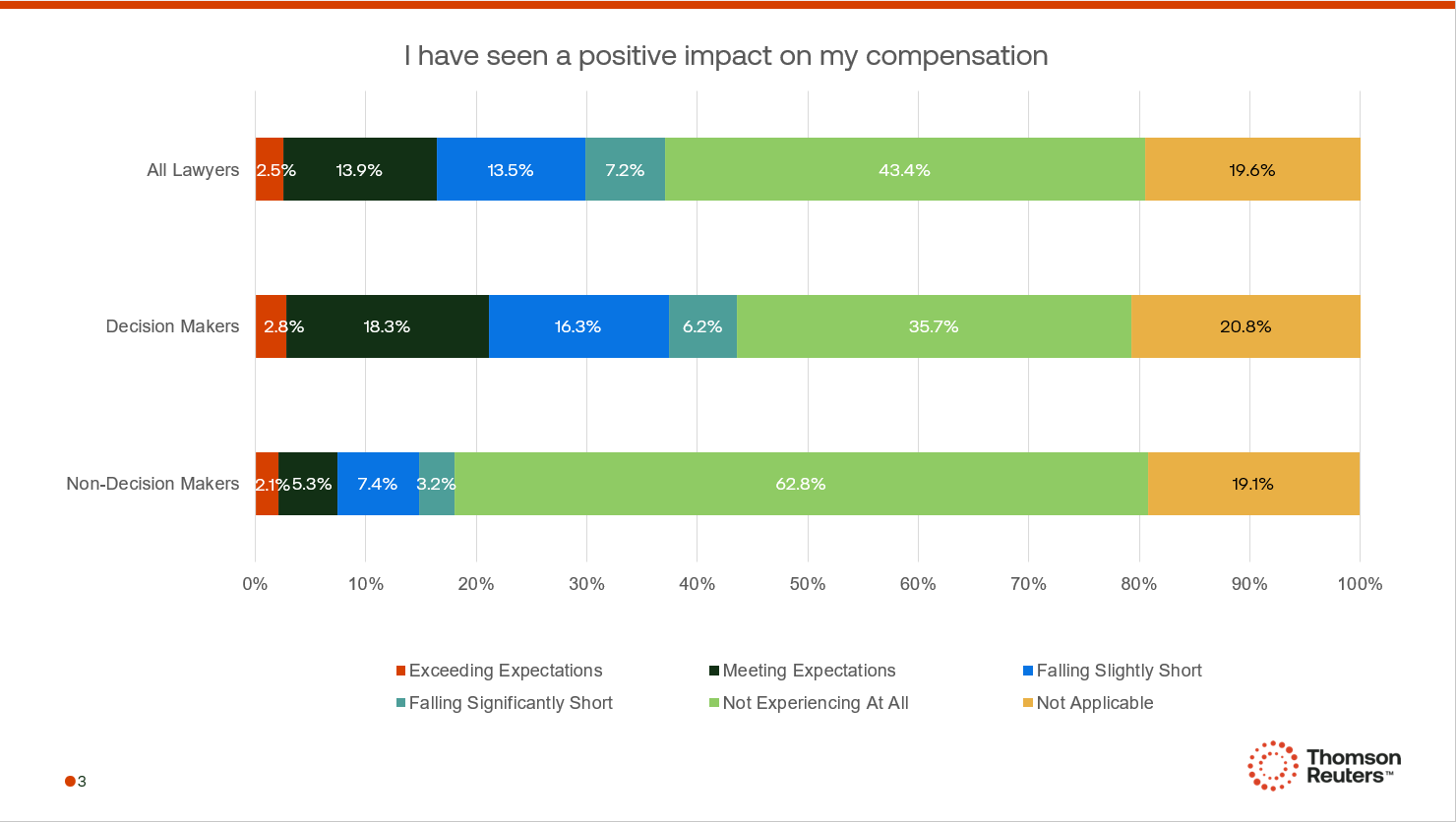
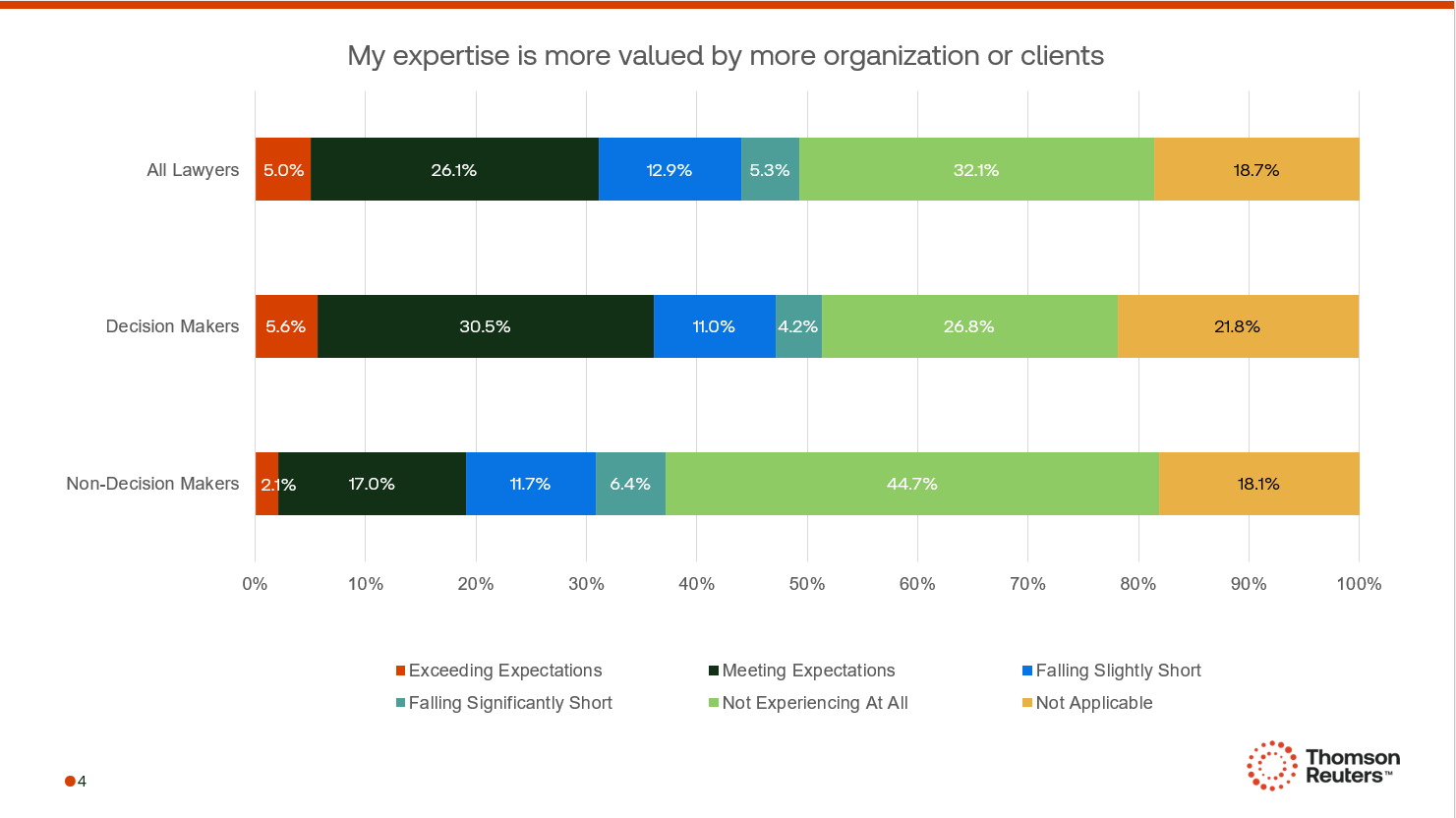
This is not simply a matter of lawyers with decision-making authority having more longevity in their careers, either. Generative AI has only been publicly available for less than four years, after all, and has had a tangible impact on the legal industry for even less time than that. What this could indicate, however, is the influence these decision-makers currently have within the firm and their importance to setting the firm’s strategic direction.
For example, lawyers without decision-making authority are typically doing work that is often repeatable, tactical, and operational in nature. This work is crucial for various types of legal matters to be completed, but it is rarely the reason that a given client will pick one firm over another. As a result, while AI is directly transforming this type of work, those without AI decision-making authority may not be able to see AI’s downstream effects on client service.
Those who do have this decision-making authority, however, are also typically those interfacing with clients, engaging in business development activities, and influencing the overall strategy of the firm. As a result, while AI’s current impact on their direct work may be more secondary, AI decision-makers are better positioned to recognize when a new factor such as AI has positive economic impact on the firm.
And as clients themselves continue to adopt AI internally and point to AI as a potential differentiator in outside counsel selection, the presence of these firm decision-makers will continue to increase in importance.
The impact on hiring
The fact that law firm AI decision-makers feel more positively about AI’s impact on their own careers could have a corresponding impact on how law firms attempt to recruit lateral hires to their firm. AI decision-makers are becoming an integral part of their firm’s overall business development and strategy, in addition to the role they play in firm operations. Thus, just as law firms have historically focused on keeping high-powered partners and rainmakers content within the firm, recruiters and other firm hiring personnel should be taking AI into account in both retention strategies and lateral hiring.
In fact, when asked whether a firm’s access to professional-grade AI tools would impact a potential job offer, lawyers without AI decision-making authority remained largely ambivalent. More than half (52%) said the lack of access would not deter them, while less than 10% said they would not accept a job offer without this access.
AI decision-makers within firms, however, tell an entirely different story. About one-third (32%) claim they would not accept a job offer from an organization without professional-grade AI access. And an additional one-third say the lack of professional-grade AI access would be a factor in their decision-making.
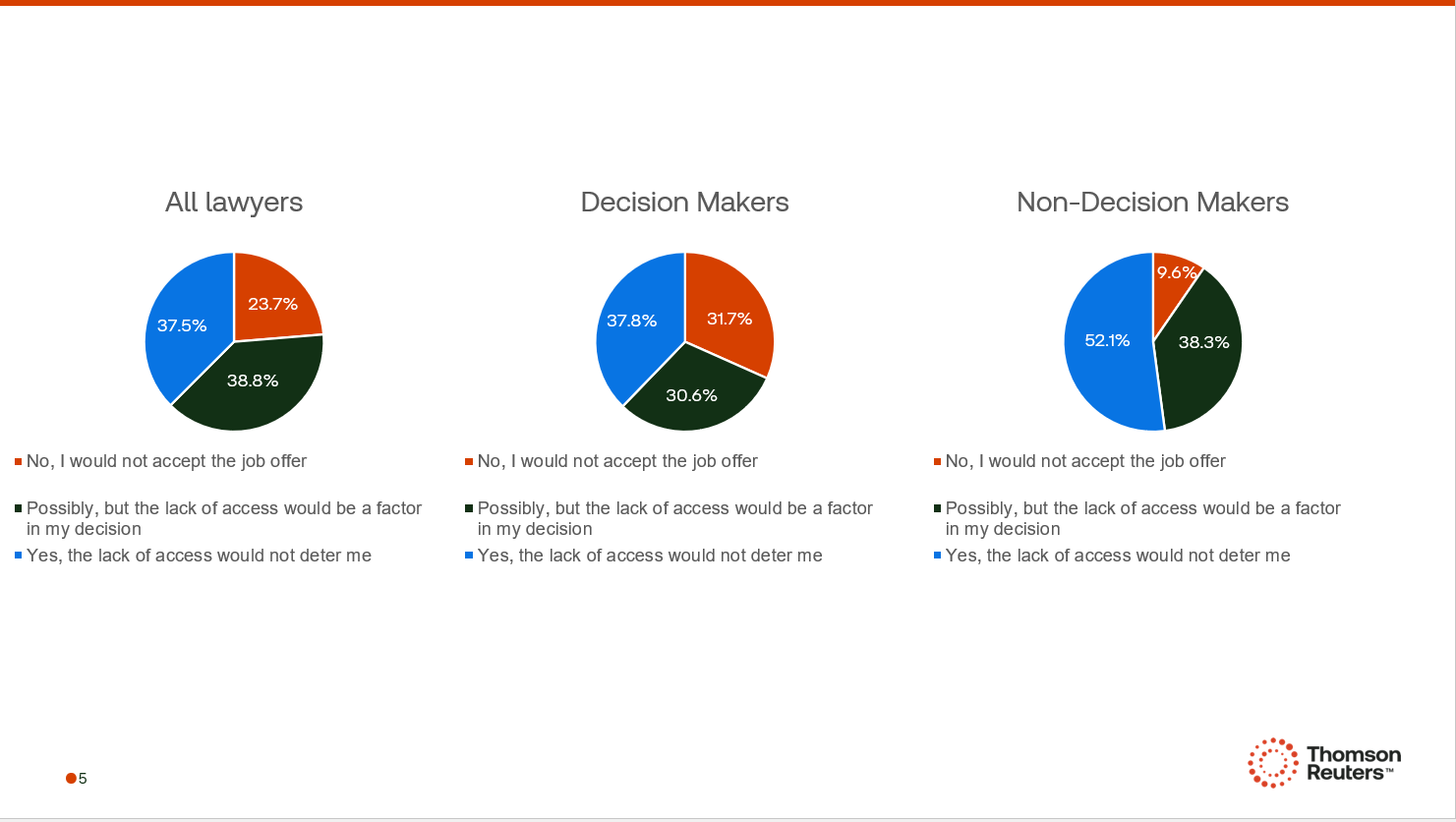
Firms should take these figures to heart, and attempting to bring in new personnel with AI decision-making authority should mean more conversations about the impact of AI on the firm and their own careers. With more than 60% of respondents saying that professional-grade AI access would be a part in their decision to accept a job offer, recruiters should come to hiring conversations prepared with information about what AI tools their firm has to offer, where AI fits into the firm’s practice workflow, how the firm generally approaches AI conversations with clients, and how AI will impact the recruit’s long-term career development.
Not discussing AI with this category of lawyer, meanwhile, could have devastating effects. In fact, it could mean missing a key portion of both law firm strategy and client development at a time that these decision-makers have made it clear that they will only accept an advanced level of AI literacy in making career decisions.
As AI continues to reshape the legal profession, the data from the Thomson Reuters’ Future of Professionals Report makes one thing clear — the conversation about AI and hiring can't stop at workflows. The lawyers most likely to walk away from an offer over inadequate AI capabilities aren’t necessarily those attorneys working with AI on junior, repeatable work. They're the partners and decision-makers that firms can least afford to lose.
For law firm leaders navigating this talent shift, understanding exactly how AI is reshaping expectations at every level of seniority isn't optional — rather, it's a competitive necessity.
You can out more about AI’s impact on legal industry hiring here
Follow us on social
Topics
Have questions?

