
Organizations need to shift their focus from measuring transformation and capability maturity to measuring enterprise adaptability, which is the ability to rapidly and repeatedly align strategy, operations, technology, data, and people in response to accelerating external change.
Listen to this article
Key insights:
- Adaptability is becoming a more important competitive advantage than transformation itself — While many organizations successfully execute transformation initiatives, far fewer develop the ongoing ability to continuously sense, respond to, and learn from change.
- Most companies face an "enterprise adaptability gap” — This gap is the difference between the speed of external change and the organization's ability to respond effectively; and when the gap widens, symptoms emerge such as slower decision-making, governance bottlenecks, and increasingly difficult transformation efforts.
- Leaders should measure adaptability capacity, not just capability maturity — Traditional metrics focus on whether projects were completed or technologies deployed; however, by measuring other factors such as time from signal to decision, speed of execution, and cross-functional dependencies, organizations can understand how quickly it can change when needed.
For decades, enterprises have invested heavily in transformation. They have modernized technology platforms, redesigned customer experiences, automated processes, strengthened cybersecurity, expanded data capabilities, and, most recently, accelerated investments in AI. AIAt the same time, leaders have navigated supply-chain disruptions, geopolitical uncertainty, changing workforce expectations, new regulatory requirements, and shifting customer behaviors.
However, despite all this transformation, an uncomfortable question remains, “Is my organization actually becoming better at changing?”
The “emerging adaptability” gap
Consider the number of forces an executive team may be managing simultaneously. AI is changing the economics of work and information, and regulations change how data, technology, and business processes must be governed. Further, geopolitical developments alter supply chains and sourcing strategies, while new competitors are constantly emerging. Customers expect faster and increasingly personalized interactions; and technology cycles continue to compress.
None of these forces operate independently. A change in technology can require changes in skills; and changes in data can create governance requirements. Regulatory changes can alter technology architecture, while new operating models can change economics. Strategic decisions can require all these elements to move together. The challenge, therefore, is no longer to simply manage change; rather, it’s to manage interacting with change.
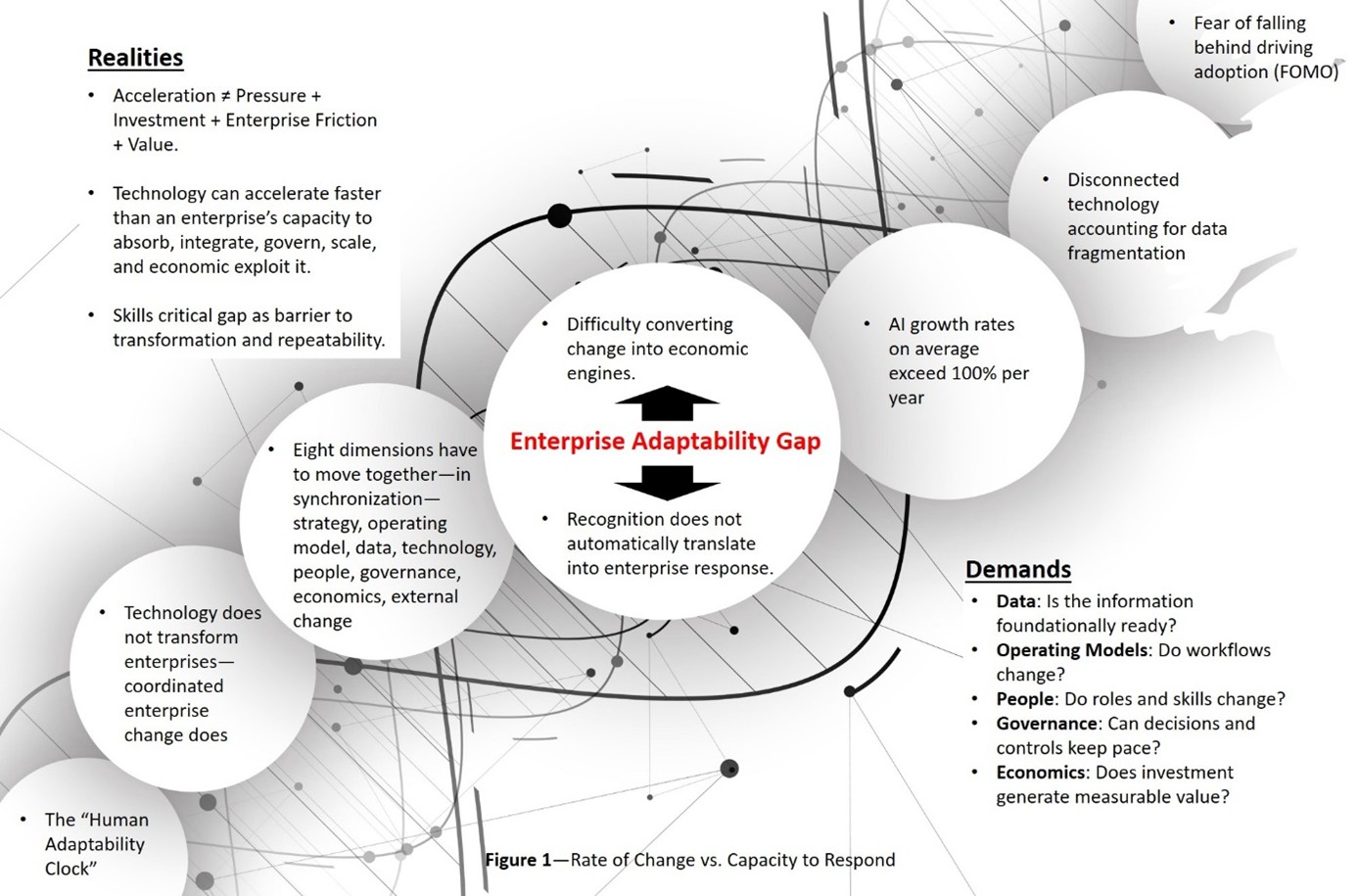
This creates what might be called an enterprise adaptability gap — the difference between the rate at which an organization's environment is changing, and the rate at which the organization itself can respond effectively. When those rates are reasonably aligned, the organization can absorb disruption, take strategic advantage of opportunities, make decisions, redirect resources, and improve operations.
When the gap widens, however, familiar symptoms appear. Decisions take longer, transformation programs multiply, and technology investments fail to produce expected business outcomes. Consequently, data remains fragmented, governance becomes an obstacle rather than an enabler, and employees experience change fatigue. In this environment, executives discover that seemingly straightforward strategic decisions will require modifications across numerous systems, processes, and organizational boundaries.
The enterprise may still be performing, but its ability to change is becoming progressively constrained. That distinction matters, because today’s strong performance does not necessarily indicate strong adaptability will be ready for tomorrow.
Transformation is not the same as adaptability
Organizations have become remarkably proficient at launching transformation initiatives, yet transformation and adaptability are not synonymous. Transformation typically has a destination, but adaptability is different, as it’s a capability that may have no final destination.
An adaptable enterprise develops the capacity to repeatedly sense change, interpret its implications, make decisions, and mobilize resources. They also learn to modify strategies and operations, learn from outcomes, and adjust again.
Not surprisingly, this distinction changes what leaders should measure. Traditional transformation metrics tend to measure whether the organization completed the program or implemented the technology. Measures of adaptability introduces a different set of metrics that can measure how quickly the organization recognized the need to change and how decisions were moved to execution.
Organizations also need to understand what they learned from the change, and whether the whole process is repeatable.
The last question may prove particularly critical. An organization can survive one major transformation through extraordinary leadership attention, large investments, or employee effort; but that does not necessarily make the organization adaptable. Adaptability needs to become part of the enterprise's normal operating capacity.
8 dimensions that have to move together
One reason adaptability is difficult to measure is that it does not reside in a single organizational function. It emerges from the intersection among eight dimensions, including strategy, operating model, data, technology, people, governance, economics, and external change.
Organizations frequently assess these dimensions separately. While strategy teams examine markets and competitors, tech teams assess architecture, and data teams focus on accuracy, the enterprise can still struggle to adapt because adaptability exists in the connections between those capabilities.
Executives therefore need to understand not merely whether individual capabilities are mature, but whether those capabilities can move together.
The accumulation of adaptability debt
There is another consequence of years of disconnected change. Technology executives are familiar with technical debt: earlier decisions that make future systems more difficult or expensive to modify.
Many organizations, however, may be accumulating something broader — adaptability debt, which develops when organizational structures, technologies, data, and other factors become increasingly difficult to change together.
A legacy system can create adaptability debt, but so can fragmented data, overlapping decision rights, outdated policies, organizational silos, and more. When leaders put all the individual elements together to form a roadmap to compare their rate of change to their capacity to respond, we arrive at the chart below, which shows the interconnected dynamics of the enterprise adaptability gap.
Individually, these constraints may appear manageable. Collectively, they increase the cost and time required for the enterprise to respond. Burdened by this, the organization still changes, but every subsequent change requires greater effort.
Eventually leaders find themselves confronting a paradox, in which their enterprise has undergone years of transformation, but it has become harder, rather than easier, to transform.
From maturity to adaptability capacity
This suggests another shift in executive thinking. For years, organizations have relied on maturity models, which can be useful because they provide structure and allow organizations to evaluate capabilities against defined practices, but, like successful transformation, maturity does not always equal adaptability.
A highly standardized organization may perform efficiently under stable conditions yet struggle when conditions change rapidly. Conversely, an organization with less sophisticated infrastructure may respond effectively because decision rights are clear, leaders are aligned, and information moves quickly.
What executives increasingly need to understand is their adaptability capacity — the ability of the enterprise to respond repeatedly to meaningful change without destabilizing its own performance. That capacity might eventually be measured through indicators such as the time from external signal to executive recognition, or from decision to implementation. Leaders could also measure the number and complexity of cross-functional dependencies, their ability to redirect capital and resources, or the speed of governance and risk decisions, among other metrics.
The objective would not be another corporate score, rather it would be to identify where the enterprise's capacity to respond is constrained.
5 questions leaders can ask now
Organizations do not need to wait for another major transformation initiative to begin examining adaptability. Leadership teams can start now by asking themselves five key questions:
- What is changing outside the enterprise faster than our current planning cycles can accommodate? This establishes the external rate of change.
- Where does our response consistently slow down? The answer may involve areas of decision making, data, governance, technology, or combinations of those and other factors.
- Which dependencies make seemingly simple changes difficult? This begins exposing adaptability debt.
- How long does it take us to move from signal to measurable outcome? Organizations measure process cycle times extensively, but few apply the same discipline to enterprise change.
- If conditions changed materially tomorrow, what would prevent us from responding? Perhaps the most valuable answers will not identify specific technologies, but instead identify decision rights, organizational structures, information gaps, or other economic constraints.
In providing those answers, leaders can give themselves starting point for measuring adaptability.
The next management discipline
The past several decades produced increasingly sophisticated methods for measuring operational or financial performance. But the next challenge may be measuring something more dynamic — How effectively can the enterprise change itself?
The competitive divide of the coming decade may therefore be less about which organizations implemented a particular technology first and more about which developed the capacity to repeatedly adapt their strategy, operating models, data, technology, and people as conditions changed. That is a fundamentally different management challenge.
Indeed, it moves the conversation beyond transformation and technology adoption, asking instead the enterprise itself can respond at the speed its environment demands.
You can find more blog posts by this author here
Follow us on social
Topics
Have questions?

