.jpeg)
Project Excelsior is Thomson Reuters' first major GCO 2030 initiative, transforming the customer contracting process through simplified terms, automation, and streamlined workflows.
Listen to this article
Key insights:
- Turning a perceived bottleneck into a business enabler — The new initiative looks to make the contracting process faster, smoother, and more customer-focused, helping the GCO become a strategic partner rather than a source of delay.
- The first major proof point of the GCO 2030 vision — The initiative demonstrates how the GCO 2030 strategy can be put into practice in contracting by using technology, automation, and AI to free lawyers to focus on higher-value advisory and negotiation activities.
- Success depends as much on people as on technology — AI transformation requires stakeholder buy-in, new ways of working, training, and measurable outcomes.
It should be an exciting moment when a sale closes, as it’s an opportunity to build trust in the customer relationship; however, as many GCs recognize, instead of turning a sale into a relationship, the contracting process can too often lead to delay and friction.
This was something Thomson Reuters’ own General Counsel’s Office (GCO) decided to address through Project Excelsior, a redesign of the customer contracting experience from the ground up. The ambition goes far beyond simply enabling faster paperwork, the team’s goal is for the GCO to be viewed as a strategic partner and not as a bottleneck.
Why now?
The pressure on corporate legal departments to move from reacting to the business to genuinely enabling it is not unique to Thomson Reuters.
As AI reshapes how business gets done, about two-thirds or more of the corporate legal professionals surveyed for Thomson Reuters Future of Professionals report say that the pace, complexity, and volume of their work is increasing as a result. Further, they say their legal departments are expected to absorb that surge without a proportional increase in headcount.
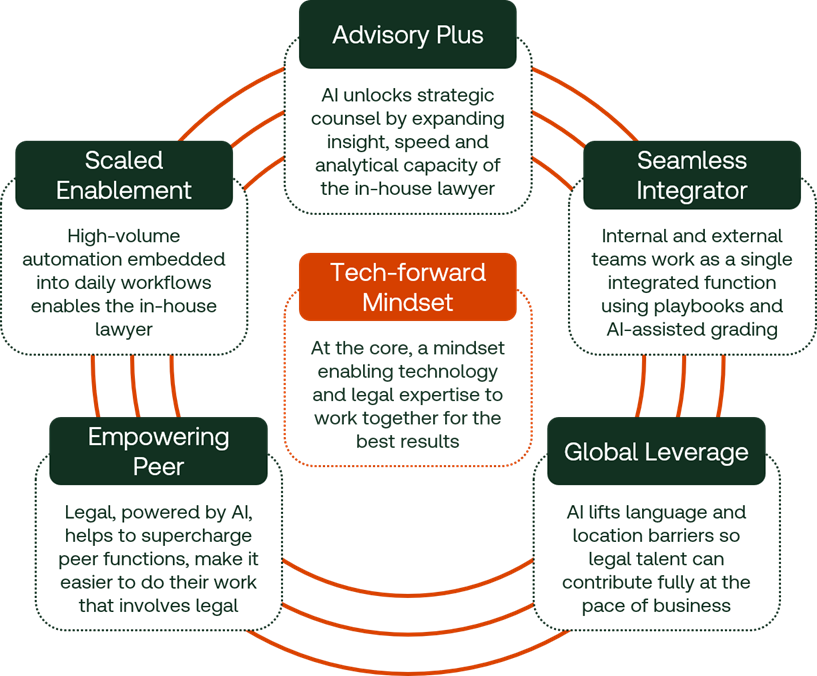
Thomson Reuters' GCO responded to this pressure with — a mission to envision the future legal department that’s enabled by technology and new ways of working and then mapping a path to get there. It envisions the future legal department through five archetypes — Scaled Enablement, Advisory Plus, Seamless Integrator, Empowering Peer, and Global Leverage — and Project Excelsior is one of the first major initiatives bringing that vision to life by rebuilding the contracting experience end to end.
"What I love most is that this was led by our own Customers & Commercial (C&C) team,” explains Norie Campbell, Chief Legal Officer at Thomson Reuters. “With decades of experience, they knew the pain points better than anyone, and there was real pent-up energy to fix it. The legal technology gave us the opportunity, but it was our people who made it truly transformative."
Project Excelsior is structured around four concrete moves:
- Rewriting underlying terms for a modern, balanced customer relationship
- Simplifying order forms so customers only see what’s relevant to them rather than a clutter of legacy language
- Building a single contracting hub to store and access scattered documents in one place
- Redesigning approval workflows so routine matters can be resolved at point of contact rather than having to be addressed by corporate legal
The result is a shift from friction to flow.
Putting GCO 2030 in motion
GCO 2030 identified Scaled Enablement — the concept of high-volume automation handling routine work — as the likely starting point for the transformation within many legal departments, precisely because it's the key to unlocking access to the other four archetypes. A team that’s still buried in manual, repetitive work simply has no capacity to become anything else and Bertil Majer, General Counsel and leader of the GCO's C&C practice, describes what that capacity unlocks for his team: "If we get a better handle on the emergencies, maybe even foresee them, we will be better partners and better integrators. We will have resources we didn't know we had."
In practice, it looks like this:
- Scaled Enablement is the rewritten terms and the simplified order forms that can allow routine work to be automated and capacity freed up
- Advisory Plus comes about as freed-up lawyers start spending more time on more complex matters such as contract negotiations and structuring that truly need a lawyer's judgment.
- Empowering Peer is equipping the sales and commercial operations teams move forward on standard contracts themselves, without waiting on permission from corporate legal for work that doesn't need a lawyer at all.
Of course, none of this happened without real effort behind the scenes. Alex Graydon, Associate General Counsel at Thomson Reuters, who led much of the day-to-day building of this process, called it "the most significant rewrite we've done in a decade," adding that it took the collaborative efforts of legal, sales, commercial operations, and business functions — all working through the details together.
Majer agrees, describing building new AI habits as an ongoing discipline. "It’s like working out and staying in shape — transformation is never a straight line,” he says, adding that by his account, the team has now reached a tipping point and are genuinely moving together in the same direction.
The road ahead
Reaching this milestone doesn’t mean the work is done. Indeed, three factors will determine whether Excelsior delivers on its promise, including:
- Creating an AI-enabled playbook — By embedding a generative AI assistant, in this case Thomson Reuters CoCounsel, directly into how lawyers and deal teams operate day to day will mean that new terms and structures aren't just documented but actively used at the point of work.
- Encouraging stakeholder adoption — A redesigned contracting experience only works if the sales and commercial operations teams it's built for actually use it. These stakeholders need to be equipped, trained, and genuinely bought in, not just informed. This is a significant change management effort, and it has built out project roll out plans with communications, training, and ongoing feedback loops all ready for all stakeholder groups. “If our stakeholders do not understand it, trust it, and use it, we will just have redesigned the process on paper, but not transformed the experience, so this is all about culturally embracing the change that new technology brings,” Majer explains.
- Proving impact properly — The GCO is measuring success against the concept outlined by the Thomson Reuters Institute to represent a legal department’s strategic priorities in four areas. (Efficient: Is legal time being freed up for higher-value work? Enable: Is the deal cycle accelerating by getting products into customers' hands faster? Effective: Are stakeholders having a better experience? Protect: How consistent are we staying with our approved terms?)
"We're going to try and rate contracts to see how far they have drifted from the standard over time,” says Graydon. “The expectation and hope is that they're not drifting, because they don't need to."
The proof, of course, will be in the proverbial pudding and that’s why Thomson Reuters is committed to sharing its work, wins, and open questions throughout the GCO 2030 journey, starting with Project Excelsior.
Because becoming a strategic partner, not a bottleneck, isn't a claim you make once, it's one you keep earning, in full view.
You can learn more about the Thomson Reuters GCO 2030 initiative here
Follow us on social
Topics
Have questions?

