
Legal organizations must deliberately choose and clearly communicate which AI-driven structural model they are building, since misalignment between a lawyer's preferred future and their employer’s practice is a primary driver of attrition.
Key insights:
- "Elevate" is the dominant preference — The majority of legal professionals favor a future centered on human expertise augmented by AI, and this group is notably the most satisfied and aligned; however, their success hinges on developing structured, deliberate judgment among junior lawyers.
- "Scale" and "Reimagine" can look similar but represent different bets on organizational structure — Both rely on high-volume, technician-style work, but Scale applies AI inside the employer’s s existing structure, while Reimagine rebuilds the structure itself with different economics and workflows.
- Reimagine-preferring professionals face the starkest misalignment — Those professionals who prefer a Reimagine future are the most impatient with the pace of AI adoption, the most willing to walk over inadequate tooling, and the highest flight risk among the three groups.
The question of what kind of lawyer is your AI strategy building is top of mind among many legal organizations leaders. From the view of one AI-native firm founder, two categories are emerging: the technician, who handles a large volume of cases that are similar and relatively less complex; and the trusted advisor, who is motivated by providing clients the best guidance in an environment of growing complexity.
Unsurprisingly, many AI-native law firms already have a preference for hiring technicians. However, the question is still being decided for the rest of the legal profession.
And it's worth emphasizing that technician is not a lesser calling. Indeed, it demands its own specialized skillset, which includes pattern recognition across high volume, workflow and process design and the discipline to standardize what should be standardized so speed does not sacrifice quality. These are not innate abilities that trusted advisors automatically possess, becaue even a lawyer skilled at nuanced, case-by-case judgment calls may struggle with the systems-thinking and throughput discipline the technician role demands, and vice versa.
In Thomson Reuters recent Future of Professionals Report 2026, which gathered insight from legal professionals across law firms, corporate legal departments, and government legal teams, categorized their respondents' preferences on what they'd like to see in a possible AI future into three groups:
- Elevate, which puts human expertise at the center and uses AI to deliver it faster. More than half (52%) of respondents from the legal profession say they prefer this future.
- Scale, which treats AI primarily as a way to do more with less. One-quarter of Scale-leaning professionals want capacity-building as the central future.
- Reimagine requires structural reinvention that rebuilds operations around AI from the ground up. Just 3% of respondents from the legal industry say they prefer this paradigm.
Two of these futures describe what happens to the individual lawyer inside a legal organization’s existing structure. The third describes how the organization itself is built.
Elevate centers the trusted advisor
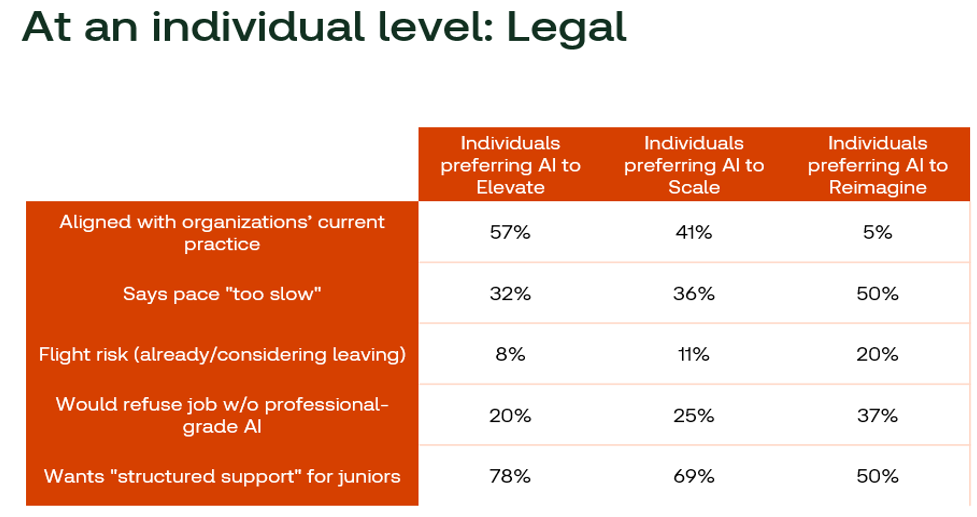
Elevate is the clearest match for the trusted-advisor lawyer. This cohort is the best-aligned and most content of the three groups, with 57% of professionals saying their preference matches their organization’s practice. Their main concern is the next generation because they expect early-career lawyers will need 1.9 more years to develop independent judgment with AI, and 78% want structured support for juniors built into the model.
For employers, the fix is not “add mentoring” as a generic good idea. Instead, it is protecting the one mechanism that makes the trusted-advisor model work at all. Developing judgment is something that AI cannot do on its own, so it has to be taught deliberately to junior lawyers rather than left to chance. In practice, this could mean:
- Requiring juniors to complete one round of independent issue-spotting or drafting before they consult AI, then treating the AI output as raw material to ensure the junior lawyer is flagging assumptions, gaps, and alternative framings rather than simply refining a draft.
- Inserting escalation checkpoints at which the junior lawyer records an initial view first, then has the supervising attorney asking to be walked through how the junior lawyer got here. This way, judgment-building happens through daily reps rather than occasional formal training.
Building capacity within the existing structure
Scale describes existing practice groups adopting AI for capacity without restructuring the organization around it. Scale-leaning professionals sit in the middle on most measures with 41% saying their Scale vision of the AI future aligns with their employer’s current AI strategy. They are also a moderate flight risk, with just 11% they would leave a job if the AI didn't deliver; and moderately impatient, with more than one-third (36%) saying their organization's pace of AI adoption is “too slow”.
For this group, employers need to draw clear lines around what gets delegated to AI at each step of the workflow and what stays human, since a technician-style workflow only holds up if those boundaries are explicit. This starts by selecting and communicating the strategy itself because 35% of professionals at organizations with a named AI strategy say it is not visible in daily practice, and 17% report no strategic direction at all.
Making the case for a function within an organization
Scale and Reimagine can look similar on the surface because both lean on technician-style, high-volume work. At the same time, they differ in what surrounds that work. Scale applies AI inside an organization’s existing structure with the same billing model, same career ladder, and more capacity. Reimagine, on the other hand, rebuilds the structure itself with different economics and workflows that are built around AI from the start. This distinction shows clearly in the data.
Reimagine-leaning professionals are the most impatient with their organization's pace of adoption with 50% saying it's too slow. They are also the most willing to leave their job over AI tools that fail to deliver (37%) and would refuse a job without professional-grade AI. Not surprisingly, they also are the highest flight risk (20%) of the three groups.
The Reimagine profile is one of people wanting a structurally different business model — and their alignment numbers reinforce this. Just 5% of Reimagine-preferring professionals say their organization's practice matches their preference; and almost one-third (32%) say they believe their organization is really pursuing Elevate instead, which is the starkest mismatch in the dataset.
To retain lawyers wanting a Reimagine future, legal employers may consider building an AI-native unit, staffed deliberately with technician-track lawyers and serving the volume-heavy, lower-complexity work AI-native firms build themselves around. This gives those who genuinely want Reimagine a place to thrive rather than leaving them misaligned inside an Elevate-majority culture.
In fact, it's worth pointing out that a unit within an organization can solve the retention challenge, and also formalize the same technician-or-trusted-advisor bifurcation the profession is debating market-wide — all inside one organization’s walls. Perhaps more importantly, this action will buy some time while the market sorts itself out.
Not every AI future maps neatly onto how legal employers are building their workforces —and this may be the most useful part of the comparison. The decision point for legal employers is whether the structure they have built matches the one in which their lawyers think they are working. Employers that name and communicate that structure clearly, and place each lawyer deliberately within it, can turn alignment into the retention lever the data already says it is. The ones that leave their AI strategy ambiguous or fail to communicate it properly will inherit the flight risk instead.
You can download your copy of the 2026 Future of Professionals Report here
Follow us on social
Topics
Have questions?