
As European businesses confront the demands of new digital real-time VAT mandates, they face major overhauls of their technology systems
Key insights:
- More than just e-invoicing — ViDAis both a fundamental compliance change as well as a major technologytransformation that reshapes how VAT is reported, shared, and validated acrossthe entire EU.
- Systemsintegration is key — Businesses that trade across the EU mustconnect their internal invoicing platforms to 27 different tax administrationreporting systems, as well as integrate those platforms.
- Technology platform decisions can becomplicated — IT functions are grappling with whether their ERPsystems are up to the task, or if they need to invest in specialized solutions;and if so, whether to use third-party or in-house-developed solutions.
The European Union’s reforms around its value added taxes (VAT) — known as VAT in the Digital Age (ViDA) — represent a fundamental transition from periodic, manual compliance to real-time, automated digital governance.
But the true "wake-up call" for tax professionals lies in the technical architecture required to manage this change. A new report from the Thomson Reuters Institute, The New Compliance Horizon: 2026 ViDA Readiness Report, found that when it comes to preparedness for ViDA, EU businesses span a wide range of readiness levels, ranging from having no ViDA program to assessing the changes needed to having a fully funded and embedded program.
Yet, only 12% of tax and compliance professionals surveyed said that ViDA compliance is currently embedded in their digital transformation. More than three-quarters of respondents (76%) say their tax functions are still assessing and planning for ViDA compliance or have a transitional program that is fragmented across different countries.
The integration bottleneck
As the report makes clear, ViDA is much more than a simple move to digitalization — it introduces a broad set of connected changes, including mandatory e‑invoicing, digital reporting requirements, and cross-border data exchange. It fundamentally reshapes how VAT is reported, shared, and validated across the EU’s 27 member states. As a result, ViDA simultaneously represents both a fundamental compliance change as well as a major technology transformation, that moves corporate tax functions from periodic, manual compliance to real-time, automated digital processes.
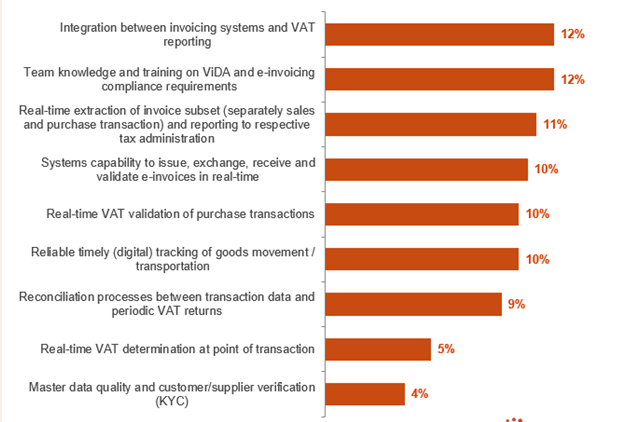
Not surprisingly as a result, many of the current gaps in organizational readiness identified by survey respondents involve tech capabilities, including system integrations, real-time data capabilities, digital tracking, and data quality. Overall, systems integration was ranked by respondents as the single biggest obstacle to achieving ViDA readiness.
Fig. 1: ViDA Readiness: Operational areas rated as “Unprepared”
The pivot toward specialized solutions
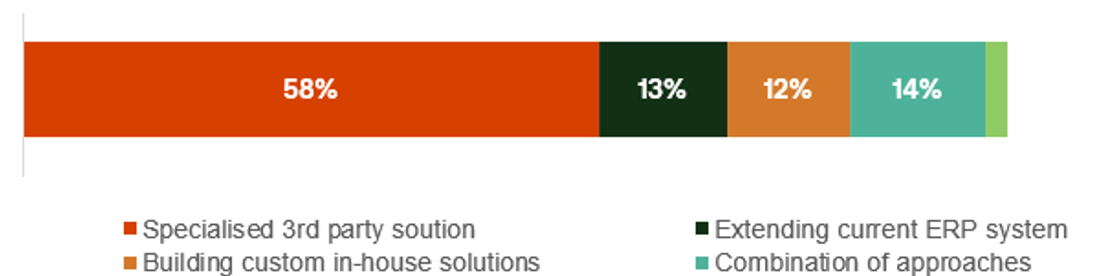
To meet these technological needs, businesses are evaluating a number of different options. Most tax and finance professionals surveyed (58%) say they are adopting specialized third-party solutions, with smaller percentages saying they are either building custom, in-house solutions, planning to extend their current enterprise resource planning (ERP) solution, or using a hybrid or combination approach.
Fig. 2: Primary ViDA compliance technology approach
This is not surprising — standard ERP systems, while essential for core record-keeping, often lack the purpose-built agility required to handle the kind of real-time, multi-jurisdiction complexity that ViDA mandates. Compliance with ViDA is more than merely moving to e-invoices; it requires real-time VAT determination, validation, and continuous transaction controls across multiple jurisdictions simultaneously.
The path to preparedness
It’s paramount to maintain the perspective that ViDA is not merely another tax compliance requirement or technology upgrade. It is nothing short of a transformational shift in how businesses handle VAT compliance and cross-border trade. For many organizations, this will require a complete overhaul of their IT systems to support mandatory e-invoicing and the transition toward real-time digital reporting requirements.
With that in mind, it is important for corporate tax leaders to be comprehensive in planning for the technology transition, including taking such steps as:
- For those organizations that still don’t have a technology roadmap for ViDA, they quickly need to assess their ERP capabilities and explore whether extending their existing ERP, using a specialized solution — either third-party or developed in-house — or a hybrid approach makes the most sense.
- Be thorough to ensure that system integration covers all needs, including ongoing customer and supplier verification, real-time VAT determination at the point of transaction, and producing multiple digital reporting requirements simultaneously. In addition, leaders should take into consideration their account reconciliation processes and ensure smooth movement between transaction data and periodic VAT returns, alongside reliable tracking of goods movement.
- Conduct an audit for master data quality and Know Your Customer (KYC) readiness.
- Ensure your ViDA program has cross-functional authority to meet both compliance and technology requirements. Tax, finance and IT functions should each have clear responsibilities: with tax, managing compliance scope and VAT determination rules; IT, making sure systems integration and tax administration connectivity works; and finance, taking care of accounts payable and accounts receivable process redesign.
- Invest in training and team knowledge to ensure that technological implementations are understood and adopted by end users.
However, the most important item may simply be taking action. While the headline focus for ViDA is often on the 2030 deadline for intra-EU e-invoicing, individual EU member nations are already implementing their own e-invoicing requirements. Businesses that have not yet implemented their technology solutions may find themselves increasingly falling behind both in the marketplace — in terms of their ability to conduct transactions — as well as falling behind their competitors.
Conversely, a thoroughly planned, well executed ViDA readiness plan can ensure smooth processing of cross-border transactions, improve real-time reporting, and reduce payment cycles while improving cash flow — all of which goes a long way toward helping strengthen the tax function’s role as a strategic enabler of the business.
You can download a full copy of the Thomson Reuters Institute’s The new compliance horizon: 2026 ViDA Readiness Report here
Follow us on social
Topics
Have questions?

