Guidelines for editing client records
Due to some potential firm-wide settings configured in your domain, updating a client's records may impact available features or access restrictions to a client's account.
If a newly added client's records are inaccurate, they won’t be able to log into their TaxCaddy account and connect with your firm.
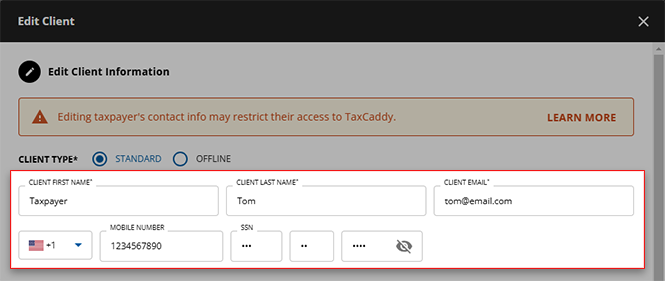
Changing contact information
When updating a
CONNECTED
client's contact information (such as
MOBILE NUMBER
or
EMAIL
) records, saving erroneous records to their profile can prevent them from accessing their account (unable to receive a dynamic password login link or 2FA code). Make sure that these records are accurate before saving any updates.
For Offline clients, you can't edit first name, last name, and email address.
Editability based on status
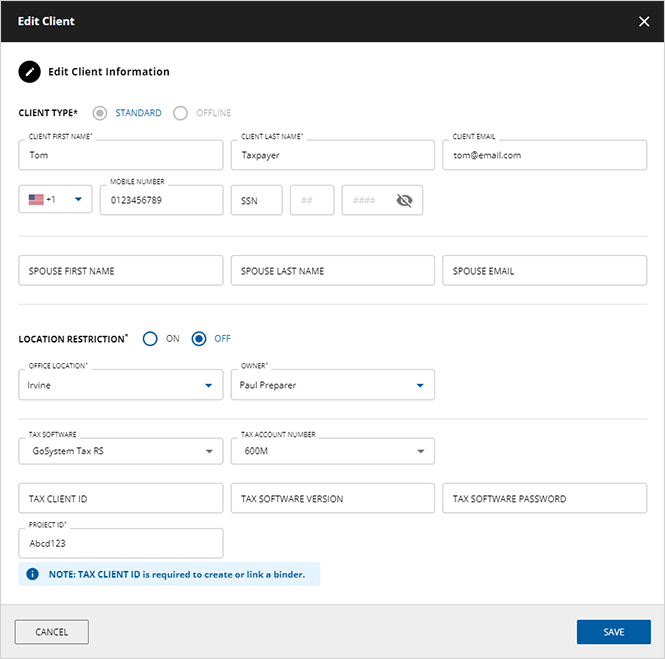
Some fields may not be editable based on status (such as a client's first and last name can only be edited if they are in the
NOT INVITED
status.).
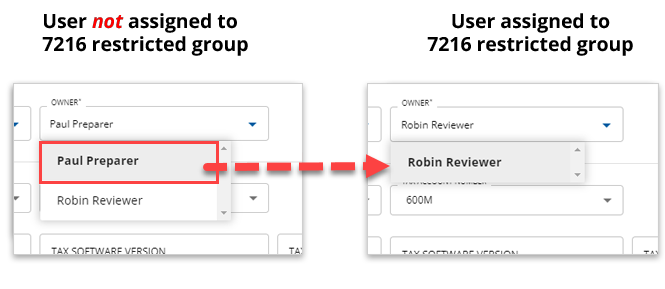
When changing a client's owner, you won’t see Owners (users) with 7216 consent restrictions in the dropdown if 7216 Restriction is enabled. This prevents you from accidentally selecting a user with 7216 consent .
Office Location restrictions
Office Restrictions can be enabled globally at the firm level for all clients or locally per client. Firm-level restrictions apply across the whole firm and override local client-level restriction settings.
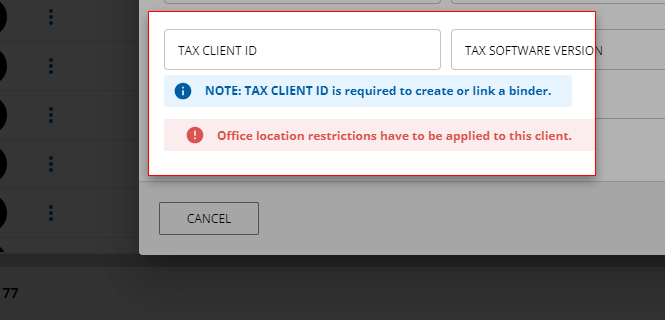
When editing a client record, you will see the following error notification if your firm enabled the
Office Locations
restriction at the firm level after the client was already created:
Office location restrictions have to be applied to this client.
If the firm has office location restriction enabled and a user doesn't have access to the client, they won’t be permitted to update the
Office Location
field.
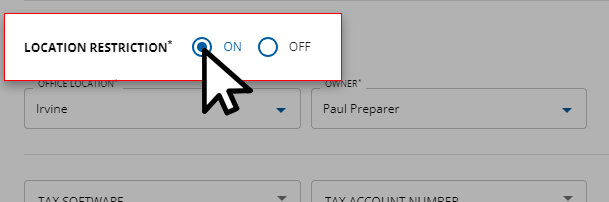
When this happens, select
ON
for the
LOCATION RESTRICTION
within this client's records, then
SAVE
your changes. You can't switch the
LOCATION RESTRICTION
feature back to
OFF
until the firm-wide location restriction is disabled.
When not editing a client's records, users without the necessary permissions to bypass firm-wide location restrictions will be unable to view restricted client profiles in
Overview
.
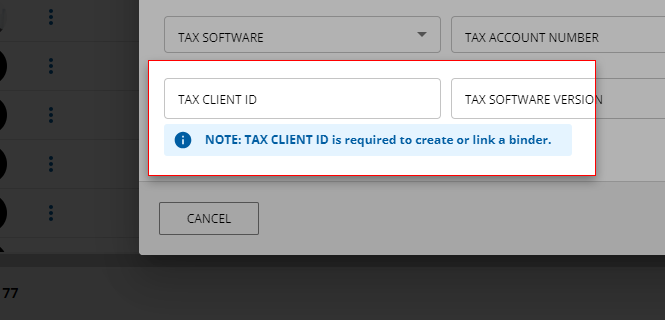
TaxCaddy uses the
TAX CLIENT ID
when creating a DRL (Document Request List) for the client or a binder.
TAX CLIENT ID
links the client profile with their associated binder in FileRoom. If you plan to update the
TAX CLIENT ID
field of a client with an existing binder (in TaxCaddy), altering a client's
TAX CLIENT ID
won’t sync the updated
TAX CLIENT ID
with the binder in FileRoom and you won’t be able to access the binder through TaxCaddy.




 Article