
While indirect tax functions shape major business decisions, a lack of formal measurement keeps their true value invisible, a new report shows
Key insights:
- Bridging the contribution gap — Fully 88% of indirect tax professionals say they believe their function adds value, but only 32% rate that contribution as "significant," pointing to a massive disconnect in organizational recognition.
- Eliminating the fragmentation tax — With 87% of organizations using multiple disconnected systems, manual data reconciliation has become a "hidden tax" on time that prevents teams from performing strategic work.
- Developing hybrid professionals — More than half of indirect tax professionals expect all staff will need to be fluent in both tax expertise and technology within two years in order to keep pace with accelerating regulatory velocity.
The current indirect tax (IDT) landscape is defined by a profound paradox, in which IDT functions strongly contribute to their organizations’ strategic decision-making, but that contribution too often is not being recognized. Indeed, a new report from the Thomson Reuters Institute, The Contribution Gap: Increasing the visibility and influence of indirect tax and compliance — which surveyed 290 indirect tax professionals across the United States, Canada, Mexico, and Brazil — reveals that many organizations’ IDT functions are at a strategic tipping point because of this paradox.
The report illustrates how IDT functions are increasingly a driver of supply chain efficiency, pricing strategy, and M&A success. However, there is a lingering "contribution gap" that threatens to leave the function overlooked and under-resourced.
The data is clear: while 88% of indirect tax professionals say they feel their function contributes significantly or moderately to their organization’s goals, only 32% believe that contribution is "significant". This gap isn't a result of a lack of capability — it’s a result of lack of visibility. The function is effectively doing the work of a strategic partner but is still being measured by the reactive metrics of a cost center.
The hidden value problem
The primary reason for this lack of recognition is a measurement misalignment. Currently, 79% of indirect tax professionals surveyed say they are measured primarily on filing accuracy and timeliness. While these are essential for operational stability, they are fundamentally "invisible" metrics — senior leadership only notices them when something goes wrong.
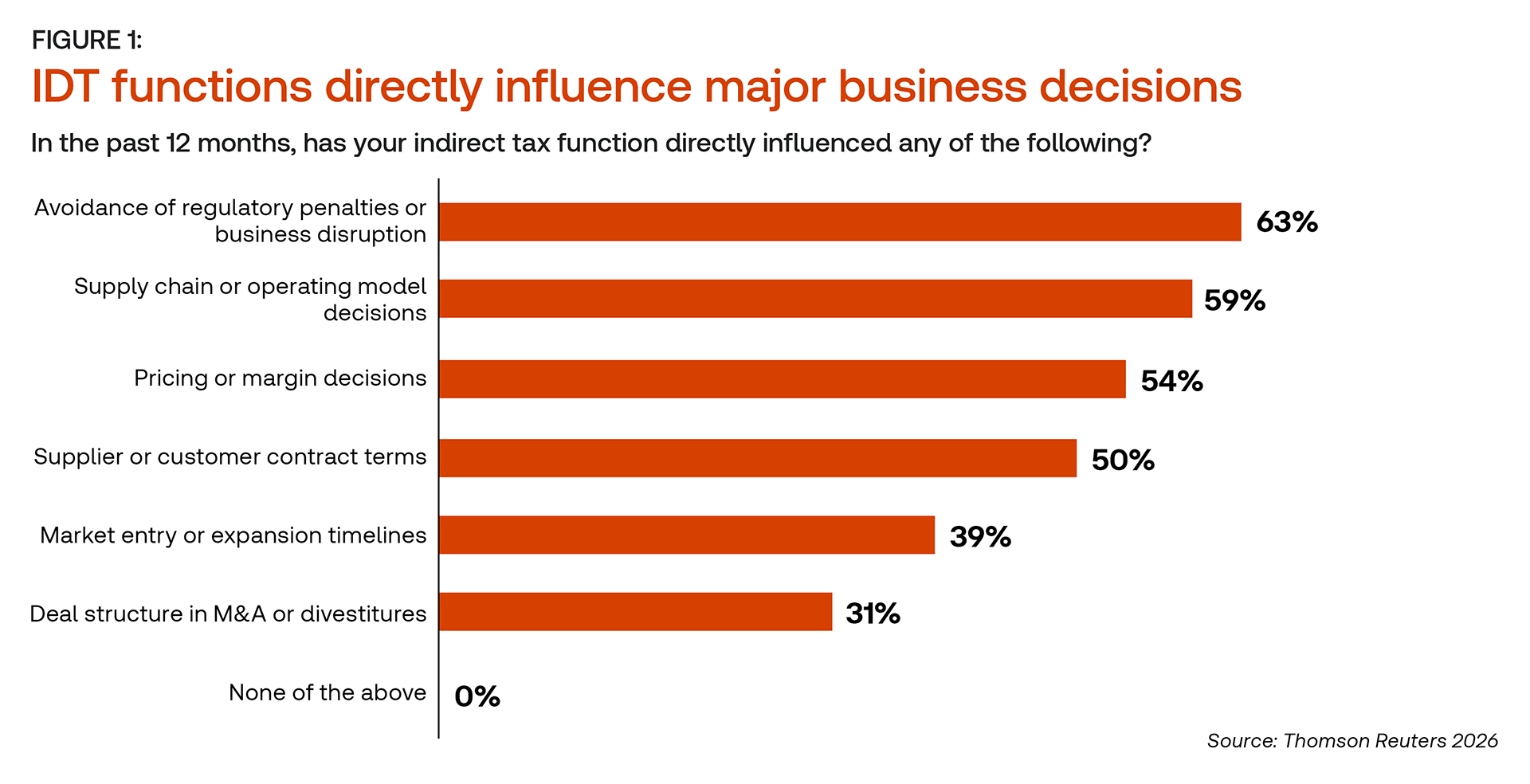
This largely masks the high-value work to which indirect tax functions are contributing. Indeed, many respondents note that they are advising on major business decisions: a majority of respondents say they influence supply chain decisions and help shape pricing and margins, and about one-third say they impact M&A deal structures. However, these contributions rarely appear in formal success metrics. This creates a "hidden value" problem where the function delivers strategic impact but does not systematically capture or communicate it.
To move beyond this, leaders must reframe their success metrics. Instead of just reporting on on-time filings, they should be documenting key items such as regulatory risks avoided, commercial value created through supply chain optimization, and the quantified impact of proactively advising the business.
The fragmentation tax on strategic bandwidth
The second major barrier to strategic evolution of the IDT function is the "hidden tax" of system fragmentation. Most respondents say their organization relies on two or more technology systems for compliance, and many use four or more. This fragmentation forces teams into a cycle of manual data reconciliation.
In fact, more than half of respondents identified data reconciliation as their top automation priority. Only 16% say they have fully automated this process, while 26% remain entirely manual. Every hour that an IDT professional spends manually bridging the gap between their enterprise resource planning (ERP) platform and a third-party tax engine is an hour lost from advising the business on e-invoicing mandates or market-entry strategies.
Further, fixing fragmentation is no longer just an IT project — it is a strategic priority for the entire organization. Leaders who treat system consolidation as a way to reclaim capacity are the ones successfully repositioning their tax functions as strategic partners.
Currently, 79% of indirect tax professionals surveyed say they are measured primarily on filing accuracy and timeliness — and while these are essential for operational stability, they are fundamentally "invisible", and senior leadership only notices them when something goes wrong.
The report also examines where IDT professionals stand on AI adoption and use within their operations, even as the industry moves toward more advanced AI use that features predictive audit risk modeling, AI-driven product classification, and agentic workflow automation. Currently, less than one-quarter of respondents say their IDT function has reached this level of agentic AI automation.
Finally, the report also looks at how the profile of the successful tax professional is changing as technology handles more of the routine compliance work. The industry is seeing the rise of the hybrid professional — individuals who possess both deep technical tax knowledge and genuine technology fluency. Indeed, the majority of survey respondents say they expect all IDT staff to need both tax and tech skills within the next two years.
The urgency of filling this skills gap is clear. For example, 59% of respondents say their IDT function influences supply chain decisions, yet a similar percentage report a skills gap in that exact area.
What’s coming next?
The report outlines the path to becoming a top-tier IDT function, citing a complementary mix of strategic measurement, regular C-Suite engagement, and deliberate investments in technology and training.
Yet the window for this transition is narrowing with every new mandate cycle. Those function leaders who move to a proactive strategic model now will be better positioned to enhance their contributions to the business, and earn their function the recognition and resources it deserves.
You can read a full copy of the new report from the Thomson Reuters Institute, The Contribution Gap: Increasing the visibility and influence of indirect tax and compliance here
Follow us on social
Topics
Have questions?
