
As workloads climb and staffing gaps widen, state courts are moving past the question of whether to adopt AI and into the much harder work of actually doing it, a new study shows
Executive Summary
Courts stand at an inflection point. Workload pressures are rising at a time when staff shortages are growing in critical areas. While AI and other technologies hold the promise of easing those workloads, courts still face significant resource and capacity restraints in pursuing the transformation.
To understand this further, the Thomson Reuters Institute and the National Center for State Courts conducted a survey of court professionals as well as more extensive interviews being done with focus groups. This 2026 Survey of State Courts Report gathers all their insight about the increasing workload pressure on courts and the potential benefits of AI — which is already improving efficiency with the possibility of even greater gains — as well as many other related issues. For example, we learned that while AI offers tremendous potential benefits, there are significant concerns among court professionals, ranging from skills deterioration to malicious AI use. Indeed, a large proportion of survey respondents have expressed the need for additional training and policies to support safe, reliable use of AI, and many are divided on whether AI will ultimately help or hurt state court operations.
While AI offers tremendous potential benefits, there are significant concerns among court professionals, ranging from skills deterioration to malicious AI use.
While our survey finds improvements in several facets of court operations and technology, there remain both gaps that need to be addressed and opportunities to improve the operations of the nation’s state courts. The survey reveals a system that has absorbed disruption in recent years and is now facing a more complex challenge: Moving from awareness and planning toward more deliberate, operational transformation. Courts have done much of the preparatory work already, and now the challenges shift to execution.
In addition to diving deep into this critical issue, the 2026 Survey of State Courts Report looks at other important aspects of state court operations, such as ways for courts to reduce backlogs, streamline operations, and modernize their systems.
Key takeaways
- Pressure is mounting on two fronts — Rising caseloads are colliding with persistent staff shortages in critical roles, squeezing state courts from both sides at once.
- AI's promise is real, but so is the hesitation — Court professionals see efficiency gains today and bigger ones ahead, yet worries continue about skills deterioration, malicious misuse, and whether AI ultimately helps or hurts court operations.
- Planning is done, so execution is the challenge now — State courts have spent recent years absorbing disruption and preparing. The next phase, however, demands deliberate, operational transformation, not more awareness-building.
Workloads: More complex cases amid staffing shortages
Workloads and the ability of courts to manage them — the core of court operations — present a mixed picture. Workloads have improved in some important respects; yet the improvements also coexist with structural challenges that contribute to case backlogs and other operational bottlenecks that can also hinder court modernization efforts.
Workload pressures increasing
Data from the National Center for State Courts shows that there has been a post-pandemic rise in caseloads, although over the longer term, caseloads have declined — dropping 27% between 2012 and 2024. And despite the recent increases, caseloads nationwide remain below pre-pandemic levels.
In our survey, half of respondents report that caseloads have increased over the last 24 months, while only 10% say they have decreased. Similarly, three-quarters (74%) say that case backlogs have either increased or stayed the same. Two-thirds say case delays or continuances have stayed about the same, while one-third say they’ve increased. The situation with case backlogs is mixed — half of respondents say they stayed the same, while one-quarter reported increases, with a similar percentage reporting decreases.
At the same time, respondents report that cases are becoming more challenging to manage. More than half said the complexity of issues they work on has increased, with a similar percentage reporting that the variety of issues grew. Participants in the court professionals focus groups also said they are seeing more complex cases with more litigation and correspondence.
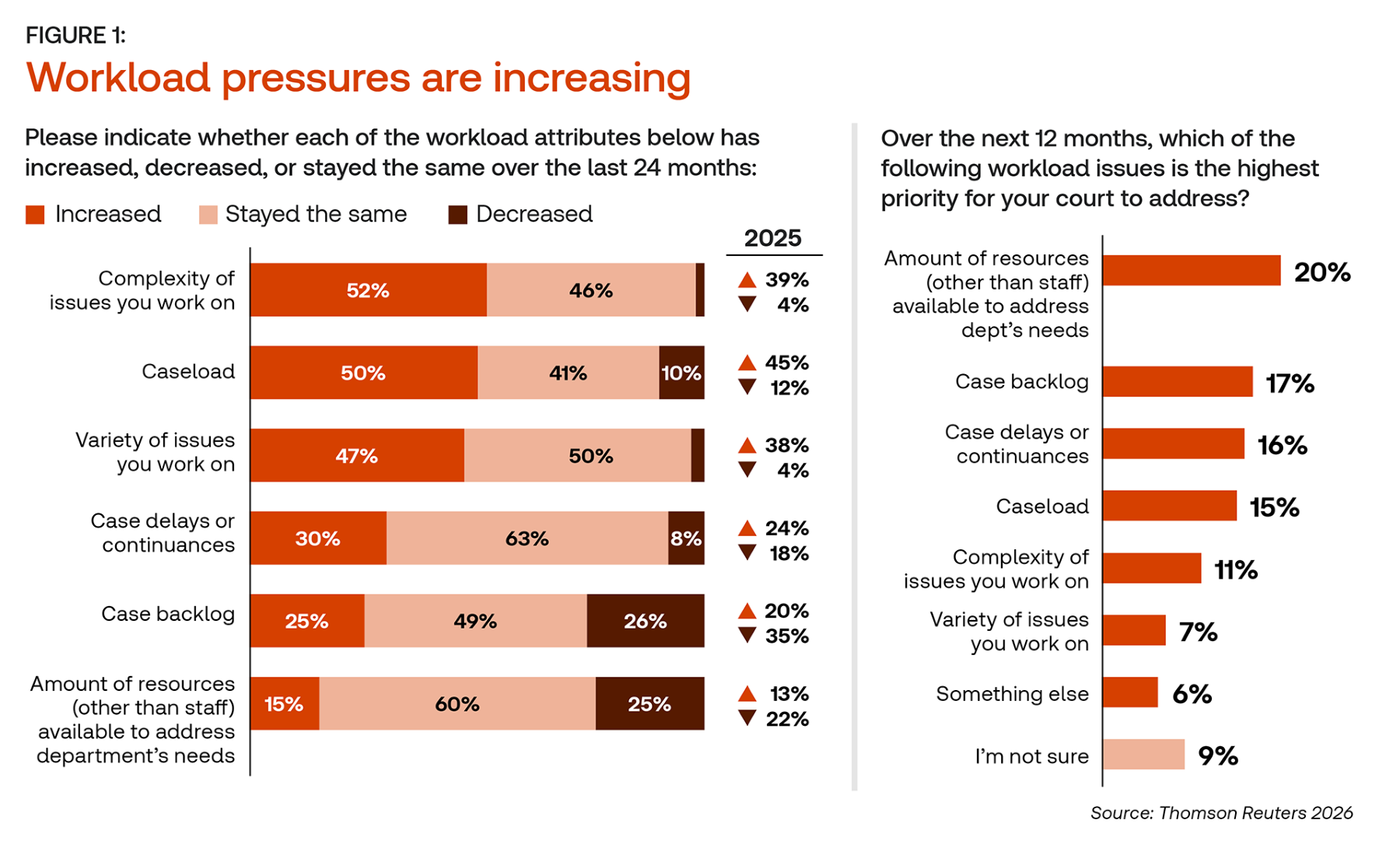
Courts are dealing with this, in many cases, with fewer resources. One-quarter of court professionals surveyed said non-staff resources have decreased in the last 24 months, while only 15% saw increases.
When asked about their highest priorities for addressing workload issues, the amount of resources (other than staff) available to address departments’ needs was the most common response. Many focus group respondents echoed that they are dealing with growing operational demands amid resource constraints.
Caseflow inefficiencies and stressors
When asked which caseflow task they consider to be the most inefficient or labor-intensive, court administration, and clerks and clerk staff chose answering questions from court users. For judges and law clerks, that came in a close second behind entering and updating data in the court management system (CMS).
The results were reversed when asked which tasks are the most stressful. Court administration, and clerks and clerk staff said data entry into CMS is their highest caseflow stressor, while judges and law clerks ranked answering questions from court users as the most stressful task.
However, there was widespread agreement on one item: data entry was ranked across the board as the most error-prone caseflow task. Because of this, automating data entry and updating for CMS represents one of the biggest opportunities for technology to improve court operations.
Other workload pressures that were mentioned include receiving and processing new case filings, calendaring and scheduling, and training and upskilling staff.
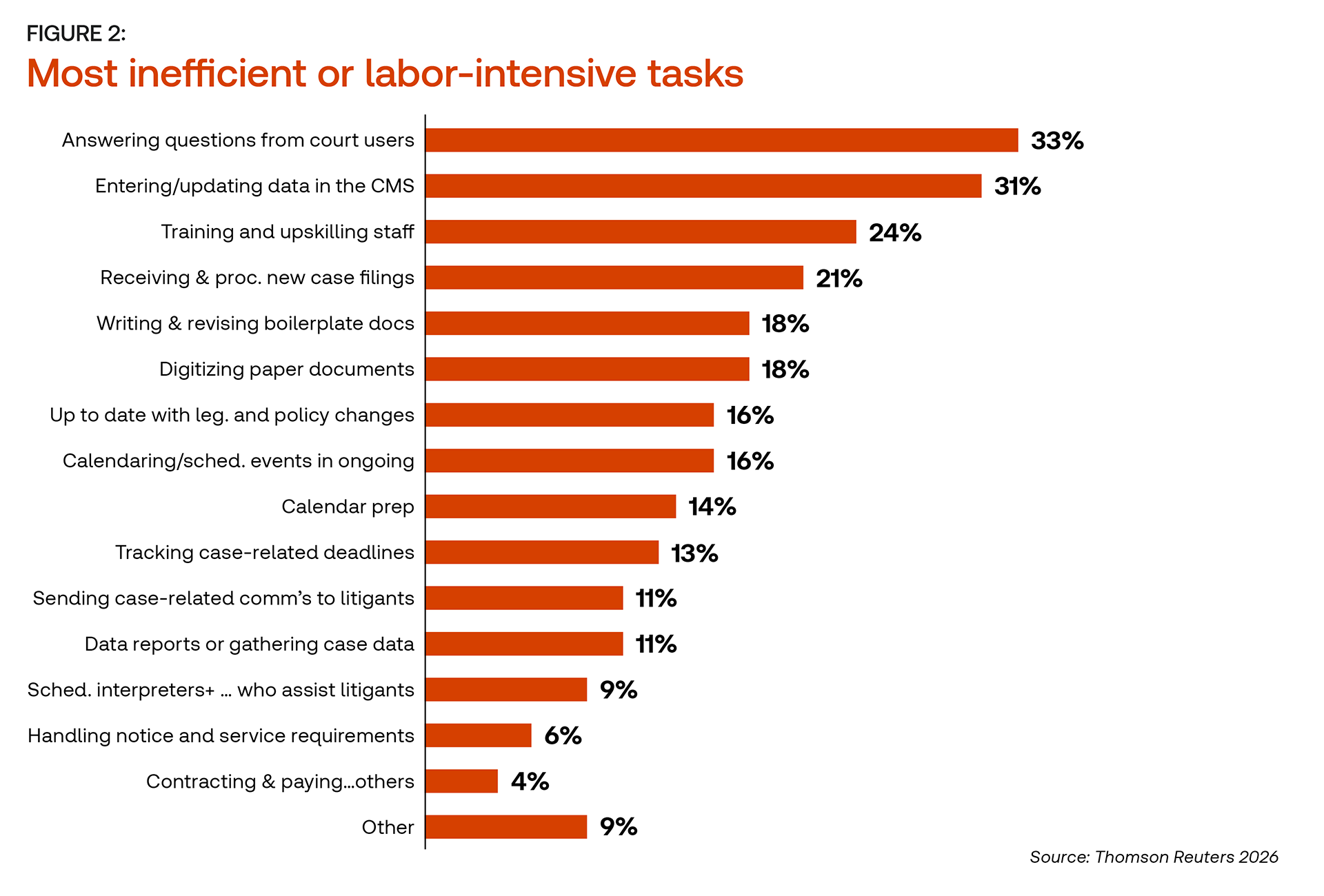
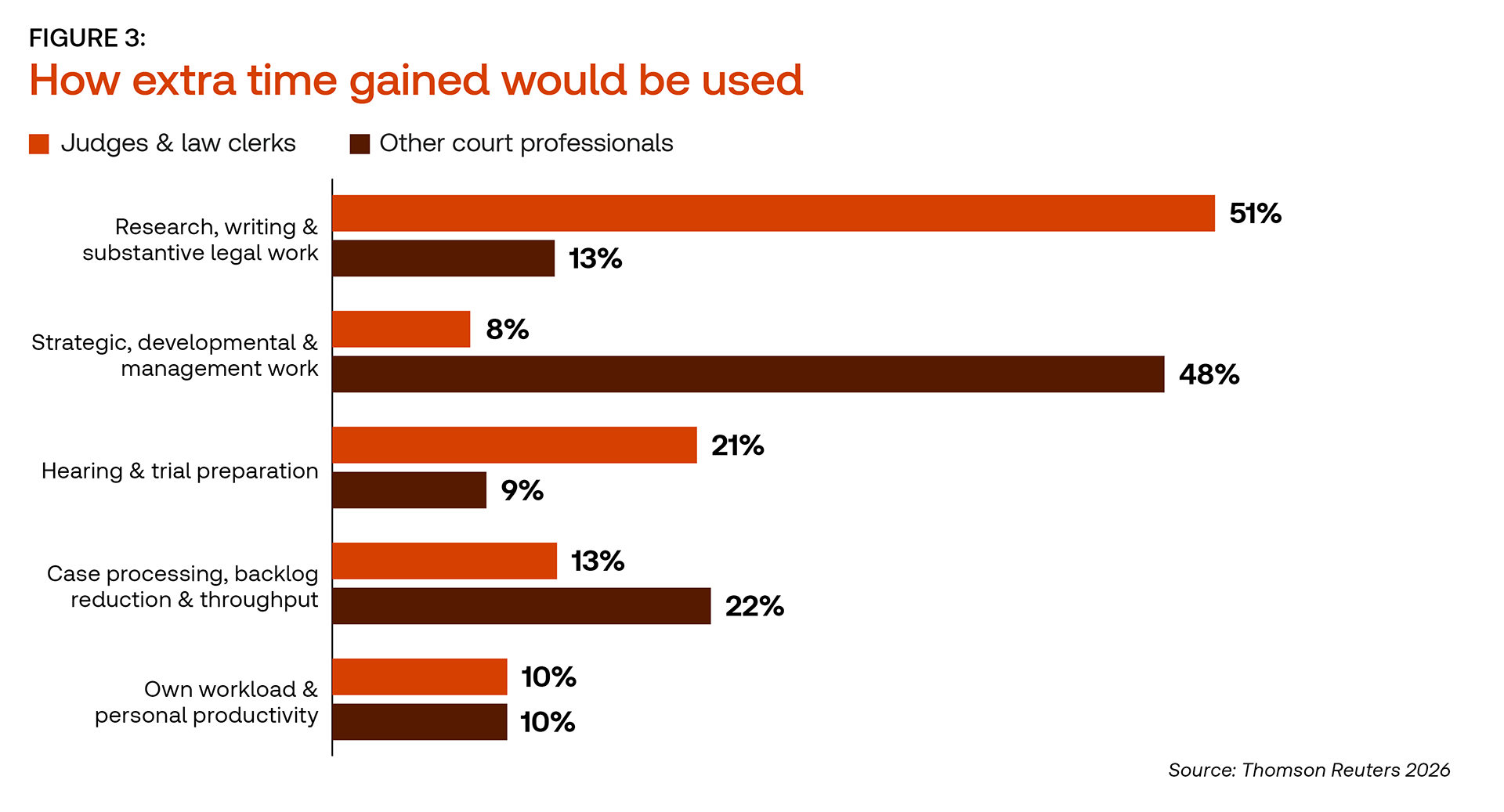
Automating these types of inefficient, repetitive, or manual tasks can improve handling of cases and free up more time for court professionals to work on administrative and higher-value tasks. One respondent said that if they could reduce or eliminate some of these inefficient tasks, “I would definitely be able to spend more time on long-range planning and more in-depth projects.”
Judges and law clerks, in particular, noted that by reducing repetitive, labor-intensive tasks, they would be able to spend more time on research, writing, and substantive legal work. Other court professionals said that they would primarily use any extra time gained to conduct more strategic, developmental, and management work.
Staff shortages are shifting
While reports of staffing shortages are decreasing overall, 59% of survey respondents said they experienced staffing shortages in the past 12 months, although that figure is down slightly from last year.
Court clerks and clerk staff, who often deal with the highest volume workloads, are the roles in which these staffing shortages are most expected to persist. Among those who reported staffing shortages during the past year, nearly three-quarters (72%) say that looking ahead, they anticipate shortages among clerks and clerk staff over the next 12 months. Additionally, respondents say those positions are currently the most difficult to recruit for and to retain talent.
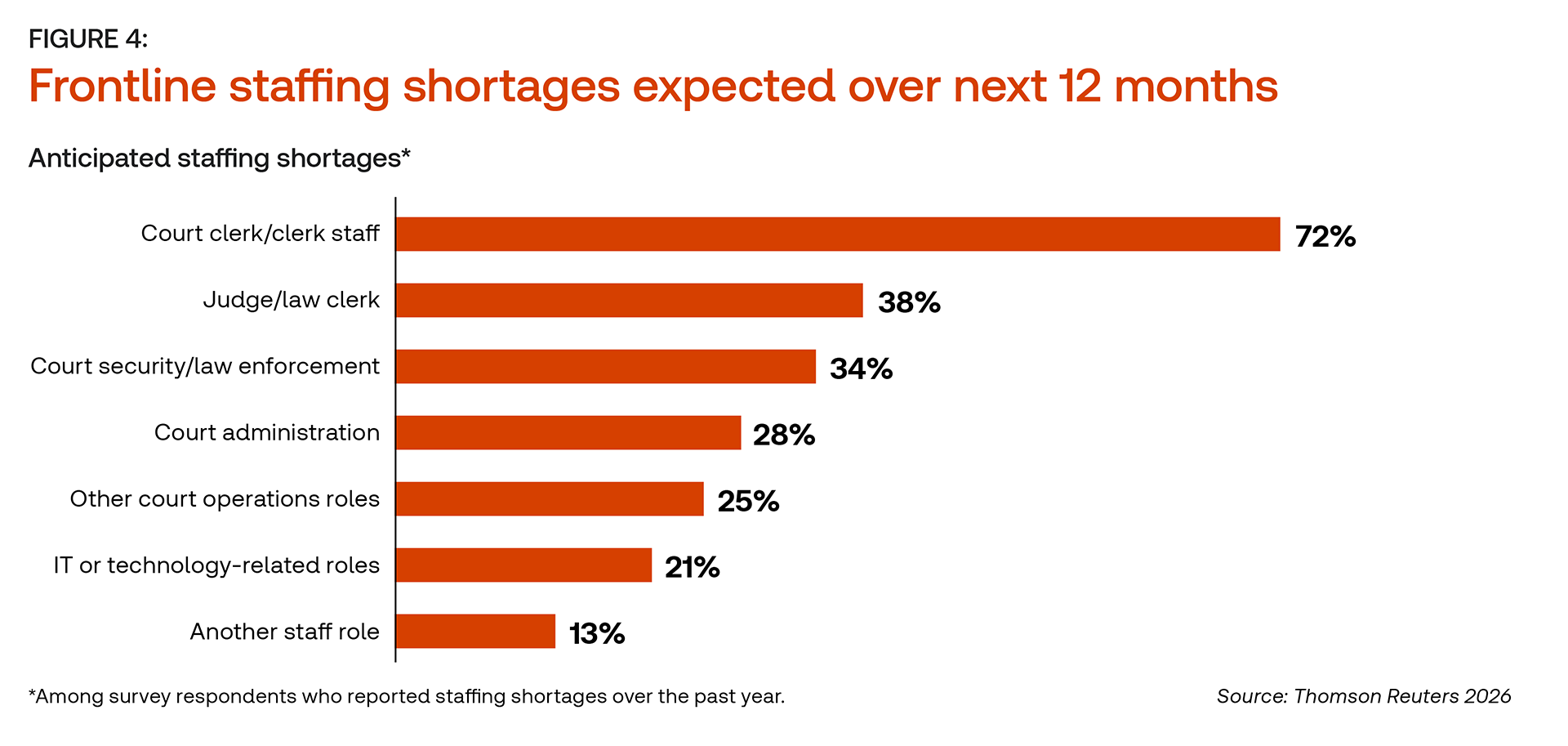
Looking further down the road, nearly three-quarters of respondents (72%) feel that shortages of skilled labor will have either a transformative, high, or moderate impact on courts over the next five years. This suggests that workforce planning will remain a top priority for courts in navigating staffing pressures in the years ahead.
AI in the courts: Its potential, opportunities and concerns
AI presents both significant opportunities and concerns for today’s courts. It holds the potential to save time, reduce the manual nature of paperwork, and give court personnel better tools for managing cases, which would ultimately help ease case backlogs and staffing shortages. However, AI also raises concerns about errors, accuracy, security, and the impact on court professionals, including worries over skills erosion.
For more information and resources on AI integration in courts, see AI Readiness for the State Courts
Are courts ready for AI?
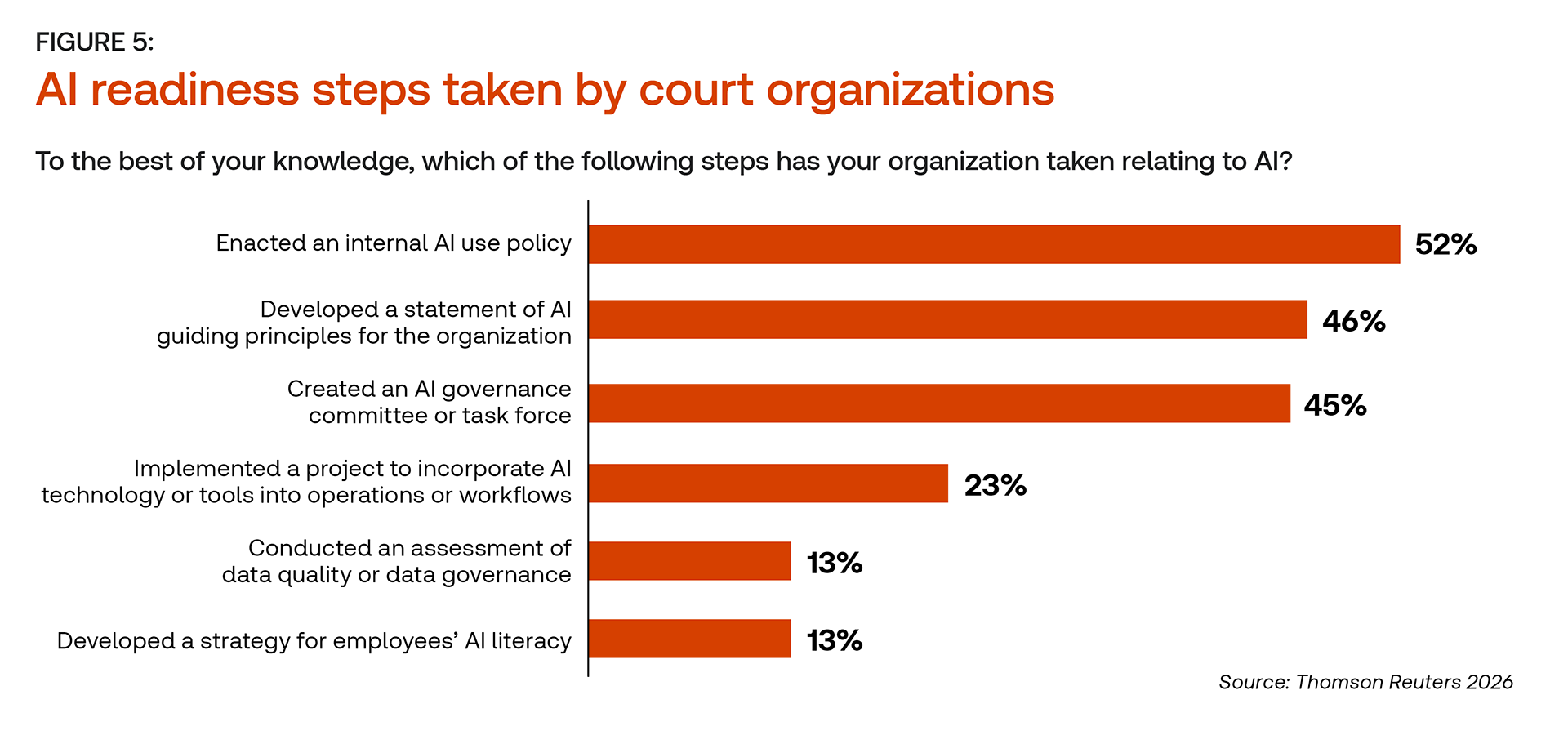
Courts are building out the necessary structures to support AI use, however much work remains to be done. About half of court professionals surveyed say their court has an AI policy, guiding principles, or a governance committee in place. About a quarter report that their court has either implemented a project to incorporate AI into workflows or operations, or plans to do so in the next twelve months. Even fewer say that their court has assessed AI data quality (13%) or has built a formal AI-literacy strategy (13%).
AI training and knowledge
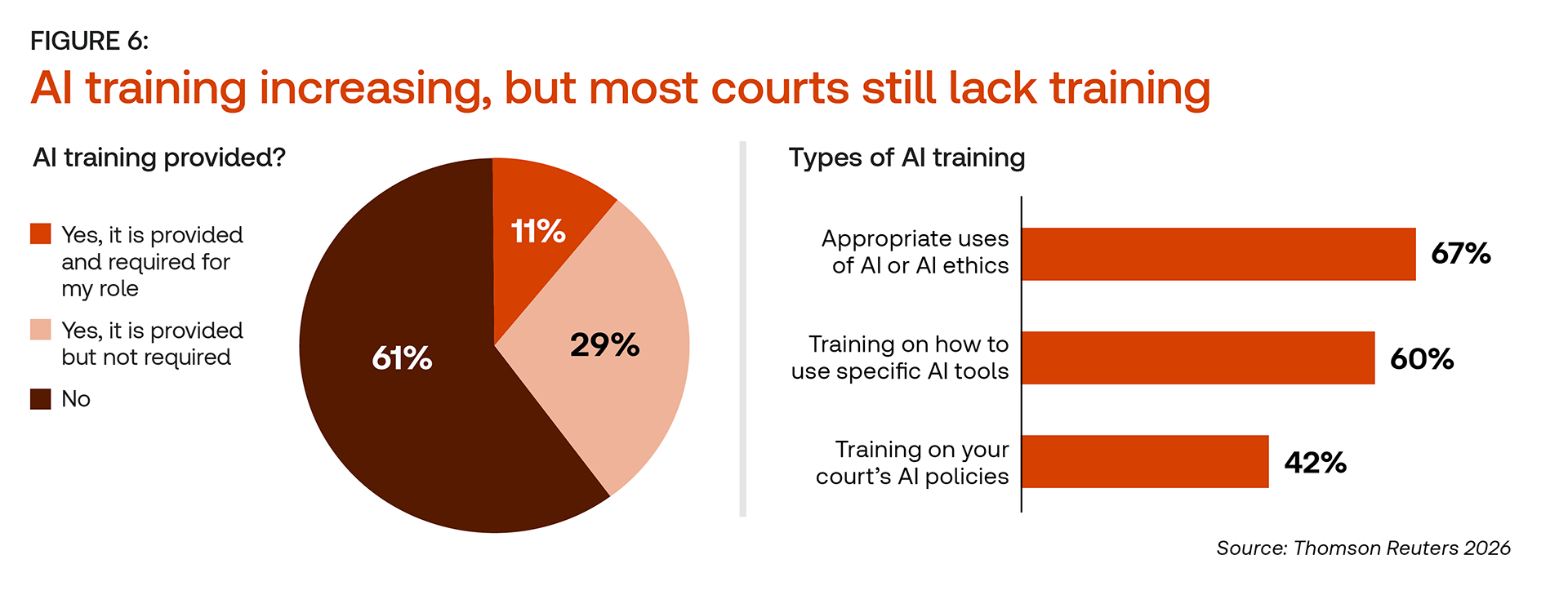
Training for court professionals is expanding — 39% of court professionals say their court provides AI training. While that is an improvement from last year, it is still a minority of respondents, leaving most respondents saying they currently lack AI training. Only 11% say that AI training is both provided and required for their role.
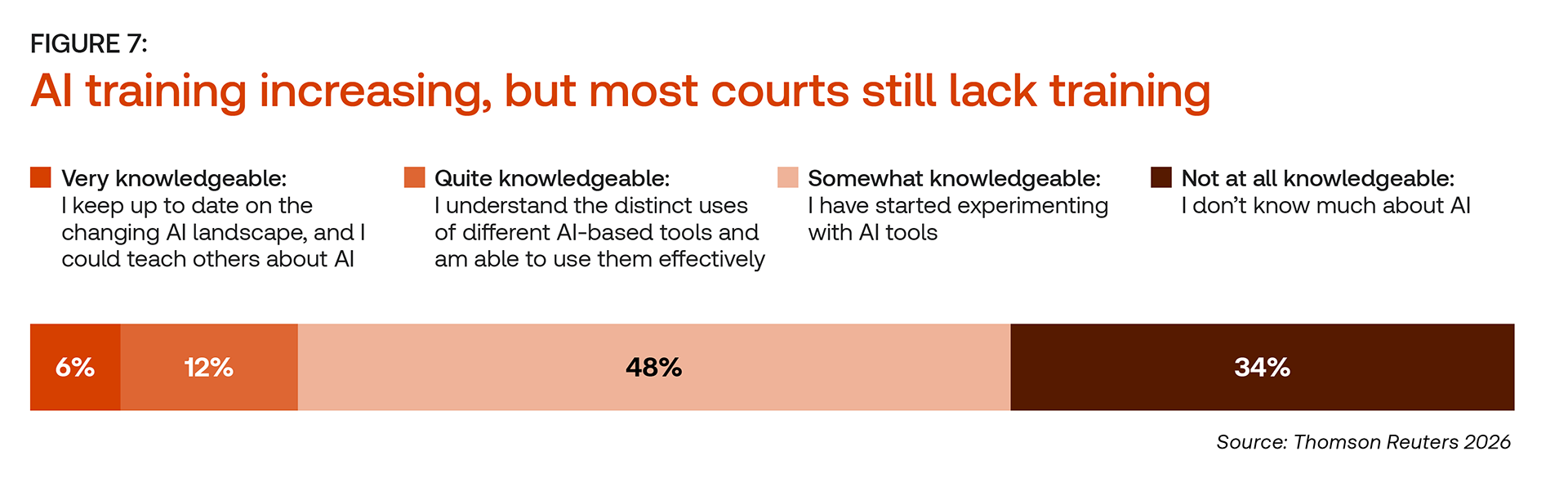
Levels of knowledge about AI among court professionals vary — 18% of those surveyed consider themselves very knowledgeable or quite knowledgeable. About half consider themselves somewhat knowledgeable and have at least begun experimenting with AI tools, leaving about one-third who feel they are not at all knowledgeable and don’t know much about AI.
Current common uses of AI
An overwhelming majority of court professionals surveyed say they are already using AI in their work in some capacity; however, they are mostly using publicly available platforms such as ChatGPT, rather than legal-specific AI tools.
Just more than 10% of respondents say that their court has integrated AI tools into their operations or workflows, and an additional 17% say their court plans to do so in the next 12 months, which is encouraging. At the same time, however, more than 7-in-10 court professionals surveyed say that AI tools have not been implemented into their operations or workflows and their court has no plans to do so in the next 12 months. While progress is being made, there is clearly much more work to be done.
Barriers to AI adoption
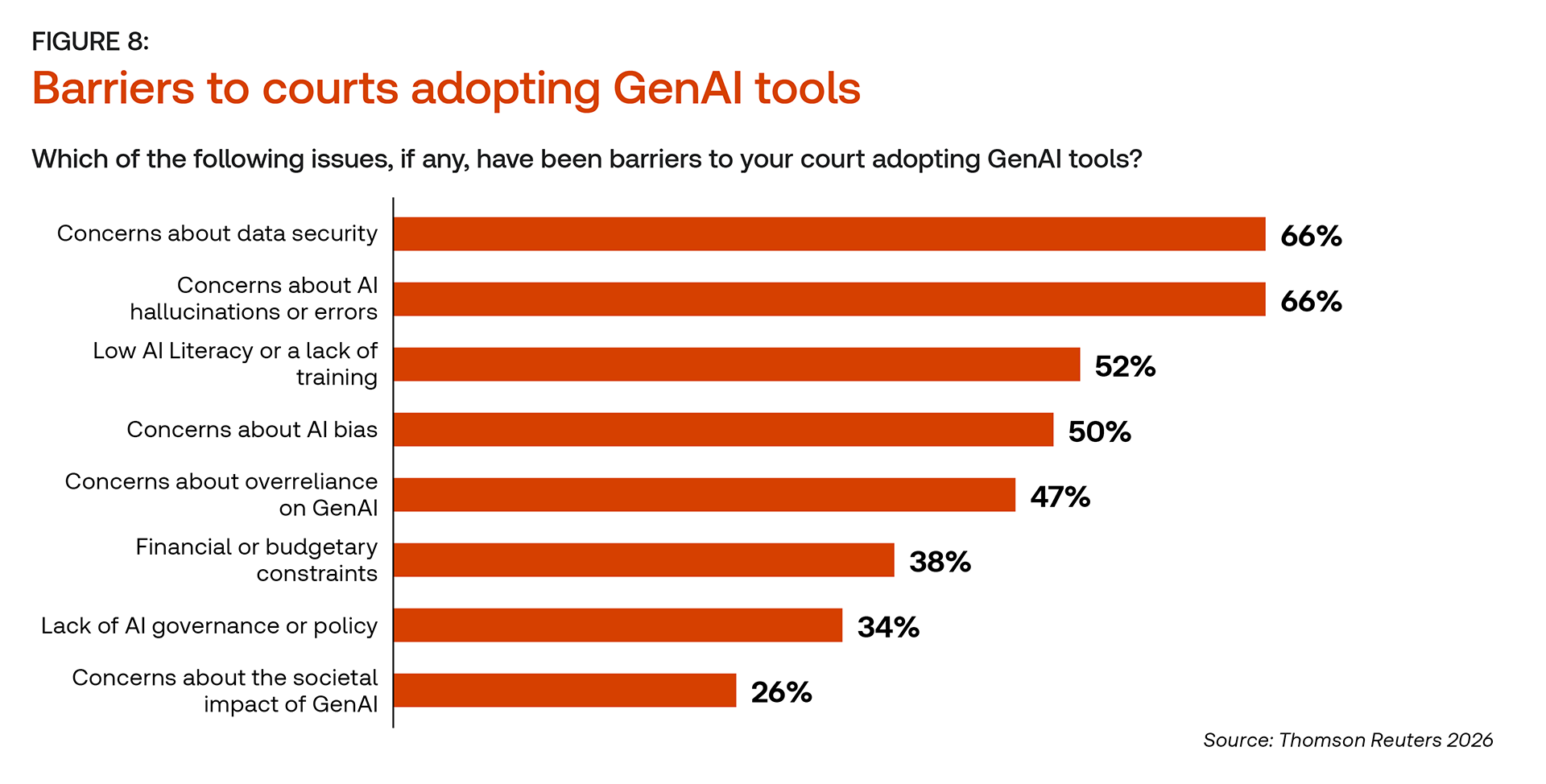
Survey respondents mentioned several issues that they consider to be barriers to court adoption of AI tools. Concerns about data security and AI hallucinations or errors are the most top of mind, mentioned by two-thirds of respondents. In addition, about half of respondents say they feel that lack of training, AI bias, and concerns about over-reliance on generative AI (GenAI) remain barriers to AI adoption.
Members of the focus group frequently mentioned that greater AI adoption will depend on training, not just access to tools, and also stressed the importance of making sure training keeps pace with rapidly evolving AI technologies.
Skills erosion is top AI concern
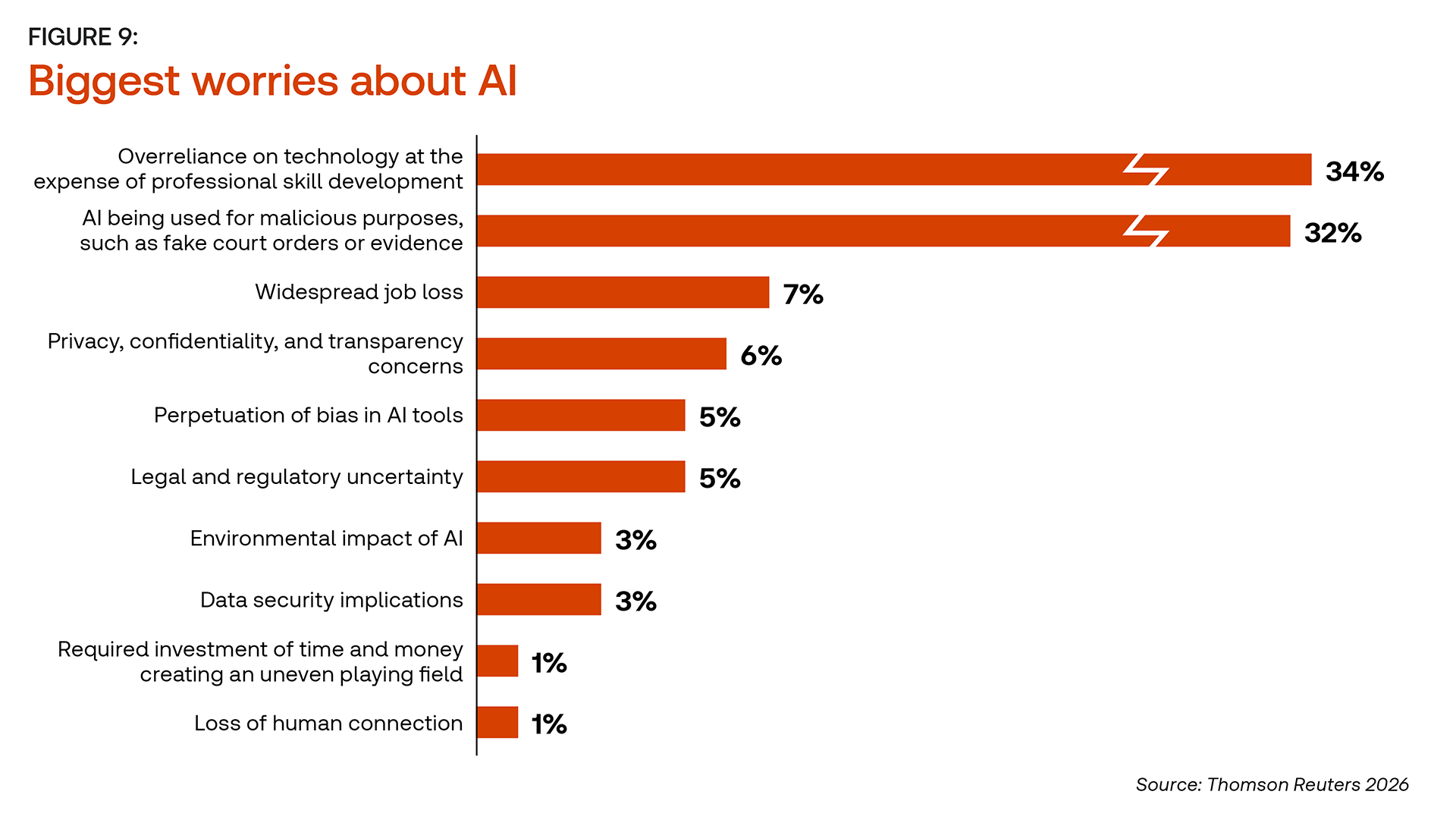
Erosion of professional skills is the top-ranked concern that survey respondents have about AI, with one-third saying that over-reliance on AI at the expense of professional skill development is the potential negative consequence of AI that worries them the most.
Following closely behind are concerns about malicious use of AI, such as fake court orders or falsified evidence. Significantly, one-third of court professionals say that the rise of AI has led to more unacknowledged uses of AI to create fake evidence, such as deepfakes, or to enhance evidence, such as in accident reconstruction.
Meanwhile, only a small portion of respondents say that widespread job loss is their biggest worry about AI. Members of the focus groups stressed that they view AI as a workload relief tool that will support staff members, not replace them. It will reduce repetitive work, help courts manage staff shortages, and shift staff time from labor-intensive tasks, such as data entry, towards more valuable work such as quality assurance.
Potential opportunities for workflow time savings
AI holds clear potential for reducing workloads and improving court operations through increased efficiency, and many courts are already realizing some of those benefits.
Among court professionals surveyed, drafting and editing documents are the most common uses of AI, with legal research being the second most-commonly mentioned use, especially by judges and law clerks. About half of judges and law clerks use AI for legal research, with an additional 24% using it for non-legal research.
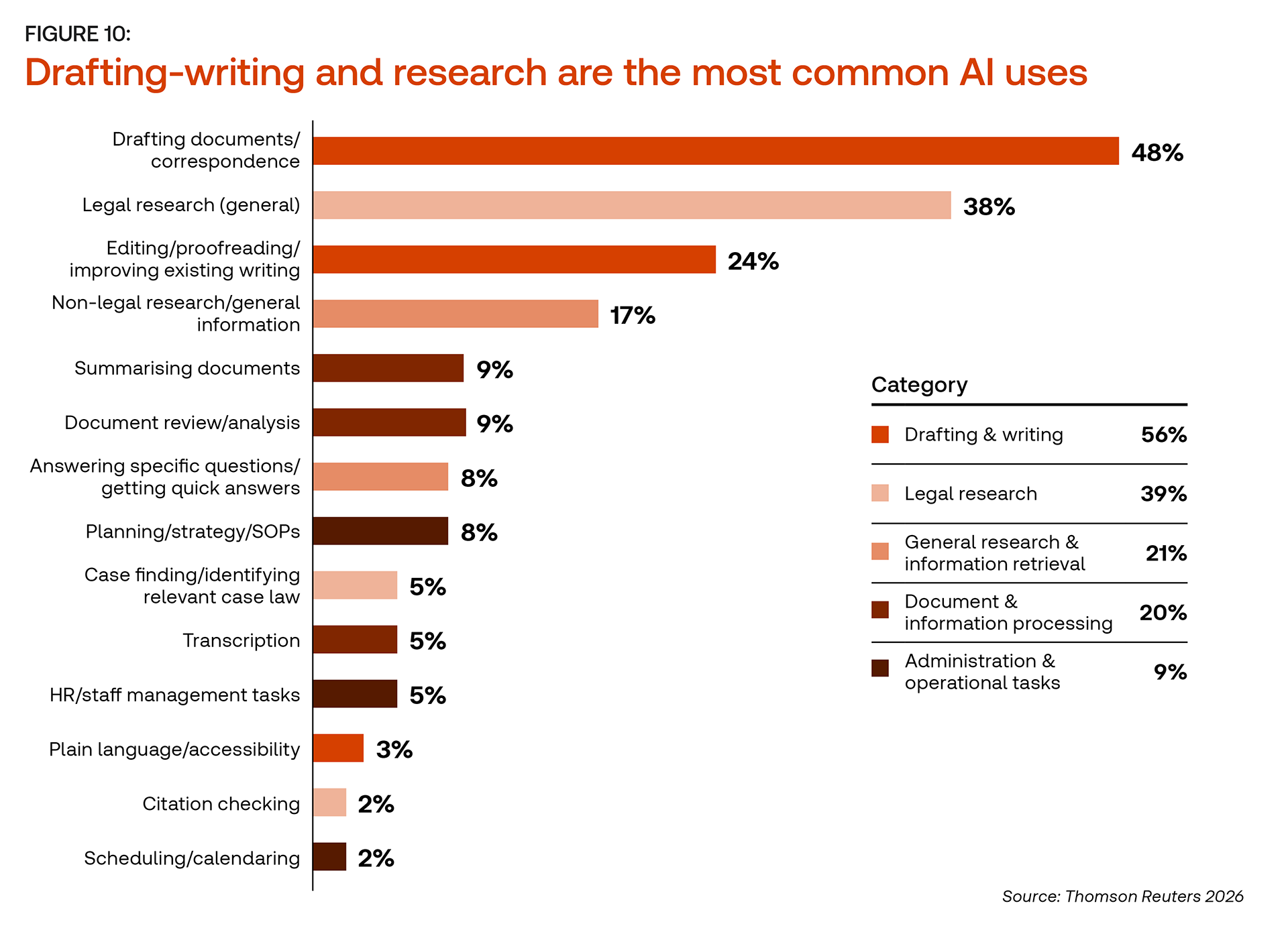
In addition, there are significant opportunities for AI to improve efficiency for other tasks. For example, scheduling and calendaring were frequently mentioned in survey results as being labor-intensive or inefficient tasks. Yet currently, only 2% of survey respondents said they are using AI to assist with those tasks.
For an in-depth look at how judges are using AI, see this report from the TRI/NCSC AI Policy Consortium.
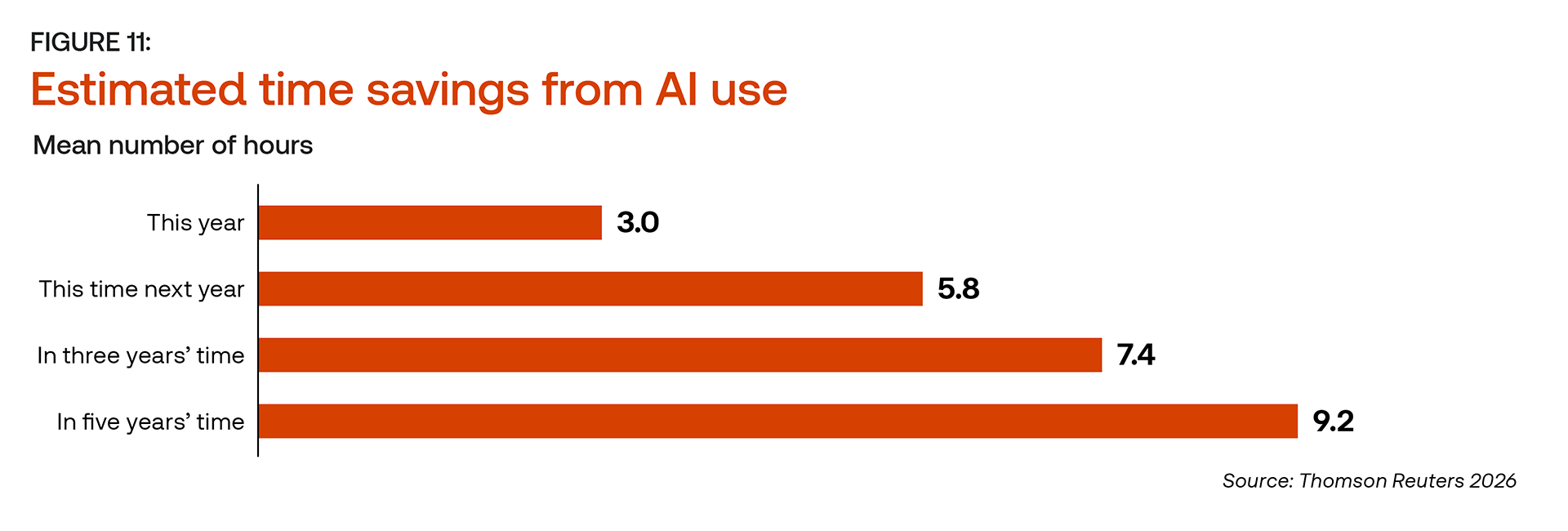
Respondents estimate that AI will save them an average of three hours per week this year; and, significantly, they expect that amount to triple, giving them more than nine hours per week within the next five years. While judges and law clerks are anticipating slightly less time savings this year than other court professionals— just over 2 hours per week — they expect that to quadruple within the next five years to eight hours per week.
Judges also say that AI is helping them manage with staff shortages. As one judge described, “I no longer have a clerk due to funding issues, so I use a combination [of AI tools] to transcribe hearings and also to analyze and compare to case law and/or statutory law.”
Survey respondents say they plan to use the newly available time for work such as strategic planning, management tasks, research, and preparation for hearings and trials. As one respondent noted, “I would definitely be able to spend more time on long range planning and more in-depth projects.”
Will AI help courts… or hurt them?
It’s clear that AI is already bringing operational benefits to courts, and additional gains of reduced workloads and case backlogs lie ahead as courts continue to integrate AI into their workflows. At the same time, however, there are challenges and concerns about AI adoption.
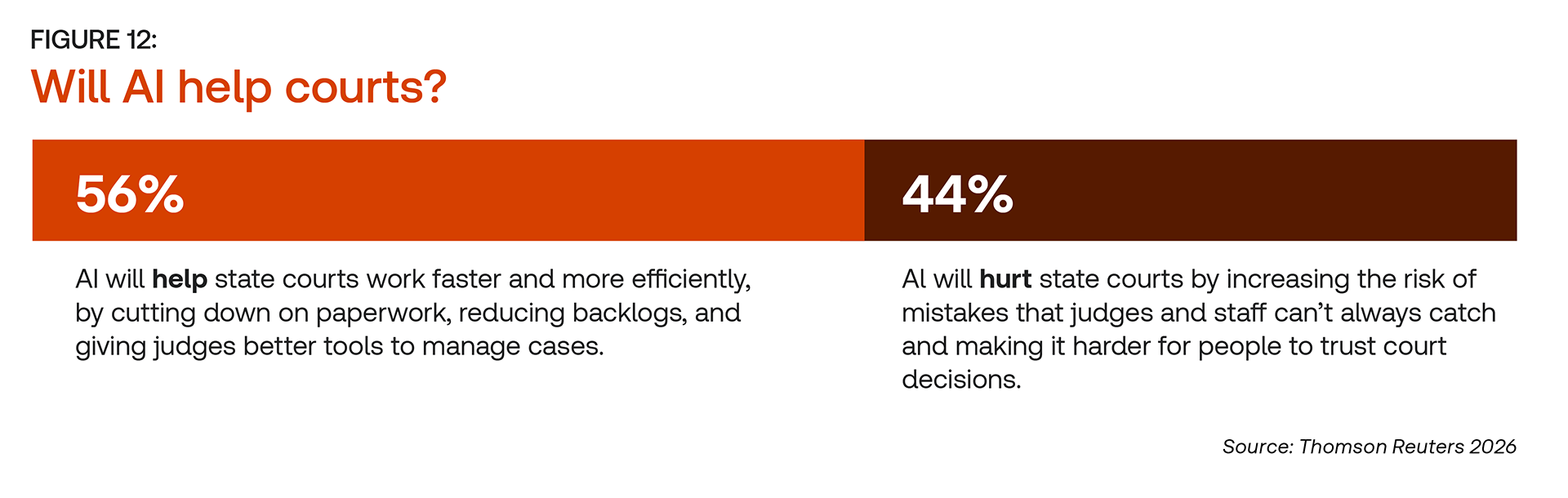
When asked to choose which statement they agree with more, a majority of survey respondents (56%) said they believe AI will help state courts, while 44% feel that AI will hurt state courts.
Virtual courts and improved access to justice
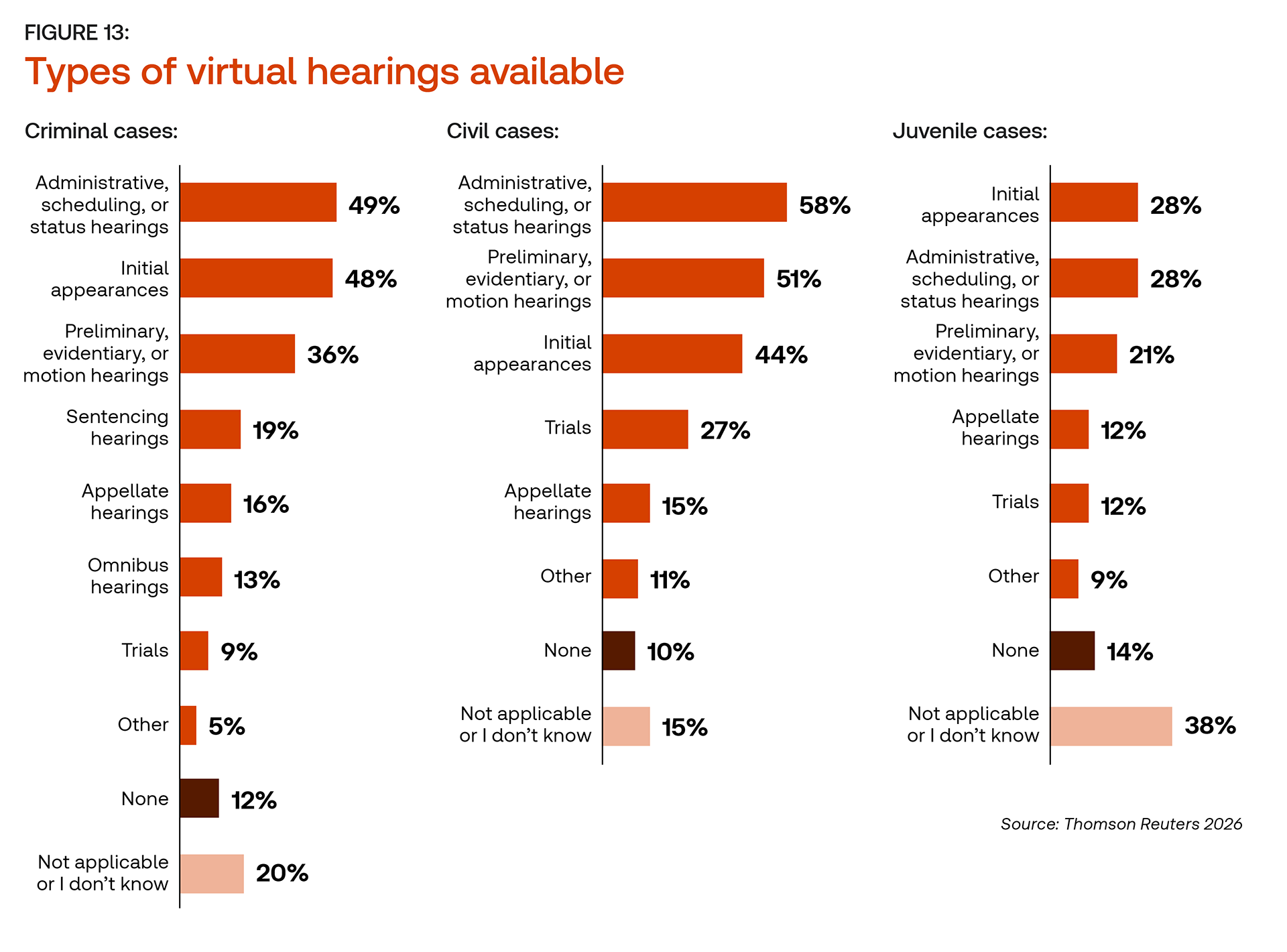
About half or more of survey respondents say their courts use virtual hearings in criminal and/or civil cases for administrative, scheduling or status hearings as well as preliminary, evidentiary, or motion hearings. More than one-quarter use virtual hearings for juvenile cases.
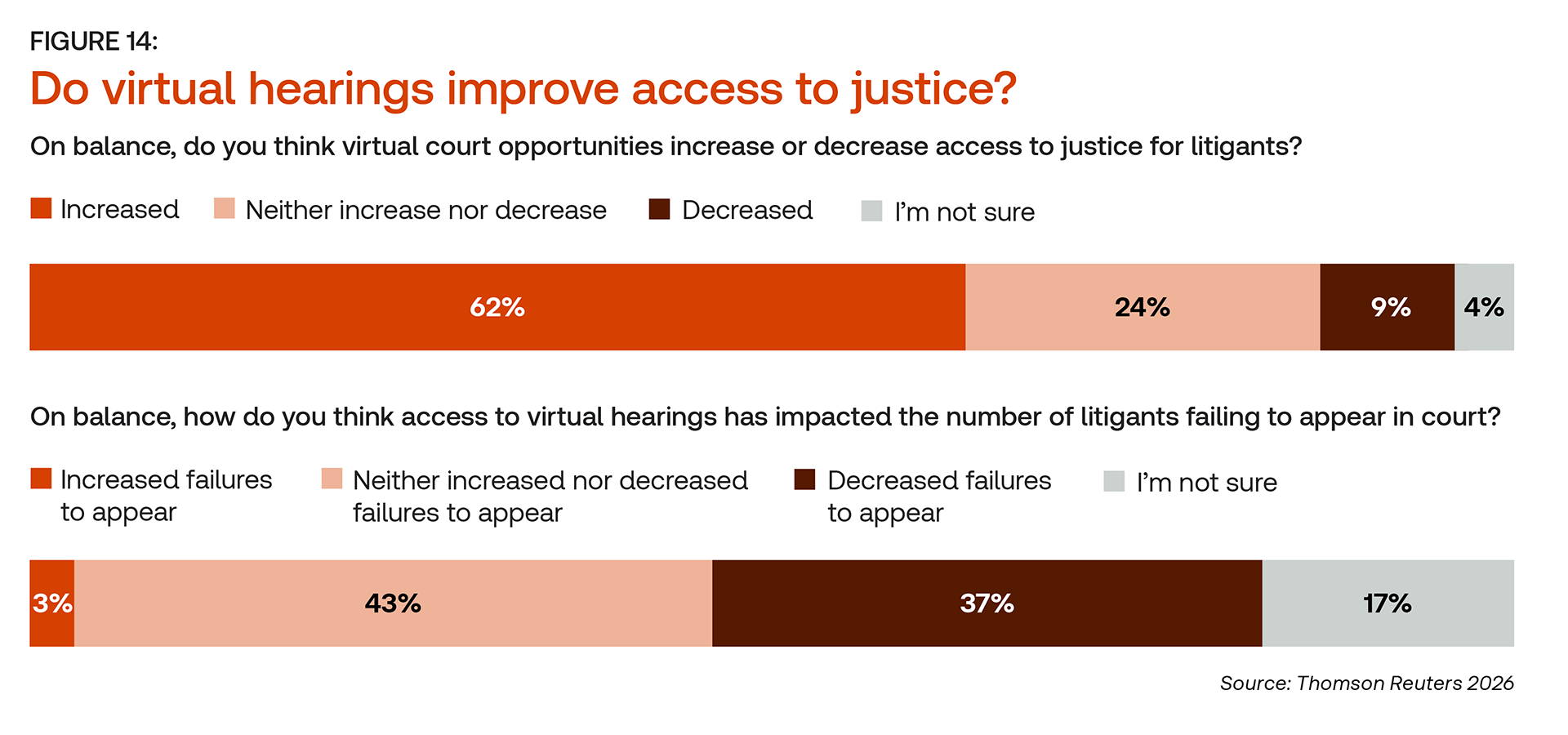
Almost two-thirds of court professionals say that virtual courts increase access to justice, and more than one-third say that virtual hearings reduce the number of litigants who fail to appear in court.
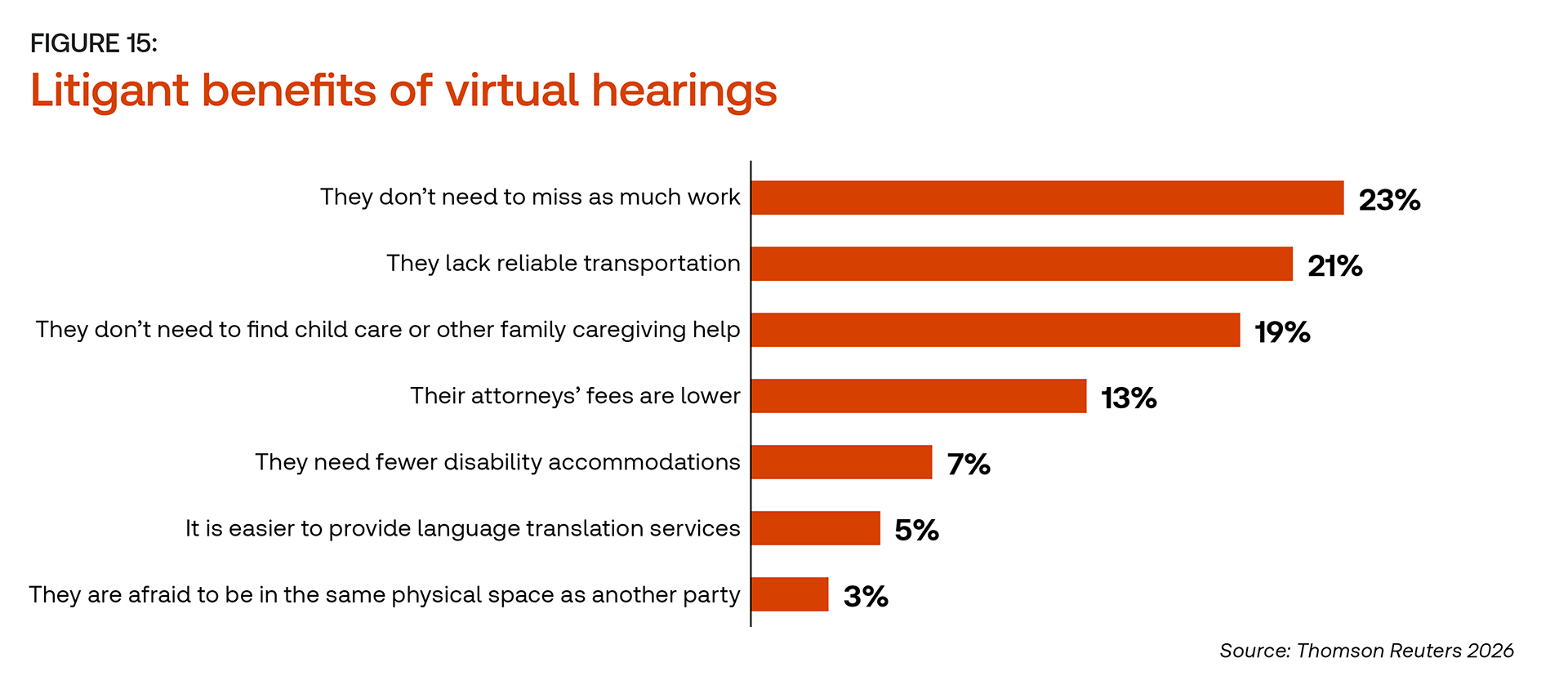
Court professionals who were surveyed mentioned several benefits of virtual hearings, including reducing litigant’s time away from work; reducing the need for transportation, child care, translation, and disability accommodations; and lowering attorney fees.
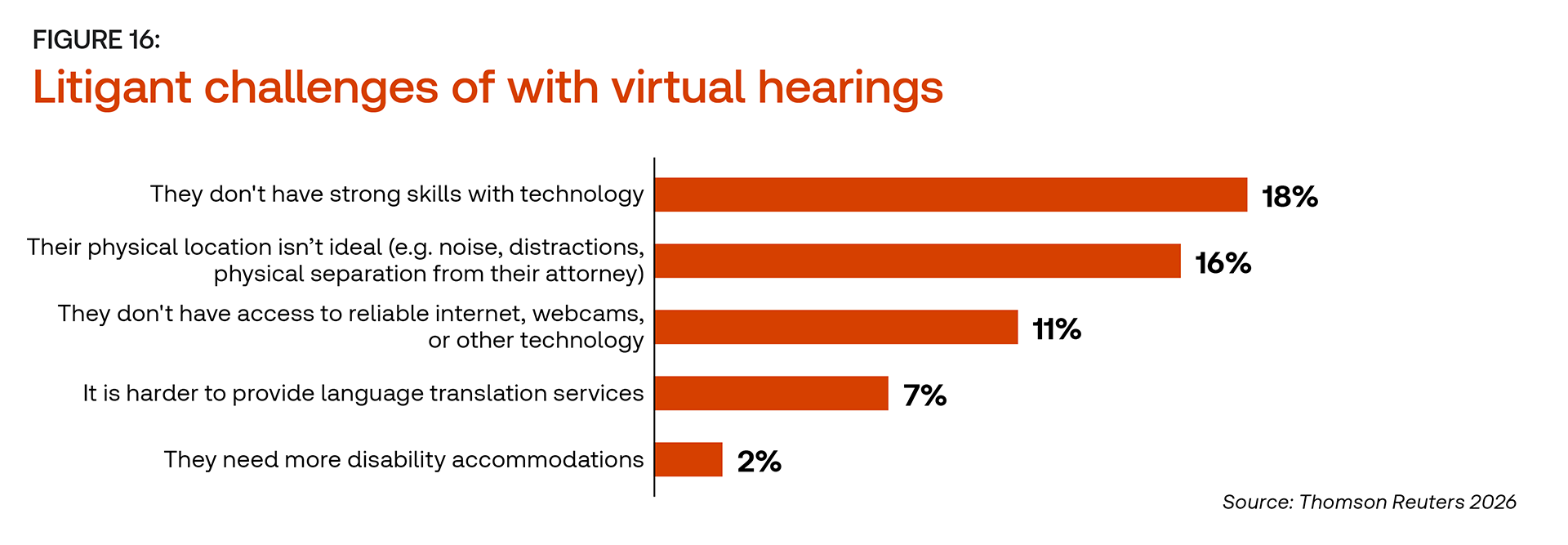
However, about one-in-ten respondents say that, on balance, virtual courts reduce access to justice. This acknowledges that some litigants face challenges that hinder their court access.
Challenges for court operations
In addition, there are still some technological needs that state courts have to address to further facilitate virtual hearings. While many of the key technical infrastructure components are now commonplace — such as e-filing, video conferencing, case management tools, calendars, and document management tools, with large portions of respondents citing their courts’ use of these innovations — many of the tools that most directly serve litigants and the public are still lacking. In fact, public-serving tools such as legal self-help portals, background checks, and online dispute resolution are used by less than half of respondents’ courts.
Another potential challenge is that focus group members say there are seeing more self-represented litigants. And almost two-thirds of survey respondents say they are seeing a larger number of filings or motions from self-represented litigants that have been written with AI or GenAI, a point echoed by the focus group.
This coincides with an overall rise in inconsistent filings and longer filings, which several focus group members and 35% of survey respondents say they attribute to the rise of AI. Despite the challenges, however, most court professionals surveyed feel that virtual courts improve access to justice.
Frameworks for action
This year’s survey and focus groups suggest that the current operational environment in state courts is equal parts challenges, transitions, and opportunities. While workload pressures are increasing, targeted management strategies and technology solutions can improve court operations.
Our research reveals insights into what separates those state courts that are making progress from those that are encountering difficulties in keeping up. Some of these insights suggest actionable steps that include:
- Redesigning workflows to address gaps — Courts may benefit from altering their workflows to prioritize personnel time toward tasks that require a human touch.
- Identifying workflow pain points first, then pursue an automated solution — CMS data entry is a common source of errors, stress, and inefficiency that along with other manual, error-prone tasks provide opportunities for courts to automate workflows and redirect staff time towards other work.
- Evaluating the scope of the court’s AI maturity — Courts currently reflect a wide range of maturity levels when it comes to AI implementation, integration into workflows, and establishment of formal training and policies. They should determine where they sit on the curve and then plan how to proceed accordingly.
- Design virtual hearings for fit, not coverage — Courts may consider codifying virtual hearings in terms of how they are used, for whom, and with what safeguards. Using person-centered design would improve understanding of who benefits, who is harmed, and what support can best bridge the gaps.
Moving courts forward into an AI-driven age
As AI technologies continue to rapidly evolve, courts are at the threshold of a new era characterized by AI-enabled court professionals and improved court operational efficiency. State courts that fail to take necessary steps to modernize are at risk of becoming increasingly reactive instead of strategic.
Courts’ overarching aims should be straightforward: redesign workflows and workforces, and implement technologies in the right places in the right ways in order to increase efficiency, improve operations, and enable courts to focus on their core mission.
Those state courts that will define the judiciary in the coming years are the ones that treat 2026 as the year they stopped planning, started executing, and began building courts that are ready for the AI-enabled future.
© 2026
Acknowledgements
Thomson Reuters Institute/National Center for State Courts AI Policy Consortium for Law & Courts
The TRI/NCSC AI Policy Consortium for Law & Courts is a joint initiative between the Thomson Reuters Institute (TRI) and the National Center for State Courts (NCSC), established to inform and educate the judiciary about the opportunities and challenges of the evolving AI landscape. The AI Policy Consortium brings together technologists, forward-leaning legal thinkers, and court leaders to discuss policy developments and responses crucial to the future of the justice ecosystem.
Visit ncsc.org/our-centers-projects/trincsc-ai-policy-consortium-law-courts for more information.
National Center for State Courts
The National Center for State Courts is a community of dedicated researchers, consultants and former practitioners who drive innovation and progress in courts and justice systems. NCSC’s reputation for trusted leadership allows us to work alongside top judicial officers to examine some of the most complex and significant issues facing society. Our team of experts and court leaders are deeply committed to advancing just, free and safe communities.
Visit ncsc.org for more information.
Thomson Reuters Institute
The Thomson Reuters Institute brings together people from across the legal, corporate, tax & accounting and government communities to ignite conversation and debate, make sense of the latest events and trends and provide essential guidance on the opportunities and challenges facing their world today. As the dedicated thought leadership arm of Thomson Reuters, our content spans blog commentaries, industry leading data sets, informed analyses, interviews with industry leaders, videos, podcasts and world-class events that deliver keen insight into a dynamic business landscape.
Visit thomsonreuters.com/institute for more details.
You can read a full copy of the report, Staffing, Operations & Technology: A 2026 Survey of State Courts, from the NCSC/TRI AI Policy Consortium for Law & Courts, here
Methodology
This report draws heavily on research conducted by the Thomson Reuters Institute and the National Center for State Courts. Using an online questionnaire, 116 state, county and municipal court judges and other court professionals were surveyed to better understand the challenges in the judicial system, especially issues around caseloads, hearings, evidence, and technology as it quickly evolves.
Respondents included judges, law clerks, court administrators, clerks and clerk staff, operations and IT/technology professionals, and other court roles. In addition to the survey, two focus groups of 15 court professionals involved in court administration, clerking, court operations, or IT and technology, were extensively interviewed.
Follow us on social
Topics
Have questions?

Featured Event
The 34th Annual Chief Marketing & Business Development Officer Forum
