
A decade ago, says the observer in 2035, enterprises raced to adopt AI, cloud, and digital transformation; but it was the ones still standing that had learned the harder truth: Survival belonged not to the most advanced, but to the most adaptive
Key insights:
- By 2035, the enterprises that survive are not the most digital, automated, or AI-driven; rather, they are the most adaptive — Cloud migration, application modernization, agile practices, and AI pilots did not guarantee enterprise resilience by 2035. Organizations endured because they redesigned themselves to respond to continuous disruption.
- The biggest weakness of digitally transformed enterprises is architectural fragmentation — Many companies entered the late-2020s with abundant data, modern platforms, and sophisticated technology stacks, but they still lacked coherent information, consistent business definitions, reusable governance, and trusted data foundations. This fragmentation created "adaptation problems" that technology alone could not solve.
- The adaptive enterprises treated data as infrastructure and architecture as a survival capability — As enterprises moved toward 2035, they saw a shift toward governed, reusable data cores, in which applications consume data, governance is embedded, AI accelerates trusted information, and architecture becomes the mechanism for continuous learning, decision-making, and enterprise response.
Now, in 2035, the conversations sound remarkably different than they did a decade ago, says the observer.
For example, executives no longer ask whether AI will transform their industries. They no longer debate whether cloud computing is the future, and they no longer speak in terms of digital transformation programs, data modernization initiatives, or technology roadmaps.
Those discussions, once dominant in boardrooms and conference halls in the mid-2020s, have largely faded into the background. Not because they were unimportant, the observer explains, but because they became irrelevant.
The illusion of digital maturity
By the middle of the 2020s, many organizational leaders said they believed they had completed their transformation journeys. Cloud migrations had been declared a success, agile methodologies had become standard practice, data lakes and analytics platforms had proliferated, and executive dashboards provided unprecedented visibility into operations. However, beneath these visible signs of progress, most enterprises remained structurally fragmented.
What many leaders interpreted as modernization was often little more than the digitization of existing complexity. Processes became faster, of course, but not necessarily smarter. Data became more abundant, but not more trustworthy. And technology ecosystems became larger, but not more coherent. The result was an enterprise environment that had been optimized for activity rather than adaptation.
Now, we can see that the organizations that ultimately survived recognized that their transformation was never about deploying technology, the observer says. Rather, their transformation was about redesigning the enterprise's capacity to respond to change.
The organizations that survived the turbulence of the 2020s eventually learned a difficult lesson — technology was never the destination. It was merely the environment in which survival would be tested.
The winners of the last decade were not the organizations with the largest technology budgets, they were not the firms that deployed the most AI models, nor were they the companies that migrated the most workloads to the cloud.
The organizations that endured were the ones that became adaptive — and that distinction changed everything.
Now, looking back from 2035, the observer notes how easy it is to forget how confident many organizations were in 2025. Most believed they were digitally transformed, and that their infrastructure had moved to the cloud. Their applications were modernized, their data platforms had been upgraded, and generative AI (GenAI) pilots had appeared across nearly every business function. Not surprisingly, technology spending reached historic levels.
However, just beneath the surface, something was fundamentally wrong. The enterprises of 2026 were larger than ever, more connected than ever, and more technologically sophisticated than ever. In 2026, leaders were continuing to operate enterprises that were designed for predictable markets, linear supply chains, stable regulations, centralized technology, and periodic planning. None of those assumptions remained true.
Figure 1: The enterprise built no longer existed
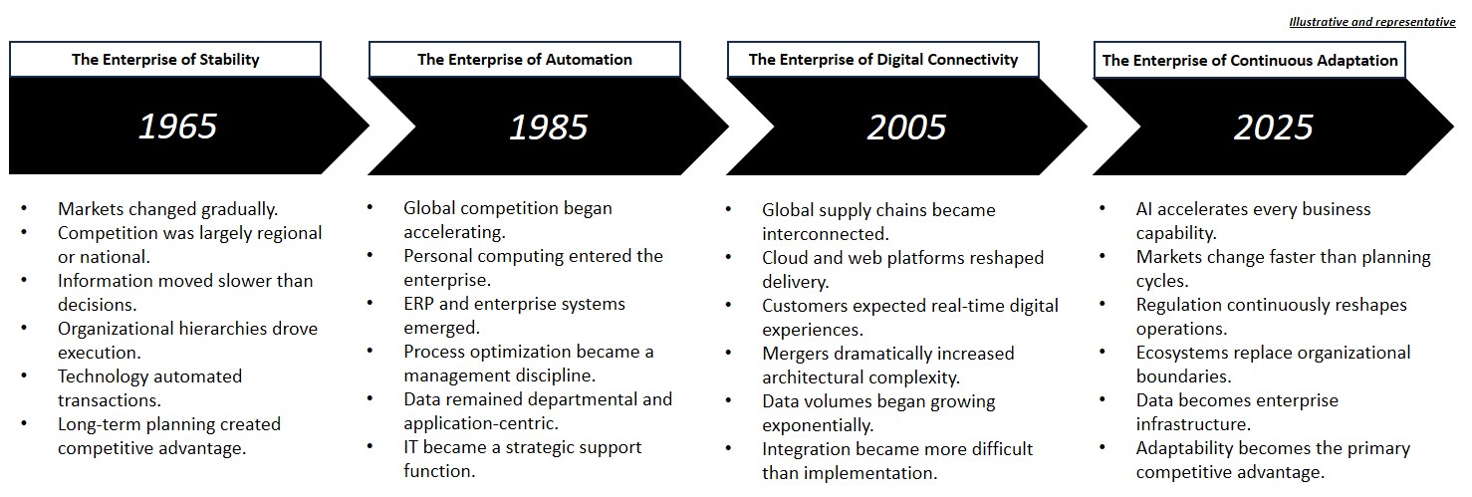
Companies were more fragmented than ever. Data existed everywhere and nowhere, business logic was duplicated across hundreds of systems, and regulatory obligations expanded faster than governance capabilities. Tragically, AI amplified these inconsistencies instead of resolving them.
Organizations generated extraordinary amounts of information, but they struggled to convert that information into coherent action. Most leaders interpreted these symptoms as technology problems, but they were not. They were architecture problems.
More specifically, they were adaptation problems. The underlying challenge, we later learned, was not the inability to generate information; rather it was the inability to organize, govern, understand, and act upon information consistently as conditions changed.
The enterprises of 2025 were optimized for efficiency within stable environments; but the enterprises of 2035 would need to thrive amid continuous disruption. Those are fundamentally different design objectives.
When change became the operating model
The decade from 2025 to 2035, became known by many strategists as the “Great Compression”, in which economic volatility accelerated, regulatory expectations expanded globally, and AI systems became embedded into virtually every operational process.
Driving the Great Compression decade forward was global disruption that saw supply chains shift repeatedly, climate events alter risk calculations, cybersecurity threats evolve from episodic concerns into persistent realities, demographic changes transform labor markets, and geopolitical tensions reshape trade relationships.
The convergence of these forces exposed a weakness that traditional management practices struggled to address.
Figure 2: 5 forces that redefined enterprise survival
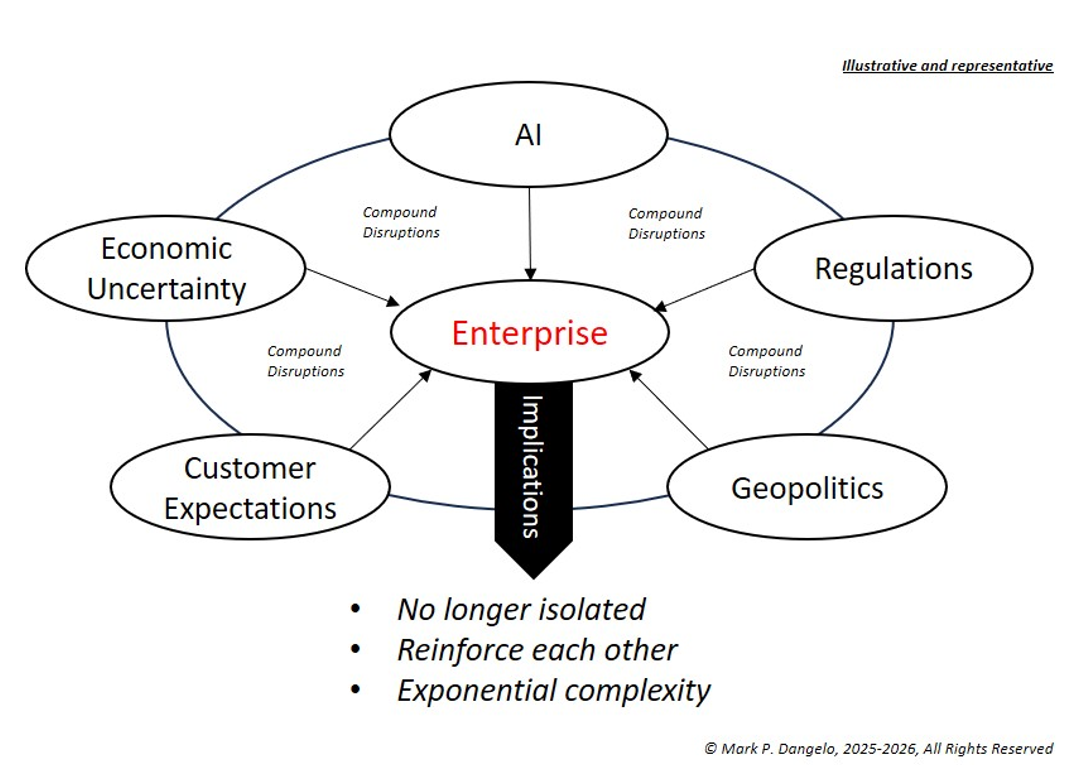
Most enterprises — having been designed around assumptions of relative stability — now encountered simultaneous disruptions across every dimension of the business. Market conditions shifted before strategic plans could be completed, and customer behaviors changed faster than product roadmaps could respond.
Competitive advantage increasingly belonged not to the organizations with the best plans, but to the organizations capable of revising their plans most rapidly. Organizations discovered that the pace of change was no longer episodic — change itself had become the operating condition. For many enterprises, this realization arrived too late.
Some organizations attempted to respond through increasingly large transformation programs. Others doubled down on application modernization. Many invested billions of dollars into AI, while leaving their underlying data ecosystems largely unchanged.
The results were predictable. AI accelerated those decisions built upon fragmented information. Compliance costs continued to rise, and operational complexity increased. Technology debt accumulated faster than organizations could retire it.
Figure 3: Technical debt is only one kind of debt
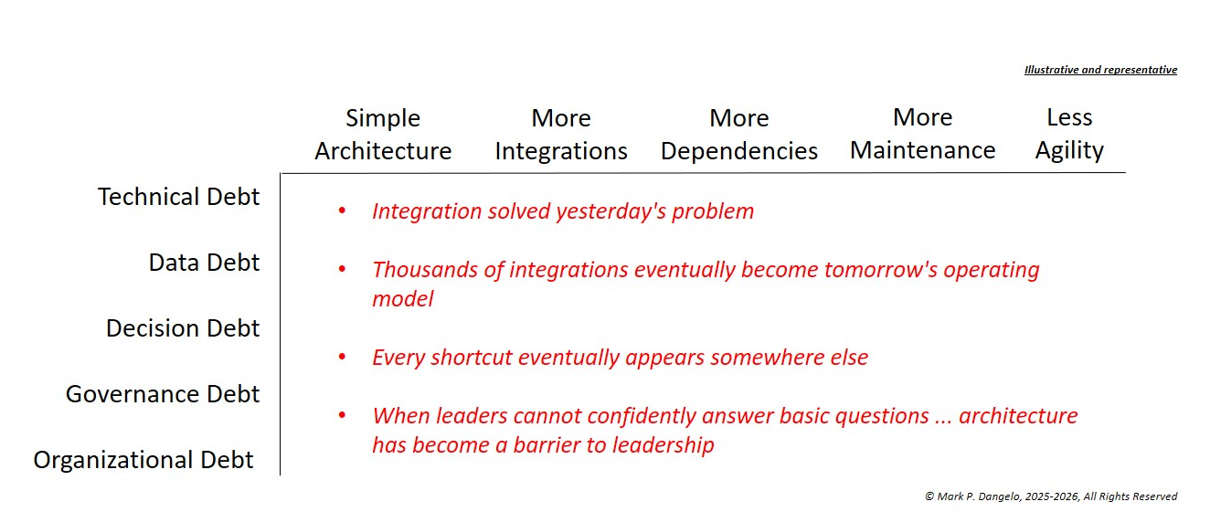
By 2020, the promise of intelligence collided with the reality of incoherence, and the gap widened, the observer explains.
The emergence of the adaptive enterprise
The organizations that survived followed a different path. Instead of asking how to deploy more technology, they asked a more fundamental question: "How do we become more adaptive?”
That question shifted the focus away from systems and toward architecture. Away from projects and toward capabilities, and away from technology and toward economics. This shift represented the beginning of what became known as the “Data Core” era.
Rather than viewing data as an output of applications, leading organizations began treating data as enterprise infrastructure in which data became the organizing construct, applications became consumers, and processes became participants. In this way, AI became an accelerant, governance became embedded, and measurement became continuous. Indeed, the architecture itself evolved into a living system.
The most successful enterprises eventually abandoned the notion that architecture existed primarily to support technology. Instead, architecture became the mechanism through which organizations coordinated learning, governance, intelligence, and execution.
This shift produced an entirely different operating model. Information was no longer trapped inside applications. Business meaning became portable, and governance became reusable. AI models became easier to deploy because trusted data products already existed. Integration shifted from a custom engineering challenge to a managed capability. The enterprise itself began functioning less like a collection of independent systems and more like an interconnected adaptive organism.
Of course, this transition did not occur overnight. It required a fundamentally different way of thinking; but by 2035, the most adaptive organizations designed systems around data.
The difference sounds subtle, the observer says, but it was transformational.
From architecture framework to survival design
This was the environment in which AXTent, an adaptive data-centric approach to deliver economic outcomes, emerged from concept into operational reality. When the framework was first introduced, many viewed it as another architectural, system-focused methodology.
However, AXTent reframed the discussion around a more fundamental question, “What is the economic value of reducing the cost of change?” This adaptation required coherence; thus, an enterprise could not respond effectively to changing conditions when information was fragmented across disconnected domains; and it could not optimize operations when decision-making was based on conflicting versions of reality.
AXTent addressed this challenge by introducing a common architecture capable of organizing enterprise information into a governed, reusable, measurable Data Core. This was never about centralization, nor was it about control; rather, it was about creating enough architectural coherence to enable continuous adaptation.
Figure 4: The enterprise was no longer a machine
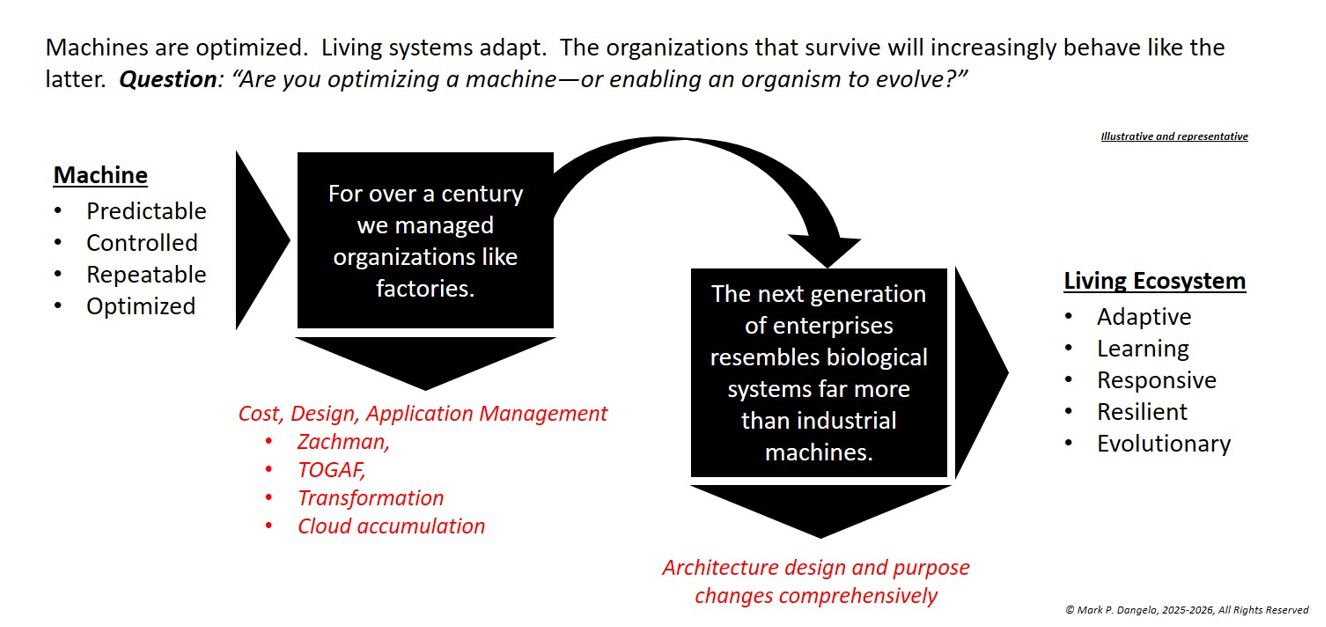
The Data Core became the nervous system of the enterprise. Not because it stored everything, but because it connected everything. As organizations adopted these principles, a fascinating pattern emerged. The greatest benefits were not technological, they were economic.
Executives initially invested in Data Core initiatives to improve governance, reduce duplication, and support AI. Those benefits materialized, but the more important outcome was organizational adaptability. Decision cycles shortened dramatically, regulatory response times improved, integration and data acquisition costs declined, and operational friction decreased.
The cost of change itself began to shrink, the observer notes.
Measuring the economics of adaptation
One of the most important developments of the early 2030s was the emergence of adaptation metrics as executive performance indicators. For decades, organizations measured efficiency, productivity, revenue growth, and profitability. And while these were valuable metrics, they offered little insight into how effectively an enterprise could respond to disruption.
Thus, as the observer explains, new measures began emerging, such as time-to-regulatory-response, time-to-integrate acquisitions, and time-to-deploy trusted data products. Also, more complex measures, such as AI deployment velocity, data reuse ratios, and decision latency. Of course, enterprise observability coverage and the cost of change were measured too.
Collectively, these metrics revealed a powerful truth, the observer says. The most adaptive organizations consistently outperformed their peers across both growth and resilience measures. Adaptability was no longer viewed as a cultural attribute, rather it became an operational capability that could be measured, managed, and improved.
Figure 5: The hidden economics of architecture

This realization fundamentally changed executive investment priorities. Architecture became recognized as a strategic asset capable of producing measurable economic returns and was no longer evaluated solely as a technology expense.
For the first time, architecture could be directly connected to enterprise economics. Indeed, the observer notes, this was one of the most significant strategic discoveries of that decade. Truly adaptive organizations began measuring something else: Adaptability. Not as a slogan, but as a quantifiable capability. Organizations increasingly evaluated themselves using metrics such as decision velocity, data trustworthiness, reusability, and integration efficiency. They also put a heavy emphasis on monitoring their regulatory readiness, operational resilience, AI readiness, and economic agility.
Together these measures formed a new category of enterprise performance known as adaptive capacity. Since the 2030s, the observer explains, adaptive capacity has become one of the strongest predictors of long-term success.
Coherence becomes competitive advantage
Analysts, looking back a decade from 2035, struggled to explain why organizations with similar technology investments produced dramatically different outcomes. Then, they saw a pattern emerge over time. Success, the analysts saw, correlated less with technology acquisition and more with information coherence.
Enterprises that maintained consistent business definitions, governed reusable data assets, and embedded observability into their operations adapted more rapidly than those relying upon fragmented architectures. Coherence became the foundation upon which resilience, innovation, governance, and AI effectiveness were built.
By the early 2030s, the distinction between leaders and laggards became increasingly obvious. The leading organizations shared common characteristics, such as possessing a coherent Data Core and governing information consistently. These leaders treated architecture as an economic discipline and embedded observability throughout their ecosystems while continuously measuring outcomes. Overall, they viewed AI as a capability enabled by architecture rather than a substitute for it.
Most importantly, they embraced adaptation as a permanent responsibility. The laggards followed a different trajectory as many continued operating through fragmented environments assembled over decades. Lacking coherence, the laggards’ adaptation became increasingly difficult.
Architecture moves into the boardroom
By the late-2020s, many organizations had delegated architecture decisions to technical teams, while strategic decisions remained concentrated within executive leadership, the observer says, adding that this separation increasingly proved unsustainable.
Every strategic initiative eventually encountered the same limiting factor — the organization's ability to access, trust, govern, and operationalize information.
As a result, architecture evolved from a technical specialty into a board-level concern with directors increasingly evaluating data governance, AI readiness, regulatory resilience, and integration capabilities as indicators of long-term enterprise health.
The question was no longer whether architecture mattered; rather, it became whether leadership understood the economic consequences of poor architecture.
Figure 6: Architecture as a competitive differentiator
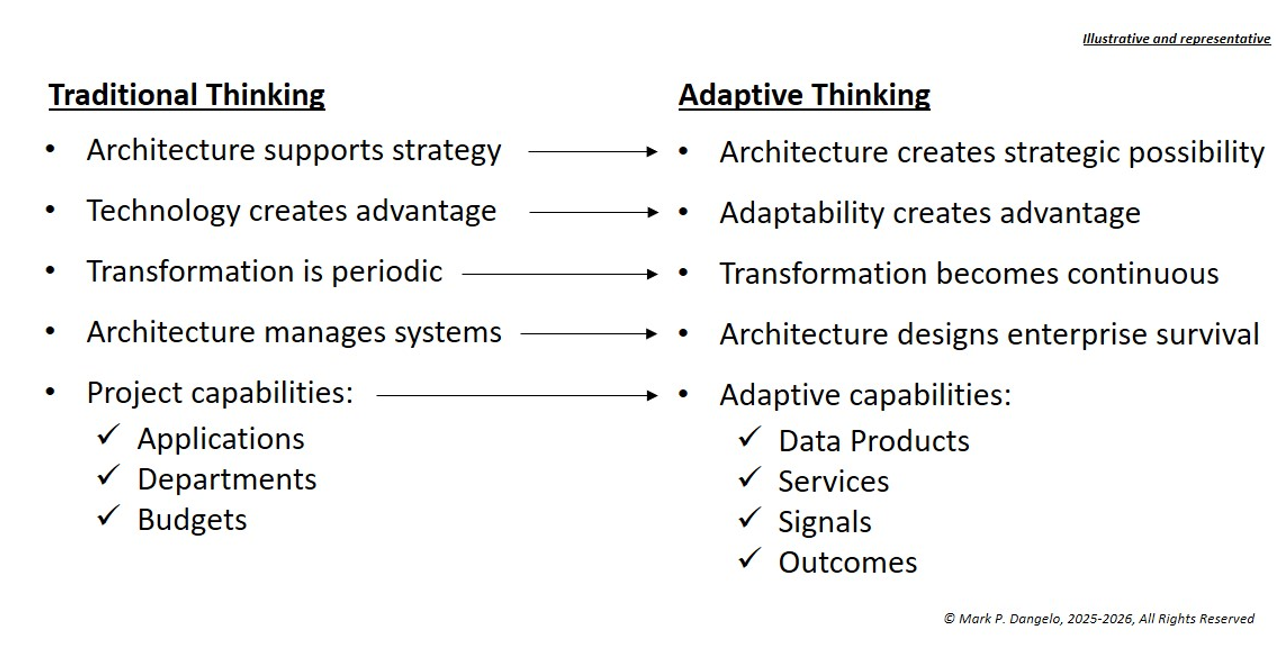
Perhaps the most surprising lesson of the decade involved leadership. Throughout much of the early 21st century, technology strategy was frequently delegated, and architecture became an IT concern, data became a technical issue, and governance became a compliance function.
By 2035, those distinctions had largely disappeared, the observer notes. The most successful CEOs understood something their predecessors often overlooked: Architecture is leadership — and it cannot be easily copied by competitors.
The structure of an organization’s information determines the structure of its decision-making, which determines its speed of adaptation and ultimately, its survival. In other words, enterprise architecture became inseparable from enterprise strategy.
This realization elevated architecture from an operational discipline to an executive responsibility. The organizations that survived by 2035 were led by executives who understood that adaptive advantage could not be purchased — it had to be designed.
AI becomes an amplifier of architecture
The AI enthusiasm of the mid-2020s produced a valuable lesson, the observer says. Organizations learned that intelligence without coherence often creates acceleration without direction. Early AI deployments frequently brought up contradictory recommendations, inconsistent outcomes, and governance challenges because the underlying information environments remained fragmented.
Over time, enterprises realized that AI effectiveness correlated less with model sophistication and more with the quality, trustworthiness, and accessibility of the information ecosystem that was supporting those models. AI ultimately became the beneficiary of architectural maturity rather than its replacement.
Figure 7: The enterprise’s architectural nervous system
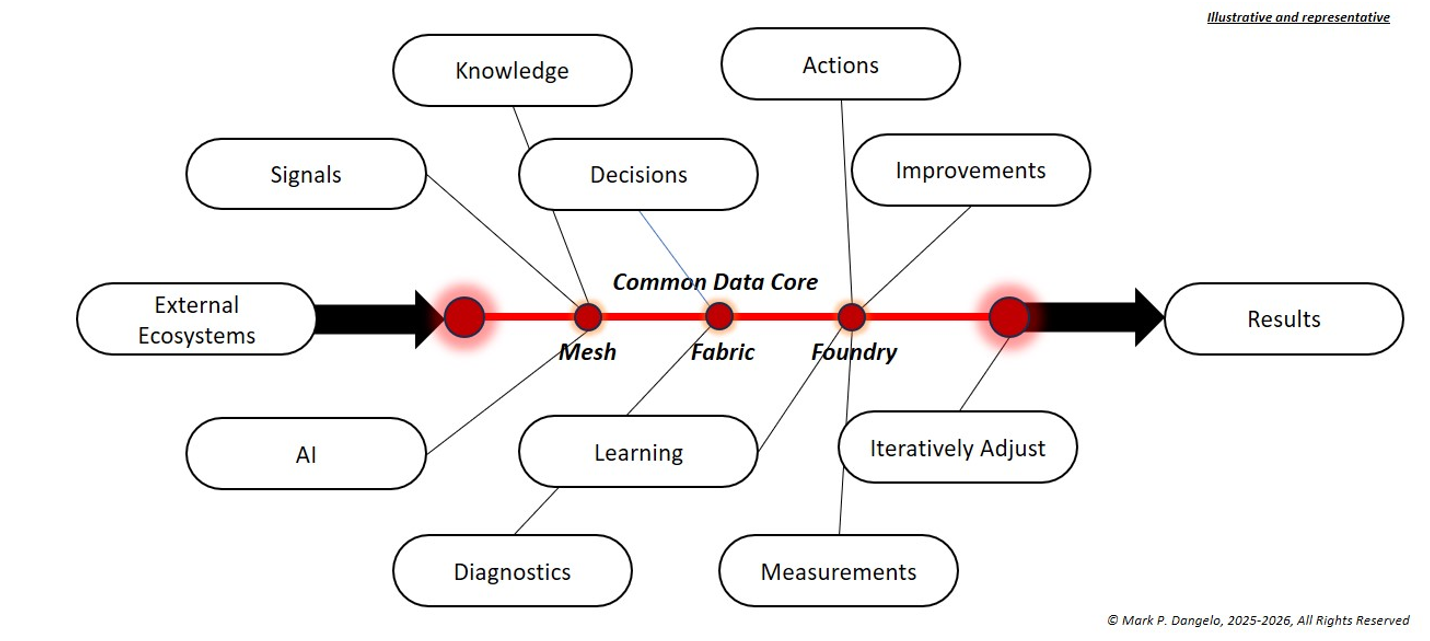
While AI was extraordinarily powerful, it was not the source of competitive advantage: Adaptation was. And those organizations possessing coherent Data Cores consistently outperformed those possessing fragmented information. The lesson became increasingly clear, the observer explains.
AI amplified whatever architecture existed beneath it; and where coherence existed, AI accelerated value. However, where fragmentation existed, AI accelerated confusion.
AI didn't win the decade, architecture did.
The final observation
If there are lessons learned from the last decade, they would include that survival was never guaranteed. Neither scale, technology, innovation, nor even intelligence guaranteed survival.
Those organizations that survived and thrived by 2025 had learned how to continuously reorganize themselves around changing realities. They developed architectures capable of learning, governance capable of evolving, data capable of flowing, operations capable of responding, and leaders capable of seeing.
Looking back from 2035, the observer says, the conclusion appears obvious. The enterprises that survived were not the most digital, or the most automated, or even the most intelligent. They were simply the most adaptive.
Because they were adaptive, ultimately, they endured.
You can find more blog posts by this author here
Follow us on social
Topics
Have questions?

