
ViDA is not the only EU digital tax reform with which tax professionals need to ensure compliance, and those professionals that aren’t actively managing new EU Member State mandates may be falling behind.
Listen to this article
Key insights:
- E-Invoicing requirements are rapidly proliferating — Individual EU Member States are adopting mandates, well ahead of ViDA’s 2030 deadline, and tax professionals need to manage those as well.
- Many tax teams may not be ready — Compliance readiness programs are frequently still in the early stages of planning or implementation, which could lead to problems.
- Risks from lack of e-invoicing capabilities are rising — Organizations may increasingly be at risk for commercial disruptions and regulatory penalties as individual Member State mandates spread.
The European tax landscape has shifted dramatically in recent months. And much of the reason has to do with the VAT (Value Added Tax) in the Digital Age (ViDA) reforms, which will require e-invoices and real-time reporting for all European Union cross-border business-to-business (B2B) transactions starting in July 2030.
In the meantime, however, individual EU Member States are rushing to implement their own individual mandates. E-invoicing is swiftly moving from a future concept to a series of active operational requirements — and the readiness of many businesses to deal with these changes is in doubt.
Major Member State mandates are taking hold
The Thomson Reuters Institute’s recent ViDA Readiness Report 2026: The new compliance horizon, found a widespread lack of readiness among many organizations for compliance with ViDA’s sweeping requirements. This may be partly due to ViDA’s 2030 effective date being seemingly distant, leading to a sense of complacency that there remains more than ample time for achieving compliance.
However, in addition to its broad mandate and seemingly generous timeline, ViDA removed the requirement for individual Member States to obtain EU approval before introducing domestic e-invoicing mandates. Consequently, governments across Europe are moving aggressively to deploy or modify their own requirements, years ahead of the 2030 horizon.
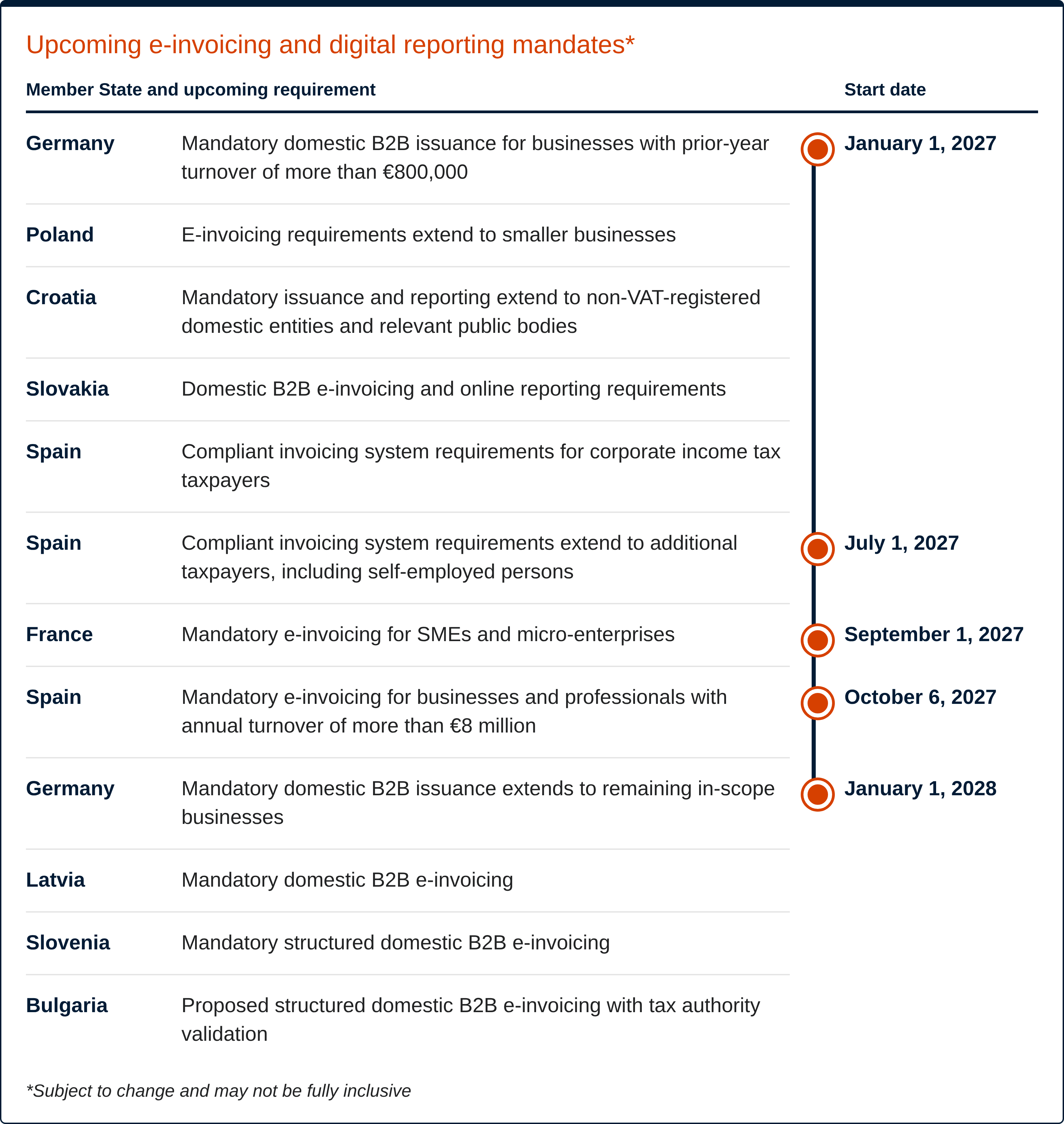
For example, as of September 1, all businesses in France that are subject to French VAT must now be able to receive e-invoices, while large and midsize companies must issue them through an approved platform as well as e-report transaction and payment data. Additionally, small and medium enterprises (SMEs) and micro-businesses must follow suit by September 1, 2027.
This was quickly followed by Greece implementing the second phase of its e-invoicing mandate that goes into effect on November 1, 2026. And the moves by France and Greece follow the launch earlier this year of new requirements in Belgium and Poland.
These represent just the most recent wave of mandates by individual EU Member States; many countries, such as Italy and Spain, have already had some degree of e-invoicing requirements in place for the past few years. Now, however, the wave continues to build. Germany, Spain, Croatia, Romania, France, Greece, Latvia, and Ireland are either implementing or expanding e-invoicing and digital reporting requirements in 2027 and 2028.
The danger of falling behind in compliance readiness
That means, for many organizations that are located or do business in the EU region, the costs of compliance and risks of non-compliance are growing by the day. With each new mandate, failure to issue compliant e-invoices risks halting an organization’s ability to conduct business involving the affected market. The ViDA Readiness Report found rejected or unpaid invoices were the most commonly mentioned consequences that tax professionals are concerned about, with business disruption, reputational damage, and financial penalties also being very much top-of-mind.
As individual Member State mandates spread, they are not only increasing the level of work required, but they are also creating a dizzying patchwork of requirements varying by jurisdiction, company type and size, and other parameters. This is elevating the operational risks that organizations could encounter, which include:
- fragmented compliance processes
- inconsistent VAT treatment across jurisdictions
- increased number of errors, and
- greater need for manual rework
Compliance readiness is lagging
Indeed, the ViDA Readiness Report found that most organizations are not prepared for the ViDA reforms. While awareness of ViDA among tax professionals is extremely high, an overwhelming 78% do not currently have a ViDA compliance program that is either funded with central governance or fully embedded in their organization’s digital finance transformation strategy. And nearly four-in-ten survey respondents say they are only in the roadmap and impact assessment phase of preparedness.
Systems and data quality are seen as two of the biggest obstacles to e-invoicing and real-time digital reporting readiness — and four-in-ten respondents say they are currently dealing with compliance on a fragmented, country-by-country basis. While such a response is understandable in a fast-changing landscape of e-invoicing requirements, it may be moving organizations further away from achieving the centralized, cross-functional solution that will eventually be needed for full ViDA compliance. Instead, they are scrambling to deal with a near-term trade environment that could encompass as many as 27 distinct domestic mandates.
Organizations are at least aware of the need for compliance readiness. Nearly all respondents said their preparations are underway for complying with both ViDA and individual Member State mandates; however, less than one-quarter say they are very confident that they understand all of the requirements and have clear plans in place. Two-thirds of respondents say that while they have made progress, significant gaps remain; and the remainder are still assessing their needs but have not yet taken any steps.
That means that the vast majority of respondents’ organizations are at risk of falling behind.
Staying ahead of the race
While ViDA’s July 2030 deadline remains the key finish line, the heat races involving individual Member States are already well underway. And the pace is picking up every month.
Organizations need to take measures to avoid falling further behind, including:
- adopting a centralized, cross-functional strategy, not local, reactive fixes
- mapping the organization’s VAT footprint across the EU
- tracking all applicable Member State mandates, both pending and proposed
- investing in flexible technology capable of handling diverse domestic mandates while scaling smoothly to 2030 ViDA requirements, and
- prioritizing data quality and auditing core master data and know your customer (KYC) workflows
With proactive action now, corporate tax departments can advance systems integration, while maintaining visibility and compliance across the multiplying mandate regimes as they move towards full ViDA compliance.
This pathway will reduce current operational friction and risk exposure and position tax departments to stay ahead of a rapidly changing tax environment that is growing in breadth and complexity well ahead of the 2030 ViDA requirements.
You can download the full ViDA Readiness Report 2026: The new compliance horizon, from the Thomson Reuters Institute here
Connect with the Thomson Reuters Institute
Topics
Have questions?

