
Tax, accounting & audit professionals are splitting almost evenly between wanting AI either to elevate their expertise or to scale their capacity. And while alignment between individual preference and organizational practice is currently high in both camps, it could erode as organizations modernize their career tracks.
Listen to this article
Key insights:
- A near-even split reveals two populations — With 44% of tax professionals preferring that AI elevates their expertise, and 42% preferring it scale their capacity, employers are serving two distinct motivations for AI adoption.
- The smallest group is the loudest warning sign — Though only 9% prefer a future that AI reimagines their core operations, this cohort shows what happens when preference and organizational reality diverge.
- AI is compressing judgement timelines, raising the stakes for talent development — AI is shortening the path to independent judgment by roughly a year, meaning organizatons need structured development mechanisms to avoid erosion and attrition.
The tax, accounting & audit profession is at an inflection point regarding AI. New data from the Thomson Reuters Future of Professionals 2026 report reveal that professionals are split into distinct camps with nearly equal portions of professionals wanting AI either to Elevate their expertise or to Scale their capacity.
Today, most professionals in both camps report their desired AI future closely matches the strategy their organization is currently pursuing — but this current state is just a snapshot.
The experience of a smaller portion (less than 1-in-10) of tax industry professionals who want AI to Reimagine their core operations and rebuild from the ground up shows what happens when there is misalignment between the employer and the group's preference. As our data shows, dissatisfaction, disengagement, and flight risk can climb quickly.
This same risk exists for professionals in the larger groups if employers treat today's rough alignment as permanent rather than something to actively protect and build on.
Three competing visions for AI in tax & accounting
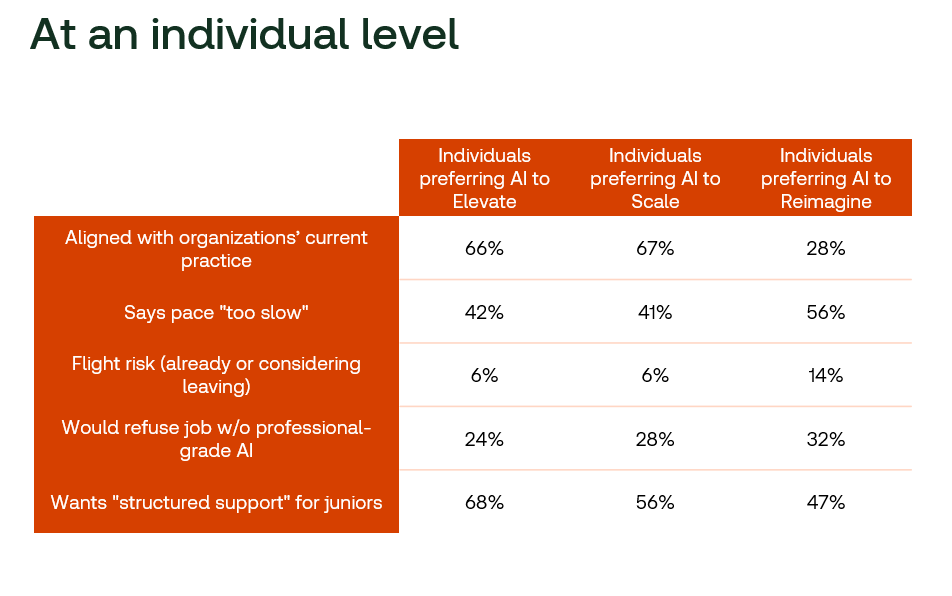
Elevate-leaning professionals see AI as a way to offload low-value tasks so they can focus on judgment and value-adding advisory work. This cohort is currently the most content with 66% reporting their employer’s day-to-day practice matches their preference. More than half (54%) say their organization's adoption pace is about right, and only 42% say it is too slow, which is the lowest complaint rate of the three groups. This high alignment is why this group is easy to overlook because nothing looks broken today.
Scale-leaning professionals see AI chiefly as a capacity solution that is particularly valuable when qualified talent is scarce. One New Zealand tax & audit partner described it as a way to compress an entire compliance season into a fraction of the time.
Scale, by a single percentage point, is the best-aligned cohort, with 67% saying their organizaton’s practice matches their preference. At the same time, the data around access to AI tools suggest fissures below the surface as almost two-thirds (64%) of Scale-preferring professionals already use professional-grade AI, and 28% saying they wold refuse a role without professional-grade AI access.
This is the first crack in an otherwise well-aligned picture because a high degree of congruence between their personal AI vision for the future and the company's existing strategic plan depends on continued tool access, not just current sentiment.
Organizations would be wise to establish dual tracks to continue to serve both these aligned groups, and the table above is the clearest evidence for why this matters now. The Elevate and Scale groups are nearly identical in size and in current alignment, but the Reimagine column shows what happens when that alignment slips. The Reimagine group's preferred vision of an AI future is not well-aligned with where the organization's current strategy is heading — just 28% say their preference is aligned with the organization current direction. At that level, flight risk more than doubles, and demand for professional-grade tools climbs to 32%.
Why flight risk doubles among AI power users
Appealing to Reimagine-leaning professionals requires a paradigm shift for organizations, and their data may function as an early-warning system for the entire tax & accounting population. This small cohort is the heaviest AI user group by a wide margin with 65% using AI multiple times a day. It is also the most dissatisfied with how AI is progressing in the workplace. Indeed, only 32% say adoption pace is about right, while 56% say their organization is moving too slowly.
The misalignment is the sharpest felt among all groups. Only 28% of Reimagine-preferring professionals say their organization's practice matches their preference, less than half the portion of those in the Elevate and Scale groups. This influences directly in mobility with 14% of Reimagine-leaning professionals already flight risks, which is more than double the rate of the other professionals. In fact, 22% are considering a move within 12 months, twice that of the other two groups combined. Also, Reimagine-leaning professionals are the most likely to walk away from an offer if it lacks professional-grade AI.
This cohort matters to the dual-track argument because it is the only group in which the preference-practice gap is strongly present, and the result is measurable attrition risk. Elevate and Scale professionals currently sit on the aligned side of that same relationship. The strategic question is whether current Elevate and Scale alignment is durable enough to survive without formal structure behind it.
Building dual career tracks for advisory depth and volume
Accounting firm leaders face a critical decision on how to structurally support employees with divergent AI preferences before their alignment erodes the way it already has for Reimagine-leaning professionals.
To address this challenge, organizations should:
Design two credible career tracks — Build distinct recognition, compensation, and promotion criteria for advisory-depth careers and high-volume careers. Remember, although the alignment scores for the Elevate and Scale groups are high now, they could slip without focused efforts to formalize these structures.
Treat the Reimagine minority as an early-warning sensor — Consider dedicated innovation pods or fast-track roles to retain these poorly aligned professionals and learn more about how to provide what they are asking for.
Build judgment sprints for junior talent — AI is already compressing the timeline to independent judgment by roughly a year; and short, high-intensity supervised review cycles for junior professionals can take deliberate advantage of this acceleration.
At the same time, individual tax, accounting & audit professionals also need to own their career path and make alignment decisions based on their preferences. Because Elevate and Scale are nearly equally preferred, professionals should rotate deliberately through advisory-heavy and volume-heavy AI-assisted work early in their career to find which future best fits. In addition, they should ask for judgment exposure early to gain access to complex, ambiguous cases to accelerate the development of this critical skill set.
The decision point
The window to act is narrowing. With Reimagine-leaning professionals already showing a rate of flight risk more than double their peers and AI compressing the path to independent judgment, organizations that delay building dual career tracks risk losing the tax, accounting & audit talent they need most to compete. And waiting for the market to settle into a single AI trajectory is a decision that will let attrition and misalignment make the choices for you instead.
You can find out more about how organizations are managing their talent and training issues here
Follow us on social
Topics
Have questions?