
As roles evolve, companies' legal department operations leaders are looking to step up
Key takeaways
- Legal ops is starting to set strategy — With twice the portion of GCs naming technology their top strategic priority this year, many legal ops leaders say their function is shifting into “its own practice area”.
- AI pressure on is landing on legal ops — As more legal departments face financial, talent, and stakeholder pressure tied to AI, legal ops has become the default first line of defense.
- Legal ops is freeing lawyers to reclaim their time — In-house lawyers say they want AI to give them freed-up time and better work fulfillment. Legal ops is seeing its role as the engine that removes friction to give lawyers these benefits.
The newly published 2026 Legal Department Operations Report looks at how corporate legal operations has evolved from a largely technology-focused support function into an increasingly strategic part of the legal department — and how AI is accelerating that transformation.
Over the past decade, corporation's legal operations function has expanded well beyond its early roots in specialist IT support. Today, legal ops professionals may be responsible for technology evaluation and selection, training, legal project management, data management, daily operations and much more. Legal operations functions are now common across large and midsize companies in the United States and increasingly around the world.
The new report shows why legal operations is increasingly becoming the nexus between legal, technology and the broader business — and why AI is likely to make that role even more important.
Now, as the report shows, AI is pushing that evolution even further. The technology is not only changing what legal operations professionals do but also elevating their stature within the legal department. As legal departments seek to integrate more closely with the broader business, legal operations is increasingly positioned to help translate technology, data, and process improvements into measurable business outcomes.
The report explores this evolution, with a particular focus on AI use, value, and talent. Indeed, the strategic importance of technology is growing rapidly, the report shows. The proportion of general counsel surveyed that identify technology as a strategic priority for their legal teams doubled between 2025 and 2026.
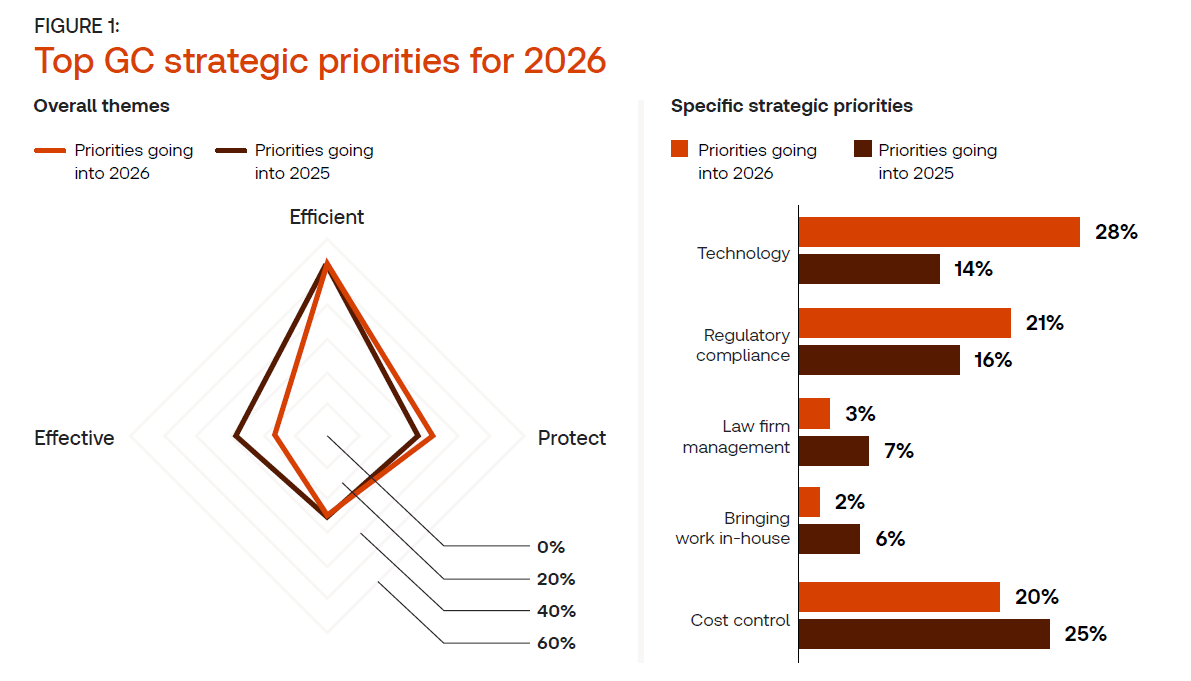
That shift comes as legal departments face pressure to demonstrate their contribution to the business. While 86% of GCs say they view legal as a significant business contributor, only 17% of other C-Suite executives share that view. Legal operations may be uniquely positioned to help close that gap through the smart use of data, demonstrative metrics, and outcome-focused communication.
Still, the legal ops function faces challenges, including constrained budgets, talent pressures, and the rapid pace of AI-driven change. However, its role is becoming harder to characterize as simply support.
You can download the full 2026 Legal Department Operations Report here, or the UK version of the report here
Methodology
The 2026 Legal Department Operations Report draws from data collected over the past calendar year by the Thomson Reuters Institute, including quantitative data that was collected for the 2026 Future of Professionals Report, which had a global sample of 1,816 professionals and 203 corporate legal professionals.
TRI also conducted interviews, between July and August 2026, with corporate legal operations professionals in the United States, the United Kingdom, and Canada for this report.
Follow us on social
Topics
Have questions?

Featured Event
The 34th Annual Chief Marketing & Business Development Officer Forum
