
Despite widespread AI strategies, few law firm partners are confident in — or even discussing — AI’s real impact on client service and business development, according to new research
Key takeaways
- Strategy doesn't equal confidence — While more than three-quarters of lawyers identified as stand-out lawyers by clients agree that their firm has an AI strategy, less than half are confident in their practice area's ability to succeed as AI becomes more integrated.
- Partners aren't talking to clients about AI — Even among high-volume embedded AI users, only about one-third of embedded AI partners said they have discussed AI with at least 60% of their clients — and partners using AI minimally have had almost none of these conversations.
- The real question isn't "if," it's "how" — Firms need to move from asking whether they have an AI strategy to asking what does this strategy require us to do differently, shifting AI from an efficiency tool to a driver of client service and business development.
Since the public arrival of generative AI (GenAI) in late 2022, law firms of all sizes have begun to explore what AI will mean for them. Some are still exploring AI’s implications, while others have fully integrated AI applications into their daily work. And still others have gone so far as to build AI tools themselves, encouraging further technological exploration.
This AI journey has directly led to a change in the overall direction of many law firms. According to new data from the Thomson Reuters Institute (TRI) — developed through 116 interviews with law firm leaders and managing partners and 2,527 interviews with top lawyers deemed “stand-out performers” by their clients — a large majority of firms already have developed an AI-specific strategy. Further, firm leadership remains focused on the impact of AI on its core business and are beginning to explore its effect on client expectations, the billable hour, and more.
When asked to explain how firm-wide strategy applies to their daily work and their value proposition to clients, many partners and top attorneys are failing to make the connection.
However, just the presence of an AI strategy does not necessarily mean that the strategy is being followed. When asked to explain how firm-wide strategy applies to their daily work and their value proposition to clients, many partners and top attorneys are failing to make the connection. In fact, although nearly 80% of stand-out lawyers believe their practice has a clear plan for AI integration, less than half are confident in their practice area's ability to succeed as AI becomes more integrated into legal work.
A critical gap now is emerging between the desire to integrate AI and the belief in its impact on the practice and business of law. This, in turn, can cause friction between firm leadership and law firm partners, each of whom want to create tangible value for clients but often cannot reconcile where AI should fit into that equation. AI strategy is being communicated, but it’s not being operationalized commercially.
And as they move into the next wave of AI transformation, law firms have moved past the question of whether they need an AI strategy, and toward the question of whether anyone below leadership knows what that strategy means for their practice, clients, economics, and careers.
AI strategy is visible, but confidence is weak
In early 2023, law firm leaders began earnestly exploring what AI would mean for the daily work of providing clients with legal service. These use cases continue to evolve, and it’s clear that some law firms are more sophisticated than they were just a few short years ago. Firms are investing in tools, discussing policies, and publicly signaling that AI matters, moving the conversation from the realm of IT and technology teams to the highest reaches of firm strategy.
At one level, the message has landed. Stand-out lawyers largely recognize that their firms have AI strategies, according to TRI data, and they see a clear plan for AI integration.
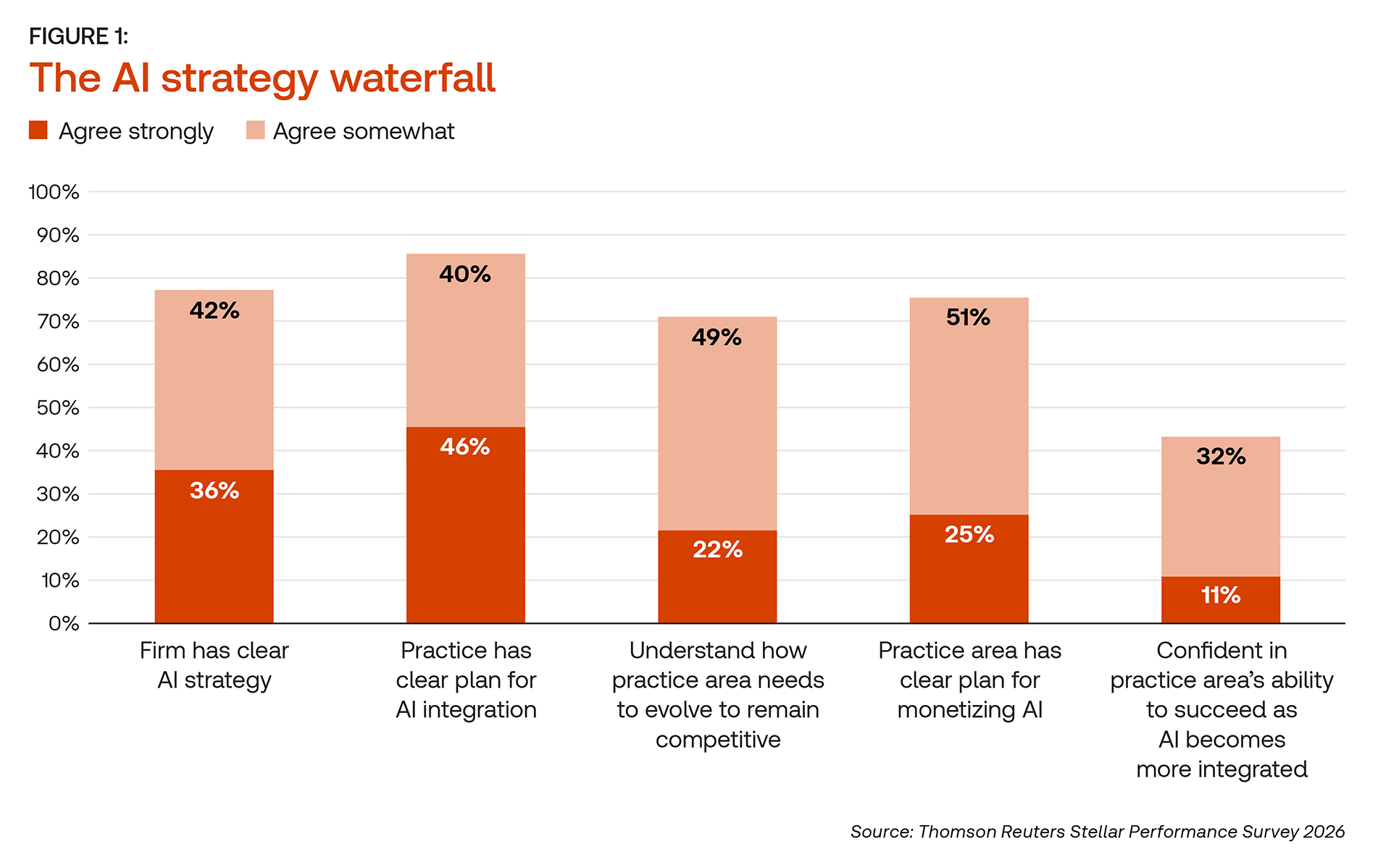
However, that confidence begins to fall away when it comes to translating that strategy into how it applies commercially for attorneys themselves. For instance, while 46% of stand-out lawyers say they agree strongly that their practice area has a clear plan for integrating AI into workflow, and 36% say they strongly agree their firm has a clear AI strategy, only 25% agree strongly that their firm actually has a plan for monetizing that AI usage. And perhaps more worryingly, just more than 10% strongly agree that they are confident in their practice area’s ability to succeed as AI becomes more integrated.
By focusing so heavily on the language of use cases and applicability to specific practice areas, such as litigation or transactional work, law firms may have eschewed speaking the language of business when it comes to AI. Indeed, a successful AI strategy is not only one that can navigate the minutia of implementation and training, but also one that answers bigger picture questions that directly affect partners’ bottom line, including:
- How will AI change the economics of this practice?
- Which work will become faster, cheaper, or more commoditized?
- Which services will become more valuable?
- How should matters be staffed?
- How should partners talk to clients about AI-enabled delivery?
- How should efficiency gains be measured and shared with clients?
It’s reasonable for law firms to not fully have the answers to all these questions right now. After all, in the grand scheme of legal industry change, the four years since GenAI’s public introduction have been comparatively the blink of an eye.
However, without even talking through these questions with their partners, law firm leaders risk the firm’s AI strategy being misinterpreted — or in the worst-case scenario, outright ignored.
Getting on the same page
When attempting to find exactly why the firm’s AI strategy is not translating into belief in its impact, it may be worthwhile for firm leaders to explore the gaps in how stand-out lawyers approach AI today.
Perhaps unsurprisingly, there is a direct correlation between familiarity with AI and the recognition of the value that AI brings. According to interviews, those stand-out partners who are embedded with AI and use it daily across multiple work types are nine-times more likely to report that AI is having a significant impact on efficiency and quality than those partners who use AI minimally or not at all.
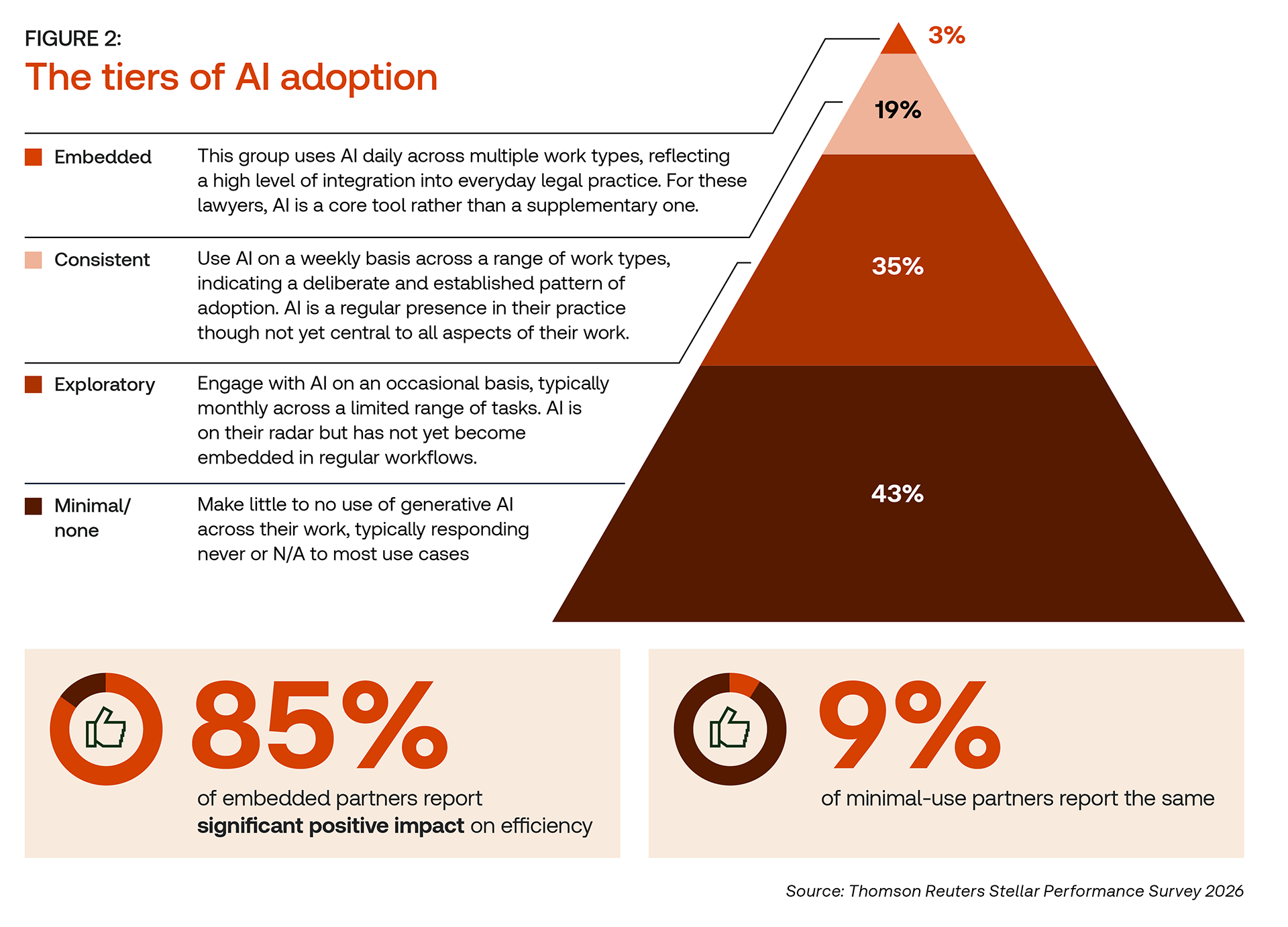
However, for law firm leaders looking to institute uniform AI policy, this gap represents a foundational issue. Partners are not just another user group. They are the commercial transmission mechanism of the law firm, tasked with determining matter strategy, billing strategy, staffing, associate expectations, and more. If there is a large gap between how some partners view AI’s impact compared with others; and, as a result, some partners are adopting AI at a lower rate, that means the firm's strategy remains a leadership document — it does not become client experience.
To hear a more in-depth discussion of this paper, listen to the new TRI Clarity podcast here
Getting all partners on the same page may not be simple. When stellar-performing attorneys were asked what factors would increase their AI usage, the top reply was to be given more time with it; yet, our data shows little evidence that embedded users have necessarily been given more time to experiment. This isn’t to say that firms shouldn’t endorse time for partners to experiment with AI, but our data shows that increasing the time allowance is unlikely to increase adoption on its own.
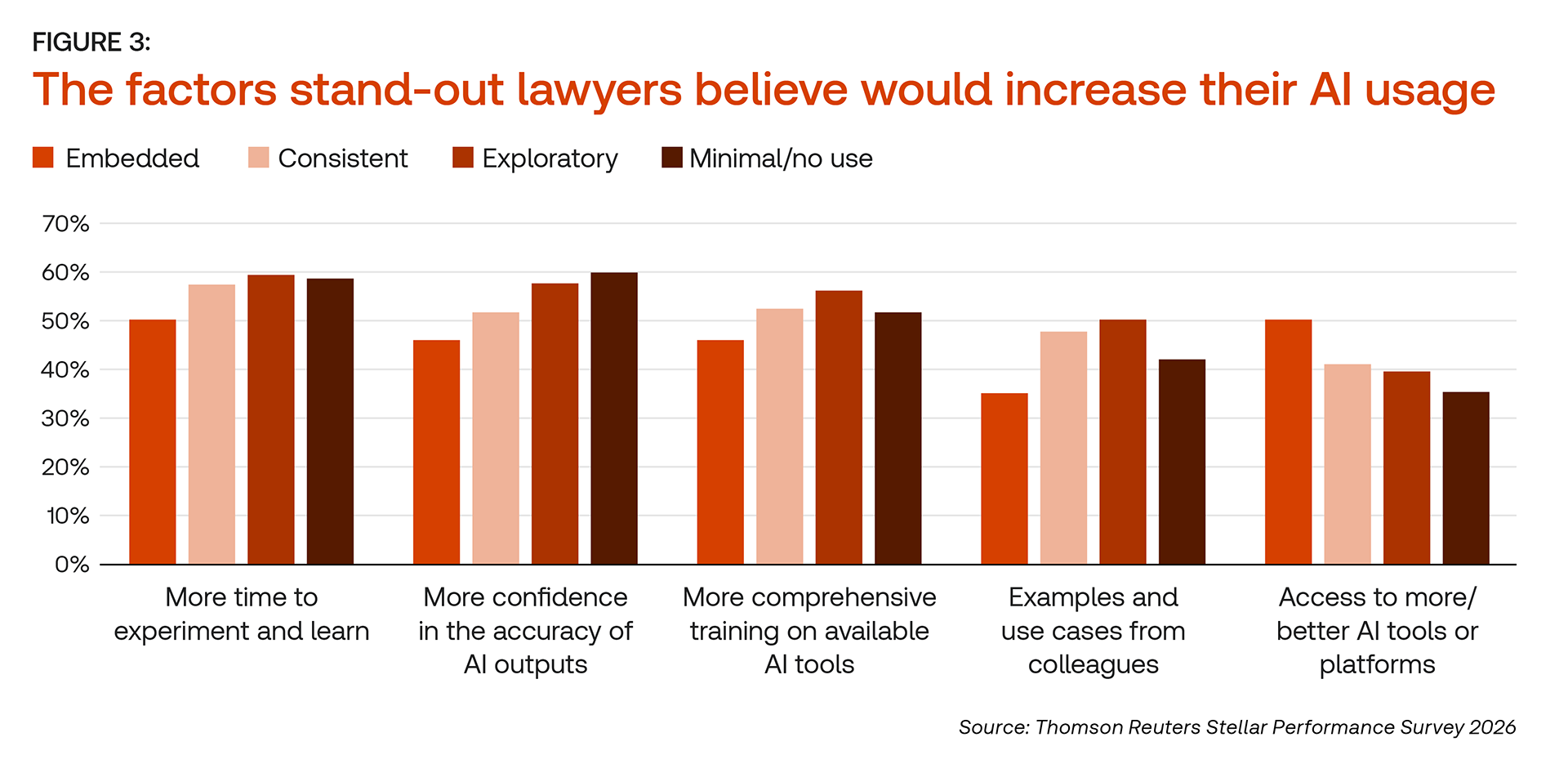
Instead, support from firm leadership should be more practical, including steps such as:
- Starting with clear information about accuracy of tools and how to rigorously verify outputs. (This is the number one barrier for limited adopters.)
- Offering training, based on real-life use cases.
- Following up with more extensive use case examples, tailored to a professional’s role, and adding a mechanism for sharing new use cases.
- Ensuring there is a strong feedback loop for embedded users to share use cases, insights, and suggestions for new tools.
The clearest sign that strategy has not translated into everyday work patterns is partner behavior. If AI were truly embedded in practice strategy, more partners would be using it consistently. Indeed, embedded AI partners say they strongly believe their firm has an AI strategy at nearly three-times the rate of partners with minimal or no AI usage.
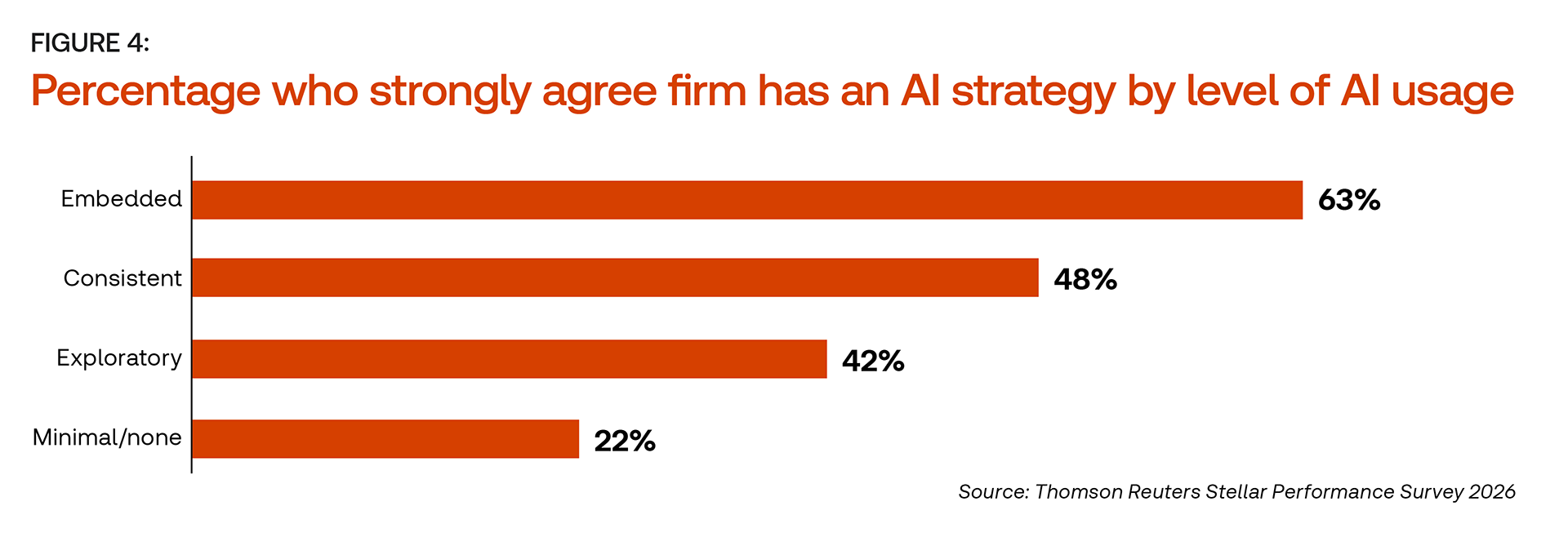
This represents both a strategic threat, but also an opportunity: A partner who has not experienced AI's impact directly cannot translate that impact convincingly to clients, associates, or the practice group. However, those who understand AI’s practical impact will be better able to speak the language of client needs.
How to talk to clients about AI
A year ago, some clients were asking firms not to use AI; now, however, law firm leaders say that pressure has reversed. Clients are not only asking their outside firms to demonstrate the firm’s AI capabilities, but clients also want insight into the expected commercial impact on pricing, talent and staffing, and ultimate matter success.
These stresses are compounded by the fact that clients themselves are facing pressures like never before. In TRI’s interviews with corporate general counsel, we learned that many legal departments are facing their own AI issues, such as tool proliferation without governance, limited or still developing legal ops infrastructure, security constraints, and team resistance.
These pressures also come in an age of ever-increasing law firm rates, which have reached year-over-year highs for the Am Law 100. Clients see AI as a potential salve, but they also say they have little insight into how law firms are adding value through AI. As one GC relates: “Are we actually seeing the benefit of that, or are we just seeing increased partner rates to offset efficiencies gained from AI for less associate billing? It’s very hard right now.”
Despite this pressure and a strong desire for more communication, even stand-out lawyers are not regularly engaging in AI conversations with clients. More than one-third of these lawyers say they had talked about AI with less than 20% of their clients. While the frequency of these conversations naturally varies based on familiarity with AI tools, even those lawyers considered to be embedded with AI aren’t having regular AI conversations with many of their clients.
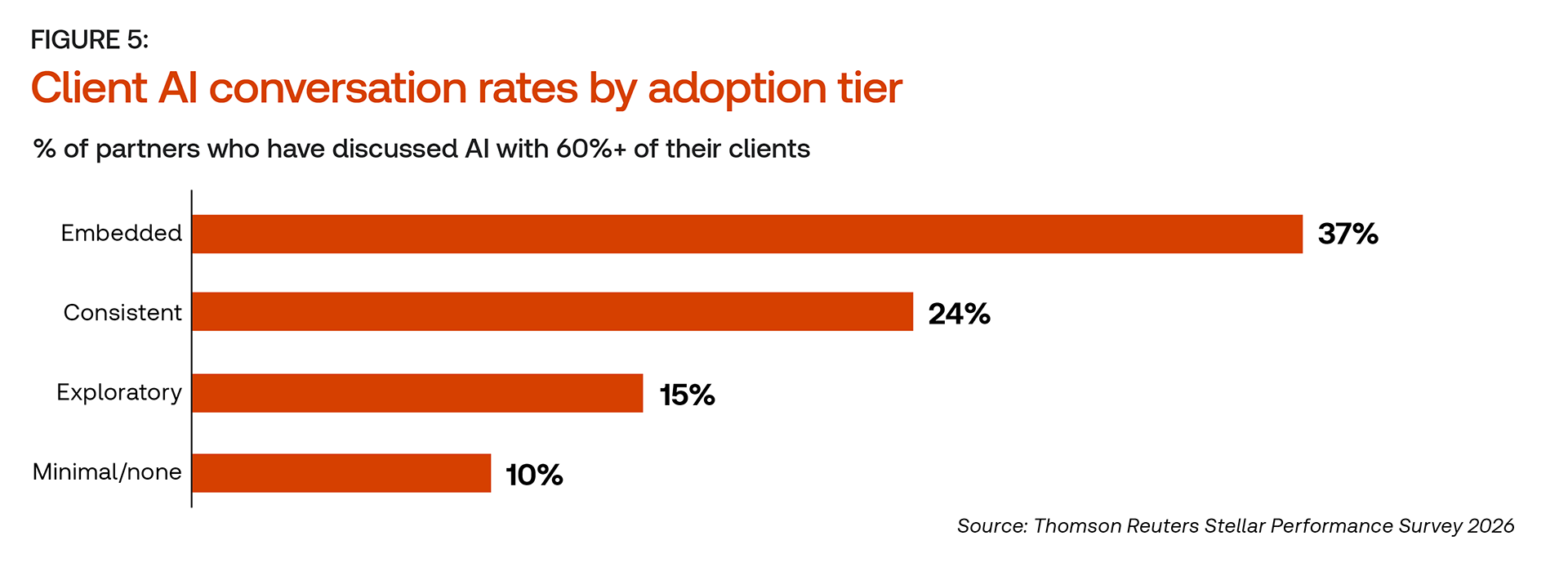
Clearly, law firm partners need a new playbook for how to approach client conversations around AI use. When these conversations occur, clients are naturally asking firms for lower fees, but also for speed and efficiency, transparency about AI use, and better advice rather than just faster advice. This represents an opportunity for firms not to simply provide cheaper service, but for partners to become clearer about where the firm adds distinctive value.
When stand-out lawyers say they have had productive AI conversations with clients, two key themes emerge:
Evidence and insight are the top lawyer needs regardless of AI usage level — Whether a lawyer uses AI daily or rarely, they say they need better client data and competitive intelligence. This is a preparation problem, not an adoption problem.
Productive conversations produce next steps — The richest outcomes come when a lawyer and a client jointly define how AI will be used, turning the conversation from a presentation into a partnership.
If firms do not define the AI value proposition for themselves, clients will define it for them — and they may define it primarily as a cost-cutter. The answer, of course, for lawyers is not to avoid the fee conversation, but to approach it and sequence it correctly.
Stand-out lawyers say that what distinguishes productive conversations is not technical sophistication, but how they structure the conversation. Clients want to understand cost impact, but the firm that leads with price concessions before demonstrating value can ultimately train clients to expect discounts rather than to pay for capability.
The better sequence in the conversation would be:
- What changed about the work?
- What changed for the client?
- What value did that create?
- How should pricing reflect that value?
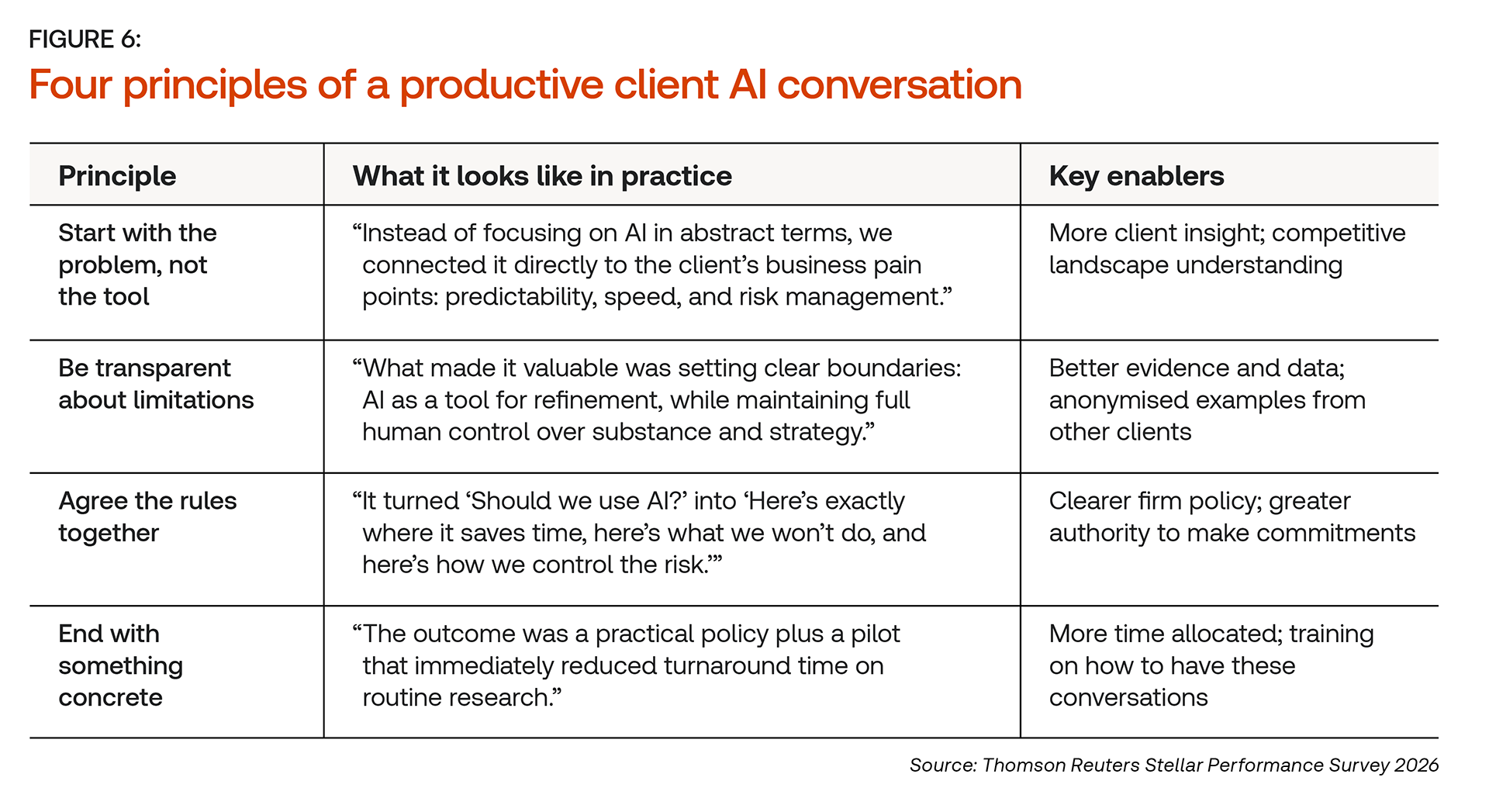
The client does not need a tour of the firm's AI stack; rather, the client needs to know what work will be done faster, clearer, safer, more predictably, and become more useful because of AI. Framing the conversation less around technical details and more around client service not only helps the client understand the firm’s position, it allows the partner to be more comfortable and engaged in having AI-related conversations in the first place.
A clearer AI positioning
Communicating AI’s optimal outcomes with partners, then, could provide a crucial roadmap to guide a firm’s AI strategy to ultimate commercial success. However, not every firm is there yet.
Some firms are using AI mainly to protect the present, by streamlining work, reducing time spent on research or drafting, improving internal productivity, and defending margins.
And while these efforts are admirable, achieving efficiency alone is insufficient. Treating AI purely as a productivity-lever leaves firms open to missing its implications for leverage, training, and transforming the business model. And as client expectations continue to accelerate the timeline, it’s becoming more important than ever to fuse top-level AI strategy with commercial outcomes.
Fortunately, many firms are beginning to ask how AI could reshape the future, seeking innovations in pricing, staffing, client experience, service design, knowledge management, and new forms of value. These questions do not necessarily reveal definitive answers today, but they do reflect an evolving strategic positioning that demonstrates how firms believe AI can directly impact commercial outcomes.
From interviews conducted with law firm leaders about their own firms, TRI has developed an AI Position Matrix to help illustrate this journey. Just as firms must become more advanced in their AI implementation strategies, so too should they journey from viewing AI merely as an efficiency tool to instead seeing AI as a way to power client service and business development goals. If law firm leaders primarily view AI through an efficiency lens, then naturally, the rest of the firm will follow that lead.
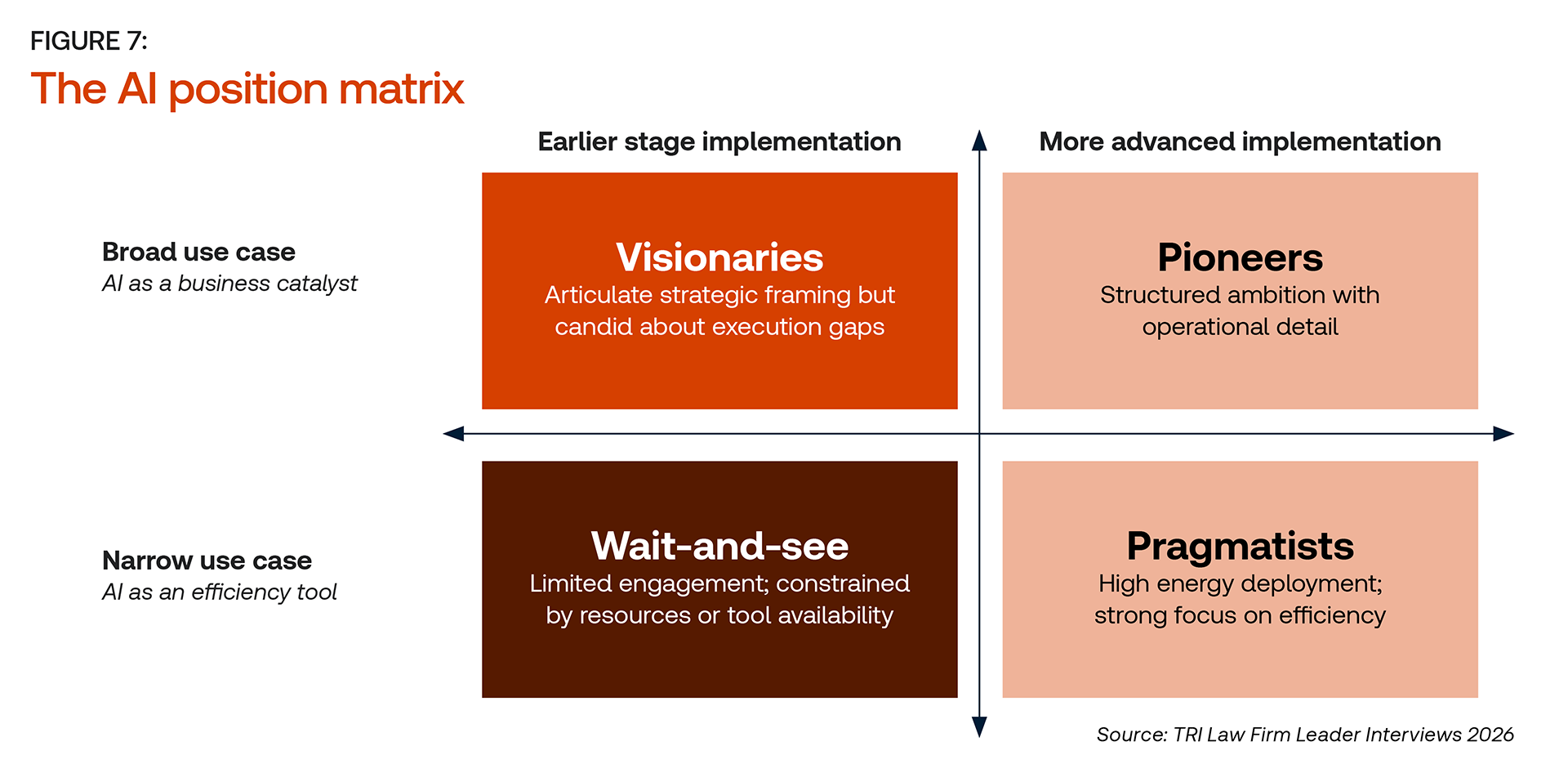
While this matrix is not saying that all firms must become Pioneers immediately, it does point out the danger of ambiguity. If leaders say AI is transformative but manage it like a productivity tool, then partners receive mixed signals. If leaders push tools without explaining their commercial intent, adoption becomes fragmented. If leaders speak in broad strategic terms without providing operational detail, lawyers then cannot convert their aspirations into new behaviors.
Put another way, the practical question for a partner is not, Does the firm have an AI strategy? Rather, it should be, What does this strategy require us to do differently?
Turning strategy into systems
AI has transformed how law firms operate in a very short amount of time, but its influence on firm strategy and lawyers’ relationship to clients promises to have a much longer tail. Today’s stand-out lawyers will make tomorrow’s firm leaders; therefore, closing the translation gap between strategy and execution now not only has an immediate impact, but will influence firm success far into the future.
When asked what makes for a good firm leader, stand-out lawyers have clear and consistent views — with strategic vision topping the list by a wide margin. Some qualities ranked near the bottom, however, such as technology leadership and change management. Unfortunately, these are precisely the ones whose absence has led to today’s AI translation gap between firm leadership and partners.
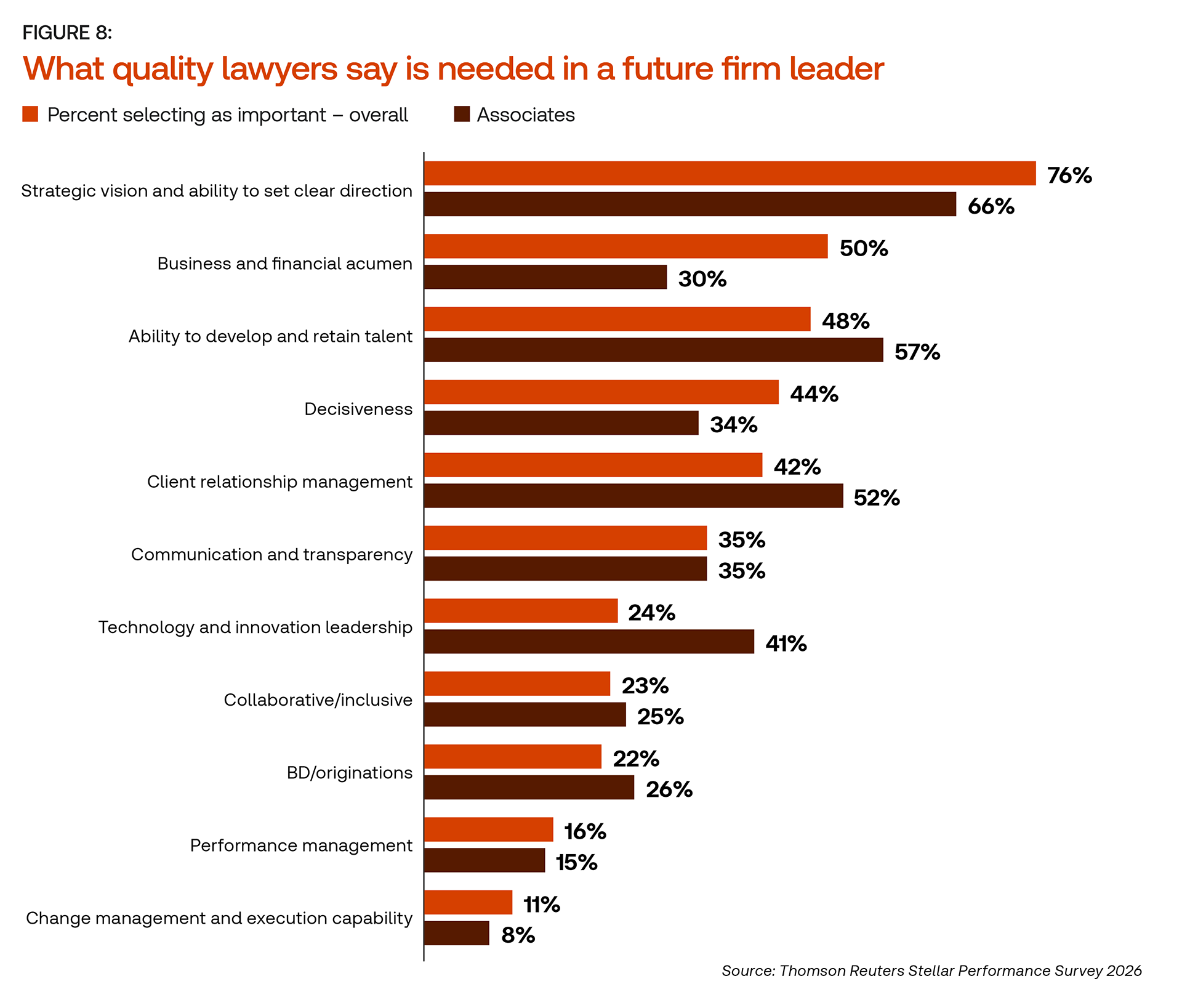
Lawyers know what they need: A leader who can set clear direction. What they have not yet recalibrated is the weight they place on a leader's ability to navigate change and technology. This creates a structural tension, in which the firms that succeed in an AI-enabled environment will need leaders with both strategic clarity and change capability. Currently, lawyers are asking for one and undervaluing the other.
Building the needed systems
Law firms do not have an AI strategy problem in the abstract — they have a translation problem. The gap between what leaders say, what partners do, and what clients experience is proving to be a formidable obstacle to achieving all the benefits that full AI implementation can bring.
That’s why the next action a firm’s AI leadership should take is not simply announcing a strategy; rather, it’s about first building the systems that make the strategy usable, including:
- Identifying practice-level commercial opportunities — Practice leaders should be able to answer which workflows are changing, which services can be enhanced, what pricing implications follow, and which client conversations partners should initiate.
- Establishing firm-wide adoption infrastructure — Leaders should establish real-life training, clear accuracy and review standards, role-specific examples, embedded-user feedback loops, and permission to experiment responsibly.
- Providing client conversation information — Partners should be given talking points and real-world examples, client-specific insight, approved language on risk and limitations, and guidance on billing implications.
- Moving to more value-based measurement — Firm leaders should move beyond efficiency metrics that just track hours saved, and toward value metrics, such as those that measure faster turnaround, better risk identification, improved consistency, enhanced client satisfaction, and the ability to take on additional work or more strategic tasks.
The winners in the law firm AI strategy race will not necessarily be those with the boldest rhetoric or the largest technology budgets. They will be the firms that make AI meaningful at the level at which legal work is actually sold, delivered, and evaluated.
Methodology
The Stellar Performance Survey 2026 was completed by 2,527 client-nominated stand-out lawyers across 65 countries (967 US, 357 UK, 344 Canada, and respondents across Europe, Asia Pacific, Latin America, Middle East, and Africa). Of respondents, 2,287 were partners, of whom 1,854 were equity partners. The firm-level analysis covers 52 firms with ten or more respondents. Law firm leader data draws on 116 interviews conducted in 2026 across Am Law 200, UK, European, Asian, and Australasian firms.
Follow us on social
Topics
Have questions?

Featured Event
The 34th Annual Chief Marketing & Business Development Officer Forum

