
The most common objection to mobile legal demand is that partners do not see it happening in their own books. They are right, of course, and that is exactly what you would expect; however, 15 years of Thomson Reuters data shows the shift they cannot see.
Key takeaways
- The evidence is an absence, and absences do not get recorded — A law firm’s financial system captures every hour worked and every dollar collected. Yet nothing in them records the matter that was never sent, which is precisely how mobile demand works.
- Client-side data closes the loop — Law firms reported their worked rates were up 7.4% through mid-2025. Over the same stretch, however, the largest corporate clients paid less per hour for partner time, some of them reducing costs by double digits. Indeed, both numbers are true; and only a change in who does the work explains them together.
- Mobile demand is a 15-year chain, not a recent trend — The behavior shows up in our archives as matter disaggregation after the global financial crisis, as ALSP and Big Four adoption before the pandemic, and as tier-shopping after it. Each new stage taught clients something that the next stage needed.
Every time someone presents the idea of mobile demand to a room of law firm partners, at least one of them tells us it is not happening — they’re book is up, their firm’s rates increased 8% and the client paid it, and they have not lost a client in six years.
All of that is generally true. Yet none of it is an argument against the existence of mobile demand, which is a hard thing to get across in the five minutes you get after a panel.
There are two reasons the partner’s objection keeps being voiced. First, you cannot see what was never yours. Mobile demand does not arrive as a client firing you or your firm. It arrives as a matter that never gets called in, or a subsidiary employment dispute that would have landed on your desk in 2015 but now goes instead to a 40-lawyer firm three states away. Indeed, firm financial systems are built to record what comes in the door, but there is no field on their spread sheet for the matter that did not. The Thomson Reuters Institute’s (TRI’s) 2024 Report on the State of the US Legal Market described the concept of mobile demand about as plainly as it can be put: Clients moved business to a different segment of the market without notifying their prior providers.
Second, this shift is measurable and has been for a long time — just not from inside any single law firm. Fortunately, TRI sits on both halves of the ledger: Our Financial Insights collects data from law firms, so we see what firms are billing; and our Legal Tracker collects data from corporate legal departments, so we see what clients are paying. A single law firm can only ever see its own half.
To better understand the evolution of mobile demand, let’s start from the beginning.
How legal work used to sit still
Before 2008, legal work was sticky to the point of being immobile, and the relationship was the unit of sale. A company had its firm, and when a new problem showed up, the GC called the firm, and the firm decided who inside it would handle the work. Firms decided which partner would work the matter, how many associates and how much document review would be needed, what got staffed in New York and what went to Charlotte. All that triage happened inside the firm. The client bought a relationship and received whatever that relationship produced on the other end. This was not naivety on the client’s part, it was capacity.
Then the fallout of the financial crisis emptied a lot of law firm offices in 2008 and 2009; and much of that talent went in-house. And GC offices acquired something they had never had in much volume: Professionals who knew exactly how a law firm prices, staffs, and leverages a matter, because they had spent a decade on the other side of the table doing precisely that. The triage function moved from the seller to the buyer. And once the client runs the triage, the client can route the pieces. Large firms did not lose that work to a competitor so much as to their own alumni.
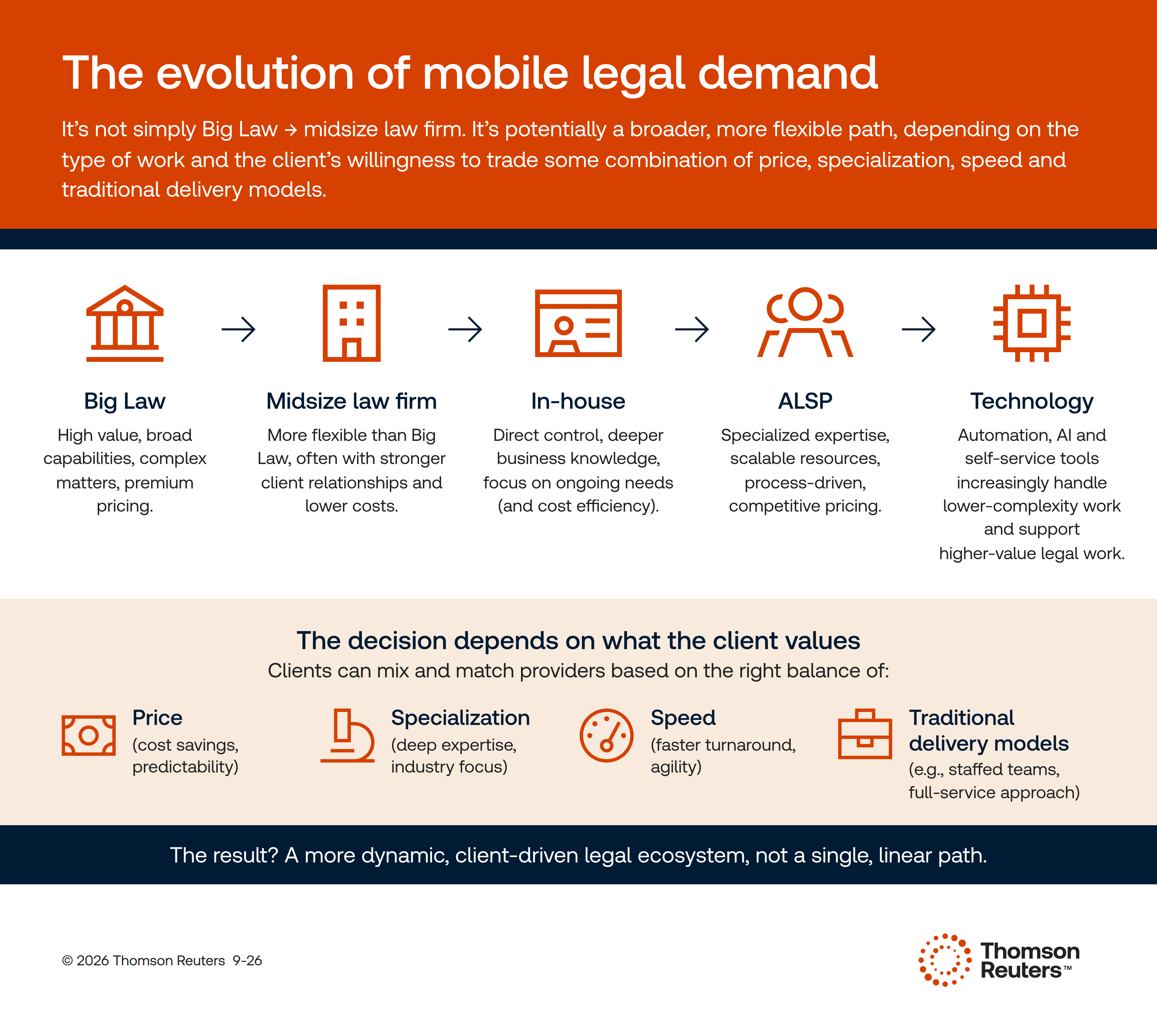
The TRI archives caught this early. The 2013 Report on the State of the Legal Market described clients growing more willing to disaggregate matters, litigation and transactional alike, parceling out phases to different firms based on expertise and cost-effectiveness.
The first destination was not another law firm
Here is the part that may surprise people. When clients started moving work, they did not mostly move it down a tier. They moved it out of the category.
A private April 2016 Peer Monitor Client Report described clients hunting for alternatives on non-lawyer work, pulling tasks in-house, and buying their own technology to control their spend. Commoditized transactional work could slide down-market, go in-house, or get outsourced without changing the client’s risk profile. For a GC, that meant if moving the work does not increase your risk, then the only remaining question is price.
By 2017 our reports had stopped treating this as opportunistic and started calling it structural, with alternative legal services providers (ALSPs) lowering costs for corporate law departments and, notably, for law firms themselves. And by 2019, TRI reports were listing the Big Four accounting firms as disrupters, taking on matters that had always been lawyer work.
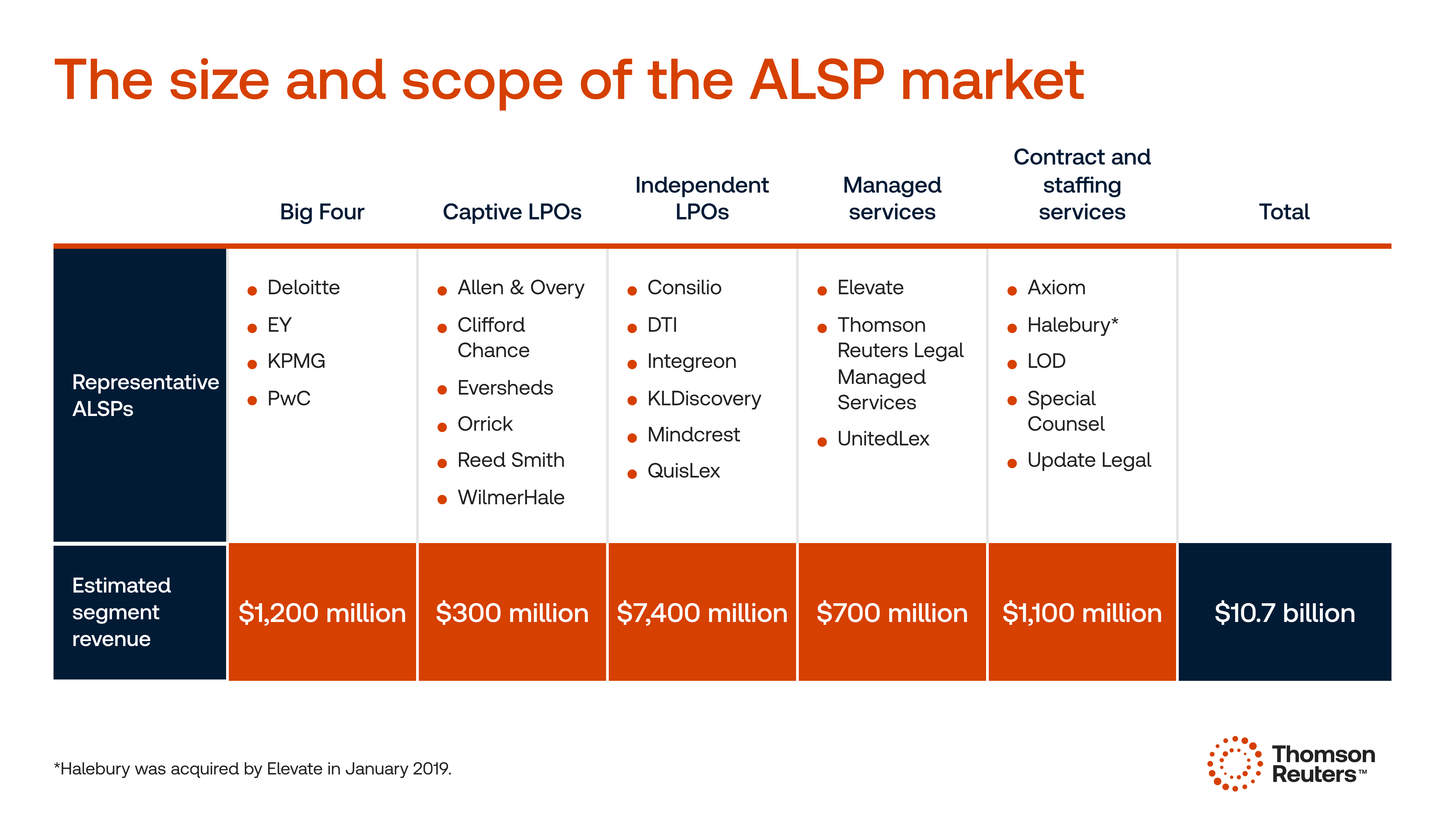
Indeed, the hard part of mobile demand was never picking a cheaper provider. The hard part was learning to take a matter apart by figuring out which pieces are document review, which are first-draft work, which are judgment, and which are the two hours of senior partner attention for which clients are actually paying. In fact, clients spent roughly six years learning to do that on ALSPs and in-house teams. Once you can disassemble a matter, however, handing a piece of it to a cheaper law firm is a relative piece of cake.
The name arrives, and then the boom
The phrase mobile legal demand does not show up in TRI’s work until the Law Firm Financial Index (LFFI) for the third quarter of 2022, which noted that smaller firms were succeeding both overall and in particular practice areas and suggested that clients were now more willing to shop around. Then conditions turned aggressive. The next few years saw rate growth at the top of the law firm pyramid run well ahead of inflation year after year, and the pricing gap between segments widened into a chasm that clients could not fail to notice. Rates charged by Am Law 100 firms crossed $1,000 an hour while the rest of the market averaged somewhere near $600. At a 40% differential, the conversation inside a legal department very soon stops being about relationships and starts being about arithmetic.
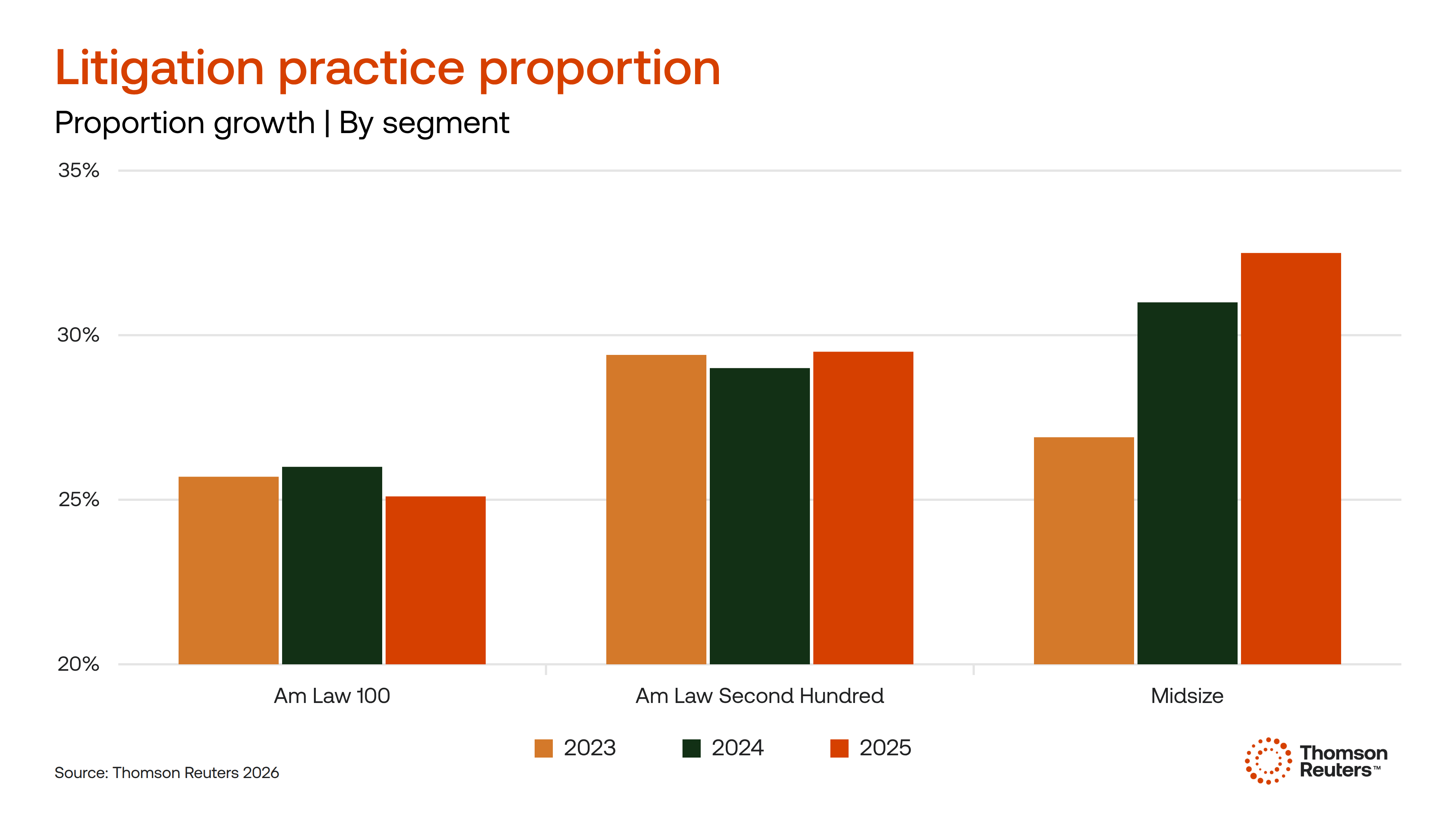
Midsize firms caught the first wave, and 2022 and 2023 were their window as they rode the surge and matched much larger firms on fees worked growth. Litigation matters were up most starkly, and midsize firms’ share of litigation demand rose 5.6% between 2023 and 2025 while the comparable share at larger Am Law firms held roughly flat.
The 2024 State of the US Legal Market put a number on the prize. A corporate legal department that reallocates its work across firm segment tiers could pull its average paid rate down 3.3% without doing anything else. No negotiation, no panel fight, no rate letter — just routing and re-routing legal matters.
The half of the ledger that firms never see
Which brings us to the best available answer for the partner who says he does not see mobile demand happening in his world.
Through the first half of 2025, law firms reported worked rates up 7.4% year over year. On the client side, over exactly the same period, however, corporate legal departments paid less per hour than they had a year earlier. Not slightly less in a way you could wave off. Companies with $10 billion or more in annual revenue paid 12.2% less per hour of partner time, 6.4% less for of counsel, and 7.0% less for associates. Companies with between $2 billion and $10 billion in annual revenue saw declines across all three categories as well.
The list price of a partner hour went up by more than ever before, according to law firm math; however, the price a large company actually paid for a partner hour went down by double digits. And the only way both numbers are true simultaneously is if the composition changed. The client is not buying the same partner more cheaply; rather, the client is buying a different partner to handle a larger proportion of their work.
Full-year 2025 showed this phenomenon at work again, cleanly. Corporate legal departments spent less per hour in 2025 than they did in 2024, while their outside law firms raised worked rates 7.3%. Over the same year, demand growth split wider than it has since the financial crisis, with midsize firms approaching 5% in the second half of the year, while the Am Law 100 was unable to clear 2%.
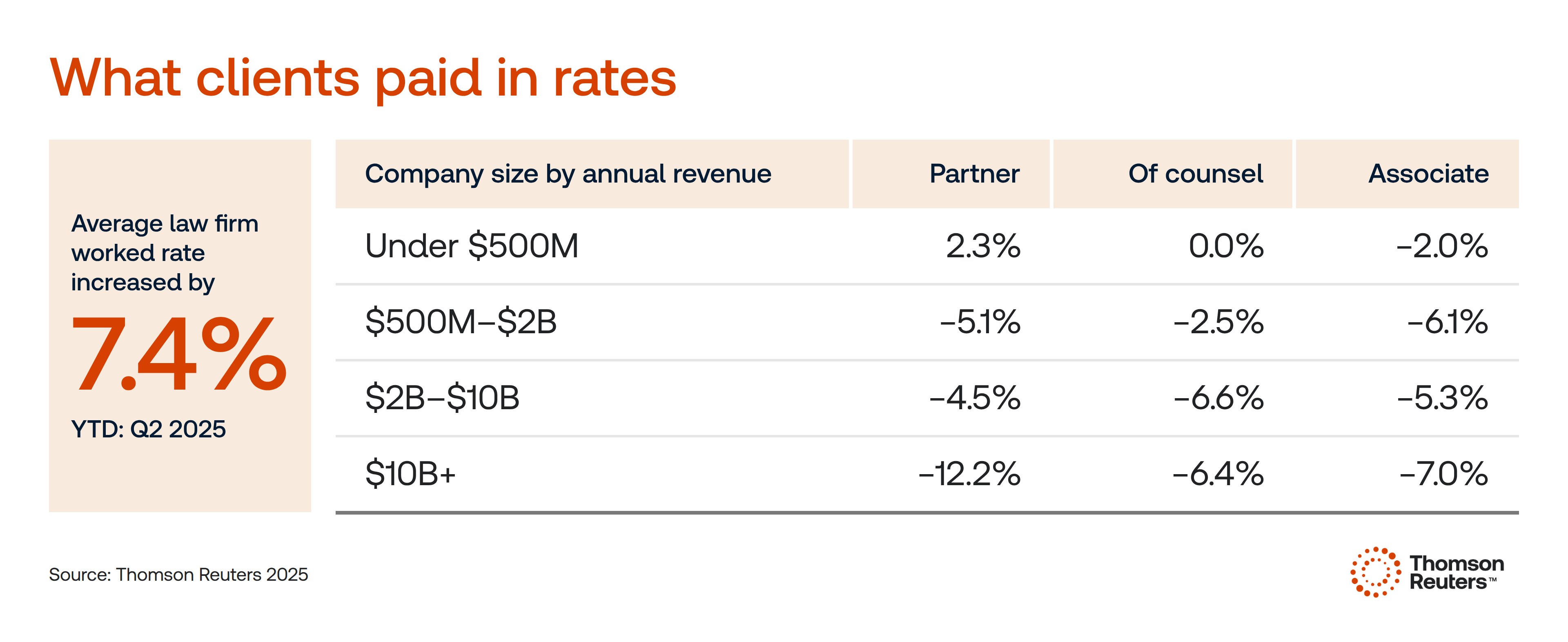
That is the chart you cannot draw from inside one law firm. Firm invoices record what was billed, but they cannot record the invoice the client sent to somebody else.
What this is turning into
The first version of mobile demand was GCs learning to play the game in the wake of a financial collapse that had forever altered an industry. The current version is a sourcing decision made matter by matter, and increasingly task by task, by legal departments now armed with the tech, knowledge, and experience to do it as a matter of routine.
A May 2025 Client Report offered an uncomfortable explanation for why this phenomena continues to accelerate, in that once a legal department has proven it can cut spend without suffering a bad outcome, that proof does not expire. As the global economy continues to experience extreme geoeconomic stress that is causing companies to need even greater legal services, these lessons are forcing GCs to stretch their current budgets even further.
The Law Firm Rates Report 2026, which allotted mobile demand its own section within its pages, explains why this has been slow to register at the top of the market. Scale cuts both ways: a 1% decline in Am Law 100 demand can land as a 3% gain for Am Law Second Hundred or midsize firms. And as the largest firms shed price-sensitive work and push rates on what remains, their financials look end up looking terrific at the same moment their share of routine work erodes. “Peak prosperity and the fault lines below,” as the 2026 Report on the State of the US Legal Market had it.
Not surprisingly, AI is the next link in the same chain, and it will likely follow the same logic rather than a new one. The question that clients have been getting better at answering for the last years — Which parts of a legal matter require the most expensive lawyer available? — will be greatly aided by AI.
Indeed, AI moves that question one level down, from delineating which outside firms should handle which parts of the matter to which parts of the matter need a lawyer at all. Same disassembly, applied to tasks instead of phases.
What the objecting partner cannot see, however, is the work that might have been theirs, but they were never told about because an experienced GC knew another firm four states away that could handle it for half the price without increasing the clients risk. Nor did the partner know that another legal matter was itself downsized because much of it was shipped off to an ALSP or (increasingly) the GC’s own legal technology team.
How long that shift remains invisible — with enough demand pouring into the industry to obfuscate what is pouring out — is the real question.
You can find more of our insight into the legal market here
Follow us on social
Topics
Have questions?

Featured Event
The 2025 Emerging Technology and Generative AI Forum

