
A new report from the Thomson Reuters Institute in partnership with the University of Melbourne shows that FY 2026 was one of the strongest years the Australian legal market has seen in a decade — yet it was also the most divided the market has been during that same time.
Key takeaways
By almost every headline number, FY 2026 was one of the strongest years the Australian legal market has seen in a decade. It was also the most divided it has been during that same stretch, however, as it saw the grouping of law firms fall into different buckets. Holding both of those concepts at once is the whole task of this report — and it takes three cars, on a grid that held only two cars in last year’s report, to do it.
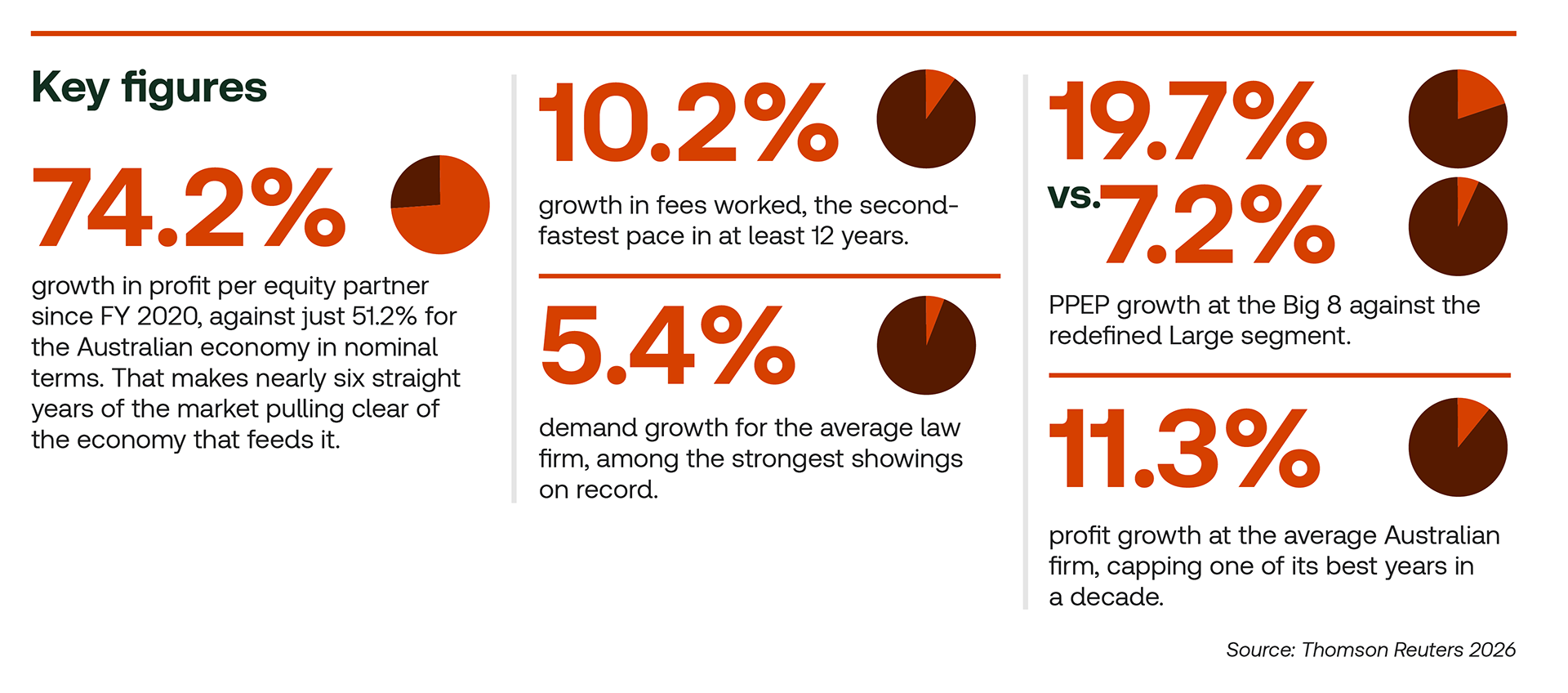
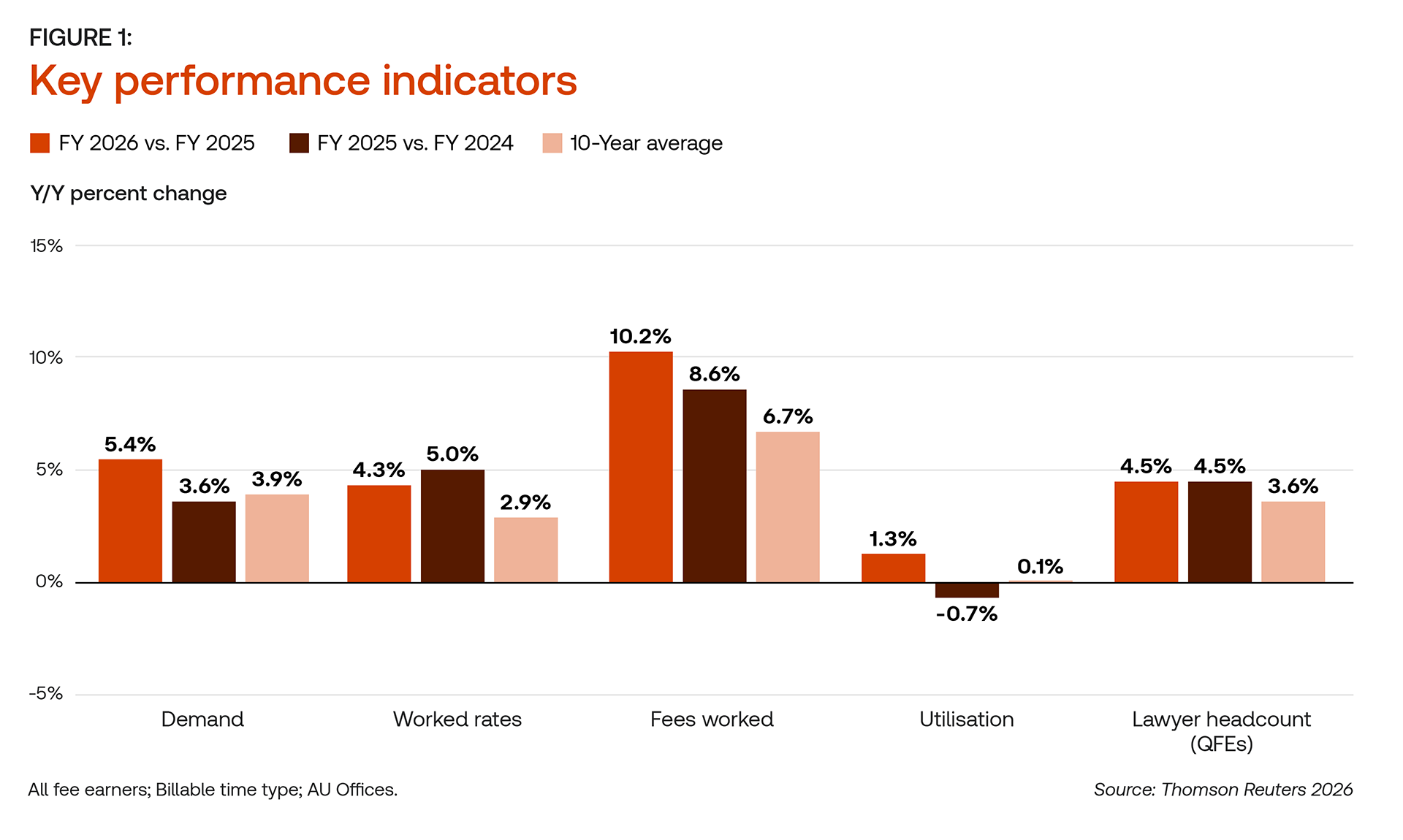
Taking a look at the surface first, we see it holds up. Demand rose 5.4%, among its best showings on record, and fees worked charged ahead as well, with 10.2% growth, the second-fastest pace in at least 12 years. Profit per equity partner at the average Australian law firm has grown 74.2% since FY 2020, well ahead of the 51.2% expansion in Australia’s nominal economy over the same period. Rate growth cooled but held well above its long-run trend, while utilisation turned positive even as other global markets watched it slide. Further, most firms spent the year reinvesting, pivoting from the hiring spree of FY 2025 toward equipping the lawyers they already employed. From a distance, the whole field looks like it ran one fast, healthy lap.
You can access a full copy of the Australia State of the Legal Market 2026 report here
The trouble with distance, however, is that it smooths everything out. Up close, the same year that produced one of the best aggregate performances also produced the widest separation among firms in more than a decade. Two factors pulled it apart: First, the overall grid of firms grew as four more firms joined the Financial Insights program this year, bringing the total to 27 firms. This fuller field showed us what a small one blurs. As a result, we’ve added an additional law firm segment to our market analysis: the Midsize group. And second, in FY 2025 the market split hard: one set of firms ran well, while the rest slid.
As FY 2026 got under way, the group we had previously categorised as the single Large law firm segment turned out to be two segments — the Large and the Midsize — each running their own race, and joining the Big 8 to make three segments that we track.
By fiscal year’s end each segment led on the specific key measure that its strategy was built to win. The Big 8 firms led on profit in every form it takes, from total dollars to per lawyer to per partner. Large firms led on scale, growing demand more than four times as fast as any other segment. And Midsize firms led on the one thing a comeback is scored on, direction, ending the year growing again after a year in reverse.
The Australian legal market has never looked better, of course. Underneath it, however, three now separate law firm segments are running the same race on the same track, but are speeding toward three different goals.
Of course, the most critical number may be the one partners take home. The Large firms, for all their scale, grew profit per equity partner 7.2%; the Big 8 grew it 19.7%, because the Large firms’ growth by addition adds partners too, and a bigger pie split across a wider table leaves each seat with less.
That is the question FY 2026 hands forward: The Big 8’s strategy built the bigger firm, the Large firms’, the better deal for individual partners — but which one is winning depends on which side of the equity table you sit.
And Midsize firms made a quiet point of their own by growing their profit per equity partner by 7.7%, even nudging past the Large segment.
In aggregate, the Australian legal market has never looked better, of course. Underneath it, however, three now separate law firm segments are running the same race on the same track, but are speeding toward three different goals.
Methodology
Over the course of FY 2026, the financial metrics in this report were collected from Thomson Reuters Financial Insights data, which is based on the accounting systems from 27 participating law firms operating in Australia. These include some of the largest firms by the number of qualified fee-earners (QFEs) in the country.
Global metrics used for comparison are based on 260-plus law firms, primarily located in the United States and the United Kingdom, which also participate in the Financial Insights program. Some numbers may have changed since the issuance of the FY 2025 report due to sample shifts, revisions, or changes in methodology.
Market insights included in the report were based on interviews with 109 Australian-based legal buyers over the course of FY 2026.
This report was done in partnership with the University of Melbourne.
Follow us on social
Topics
Have questions?

Featured Event
The 26th Annual Law Firm COO & CFO Forum