
A new report shows the law firm market accelerating rather than cooling as record pricing, strong demand, and a widening gap between segments pick up speed, albeit unevenly
Key takeaways
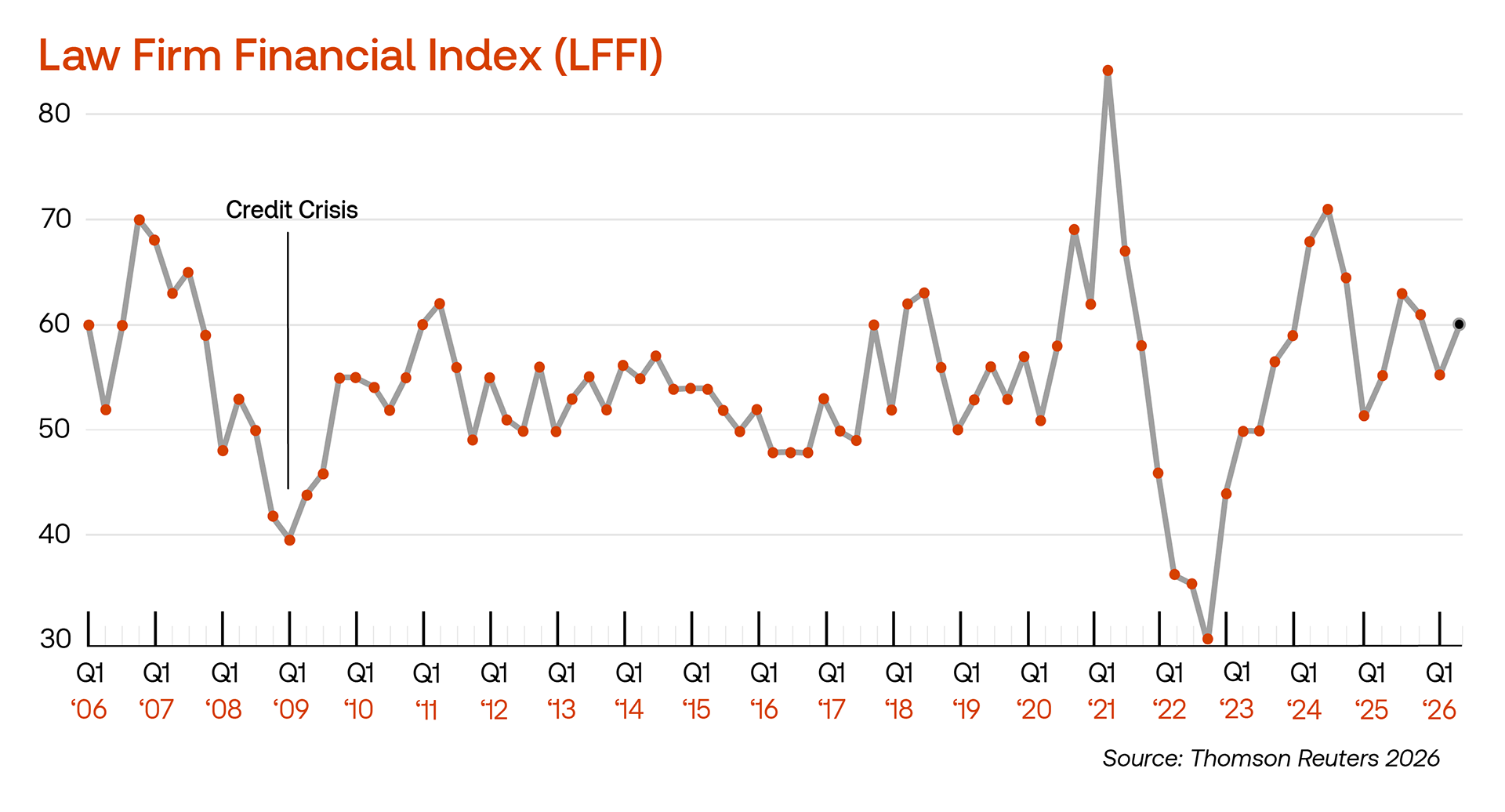
- The index climbed out of its steady doldrums — The Thomson Reuters Institute's Law Firm Financial Index (LFFI) climbed meaningfully in the second quarter of 2026, up from a middling reading in Q1, marking a genuine acceleration, not merely a calmer reading.
- Legal demand stayed strong, but it's landing unevenly by title — Overall demand growth held firm, on pace for the strongest year since 2021. Associates and non-equity partners are absorbing most of the extra workload, while equity partners and other lawyers actually pulled back on demand.
- Segments that were roughly aligned a quarter ago are now pulling apart — Am Law 100 and Second Hundred productivity are both improving, while Midsize firms continue to contract, and the gap between the two leading segments has widened noticeably since Q1.
A faster crossing, not a calmer one
In the second quarter of 2026, law firms broke out of the pattern set over the past several months in which strong inputs produced a stubbornly ordinary score as the Thomson Reuters Institute’s Law Firm Financial Index (LFFI) jumped sharply.
In fact, it’s the sharpest single-quarter gain in some time. Demand held steady year-over-year, a pace that, if sustained through year-end, would make 2026 the strongest year for legal demand since 2021's pandemic bounce-back. This time, however, it isn't a recovery off a depressed base. Measured against two already-strong prior years, this is as close to strong as legal demand gets.
Worked rates rose steeply in Q2, to a level that would have looked implausible just a few years ago, remaining the single clearest driver behind the Index's climb. Rather than reading as a temporary spike, the first half of 2026 looks like a continuation of the upward rate trend that began back in 2021.
Who's actually doing the rowing
The overall demand number hides some real divergence by title, however. Associate demand climbed solidly this quarter, and non-equity partner demand rose even further. Indeed, those two groups are carrying most of the incremental workload. Equity partner demand, meanwhile, slipped, and other lawyers pulled back as well. That's not a sign that equity partners are becoming unnecessary, since someone still has to set strategy and hold client relationships, but it does say something about where the demand growth within law firms is actually landing.
In fact, that shift shows up clearly in leverage, as the ratio of hours worked by non-equity partners against equity partners has climbed to its highest level since late 2018. That means that more of the firm's total output is coming from the layers below the equity tier rather than from equity partners' own hours. That's not simply a result of a leaner structure, either — associates and non-equity partners generate fees well in excess of their cost to the firm, especially relative to equity partners, even though non-equity partners are typically paid more than associates.
These economics point to a deliberate structure: Fewer equity partners, a larger and more heavily worked group underneath them, and leverage doing the work of turning that structure into margin.
The cargo is heavier, too
On the other side of the ledger, expenses are rising alongside the gains for many law firms. Direct expenses and overhead both grew briskly in Q2, moving in tandem with, rather than lagging behind the quarter's strong top-line numbers. Within overhead expenses, technology and knowledge management spending, taken together, remains one of the fastest-growing categories, whether measured overall or per lawyer, continuing a multi-year investment build rather than a one-quarter spike.
Even so, the payoff is showing up. For the Am Law 100, revenue per full-time equivalent grew strongly, and profit per FTE grew faster still, the kind of operating leverage that's standard for a high-margin industry and one that's currently offsetting firms' accelerating costs. The Second Hundred saw a similar pattern. Even at Midsize firms — in which revenue and profit per FTE had been moving roughly in lockstep in recent quarters — Q2 saw profit pull ahead of revenue there as well.
Below deck, the segments diverge
Dig into individual law firm segments and the picture splits further. Among practice areas, for example, intellectual property practices are behaving almost like a rogue wave: IP demand grew solidly at Second Hundred firms, while at Midsize firms it contracted, the only practice area in negative territory there. The rest of each segment's practice mix held in a much narrower band by comparison.
Productivity is diverging in a similar way. Am Law 100 and Second Hundred productivity have both been improving, while Midsize keeps contracting. The gap between the two leading segments, which barely registered as recently as Q1, has widened markedly in Q2. Segment productivity hasn't been spread out this much since late 2022, when all three groups were contracting but at different speeds. Notably, the roles have now reversed: Back then Midsize firms held up best and Am Law firms saw the sharpest pullback; now it's the large firms gaining ground while Midsize firms continues to falter.
The open question
Taken together, the law firm industry is carrying a heavier load than it has in years and still picking up speed: record demand, a widening rate advantage for some segments, and profit growing faster than revenue across the board. The question isn't whether the market can keep moving — clearly, right now, it can — it's whether every segment can keep pace with that current. If not, as with rate growth at Midsize firms, this quarter's speed could turn out to be a one-time gust of wind rather than a durable new bearing.
You can download the Thomson Reuters Institute’s Q2 2026 Law Firm Financial Index report here
Methodology
This report utilizes information from the Thomson Reuters Financial Insights competitive intelligence platform. For additional details on the data underpinning these reports or to uncover the latest granular and tailored information on the large law firm industry, please contact Tomas Arvizuat Tomas.Arvizu@thomsonreuters.com or visit the customer support website.
Follow us on social
Topics
Have questions?

Featured Event
The 34th Annual Chief Marketing & Business Development Officer Forum
