
A practical, in-progress account of how Thomson Reuters’ legal department turned strong AI adoption into a shared strategy, and what remains unresolved.
Key takeaways
- Clear expectations turn adoption into impact — A simple mission shows each person when AI belongs in a task and where their judgment steps in.
- Two tracks, applied differently by each team — Broad access for everyone, and deep investment in the few use cases that justify it.
- Measuring and moving ahead — Success is measured by the value the GCO delivers, while “no-regrets” actions move ahead despite open questions.
When Thomson Reuters' General Counsel's Office (GCO) came to write its AI strategy, adoption across the team already had reached a tipping point; industrial-strength use cases were already reshaping how work got done and leaders had spent months reimagining what their teams could look like in an AI-powered future. What came next was pulling those building blocks into one cohesive strategy.
This is the continuing story of how Thomson Reuters' (TR’s) legal department built an AI strategy — what got decided, what's still open, and what other GCs might learn from it.
The data backs up what many GCs already sense. Thomson Reuters Institute's 2025 Future of Professionals research found that informal, ad hoc AI adoption delivers benefits that stay narrow and mostly tied to efficiency, while organizations with tailored AI strategies were 3.5-times more likely to see wider-ranging benefits. However, a strategy only works if people share an understanding of it, and the 2026 Future of Professionals report found that nearly one-third of surveyed professionals whose organization has a specific AI strategy say they don't see its impact day-to-day.
From the outset, leaders in TR’s legal department knew its strategy had to work for everyone in the department, not just enthusiastic early adopters.
The work involved
In March, the leadership team undertook an exercise that asked each leader to plan their team three years out across people, process, data, and technology. The results raised a couple of important questions for the group: Are we defaulting too quickly to needing more senior lawyers? and Are we pushing hard enough to grasp AI’s transformative potential?
In August, the leadership team pushed those questions further. Assuming the data and technology pieces were resolved — workflows automated, knowledge captured, archetypes in motion — what would the future talent model actually need to look like?
Two versions of an answer kept surfacing. One has practice teams embedding their own lawyer-engineers that will build and maintain AI-driven workflows themselves. The other puts more lawyer into lawyering, leaving the engineering to specialists and using AI to make every lawyer's judgment go further.
Yet, underneath sat a sharper question: With AI expected to absorb most routine work, does the future need more senior lawyers, or does democratized legal knowledge enable junior lawyers to be more effective earlier?
Nobody on the leadership team landed on the same answer, and that spread of opinion gave this exercise a richness that consensus wouldn’t have.
Past the tipping point
One fact that leaders did agree on was that teams had already crossed the AI adoption tipping point, driven by three factors:
- AI champions showing colleagues what good looks like through practical examples;
- leaders visibly using the tools and talked about it openly; and
- CoCounsel was rolled out team-wide, which built more trust in results than general-purpose large language models (LLMs) had.
As the conversation moved from how to get people to try AI to what happens once they have, new problems arose. Polished AI output was outpacing people's habit of checking it before passing it on, so avoiding AI slop, as leaders called it, became a priority. Some junior colleagues were reluctant to admit their reliance on AI, fearing it looked like cutting corners, while others were unsure whether AI use was appropriate given confidentiality and privilege.
Leaders recognized the need to set clear expectations so individuals can own their responsible AI use. “We as leaders need to be clear about the ambition, create space to experiment and learn, and keep connecting the change to something tangible, like a better experience for our customers, our commercial colleagues, and our lawyers," says Bertil Majer, GC of Customers & Commercial at Thomson Reuters.
Alongside this was a more fundamental question: When team members set about their day, was it easy to know leadership’s expectations around the use of AI in their work? Strong usage numbers showed enthusiasm, but not whether people knew what was expected.
That question seeded a simple AI mission statement: Using AI every day, moving toward using AI in every task. With clear expectations, every team member knows when AI belongs in a task, how to use it well, and at what point their own judgement must step in.
Leaders in their own words
Transformation runs on two tracks — broad access so every team can use AI well, and industrial-strength effort on the few use cases big enough to justify the investment.
Every leader is applying these tracks differently, shaped by their team's work.
For example, drafting is central to many GCO practices, most visibly Customers & Commercial, which has built much of its progress around high volumes of consistent contracts through Project Excelsior, a reimagining of the end-to-end contracting process that accounts for half the GCO team. Experimenting with half the team is a bold move but done well it could drive the greatest impact.
Every leader’s vision includes making better use of their legal expertise. A concept called don’t pay for advice twice makes existing expertise easier to find and reuse, so the same question isn’t answered from scratch each time. Antitrust advice is the first area, with others to follow.
Katharine Larsen, TR’s Deputy General Counsel for Litigation, is focused on using the tools built for legal research to power up what her team can do: “How can each of us, with these tools, do the work of 20 lawyers?” She asks her team to start by defining the goal, whether they are aiming to enhance their work, scale their efforts, or reimagine their workflows. “It's important to stay open to the possibility that the goal might be to improve the quality of our work, even if it takes longer.”
In one instance, a team member used CoCounsel Legal to review a draft filing prepared by outside counsel and identified a missing element that could have cost $60 million. In other instances, team members have used CoCounsel while on stakeholder calls to double-check their analysis and provide impactful guidance in the moment.
Success doesn’t just mean her team is moving faster, Larsen explains, but that they have the confidence, on each filing and in each conversation, that nothing has been missed.
With AI expected to absorb most routine work, does the future need more senior lawyers, or does democratized legal knowledge enable junior lawyers to be more effective earlier?
Some fields, like M&A, will likely always need outside counsel, but maybe not for everything. Raees Nakhuda, Associate General Counsel for Strategy & General Counsel, at the TR Enterprise Centre GmbH (TREC) in Switzerland, says he has started pulling in the pieces of M&A work that depend on knowing Thomson Reuters’ own risk appetite and deal process rather than specialist legal technique.
For example, AI issues-list analysis is run alongside outside counsel on live deals; on two recent transactions, the output was substantively comparable to what external counsel produced days later. Nakhuda says he sees AI strengthening in-house capabilities so his team can work more strategically with outside counsel. “You can review and drill down on key diligence findings in real time, conduct independent research and analysis, and then meet with counsel with targeted specific questions, having done a lot of the baseline understanding and legwork beforehand,” he explains.
JP Giuliano, TR’s Deputy General Counsel for Innovation and Product, is pairing his team’s tools with two registered patent attorneys, hired specifically to combine AI-assisted drafting with real subject-matter knowledge. Trademark clearance has already moved fully in-house, and patent work is following, bringing in-house a portion of work that currently accounts for roughly half the team’s outside counsel spend.
Looking further out, Kerry Thomson, Chief Risk & Compliance Officer at Thomson Reuters, mapped her team's future as a journey from reactive to predictive and answered the future-of-talent question in her own way.
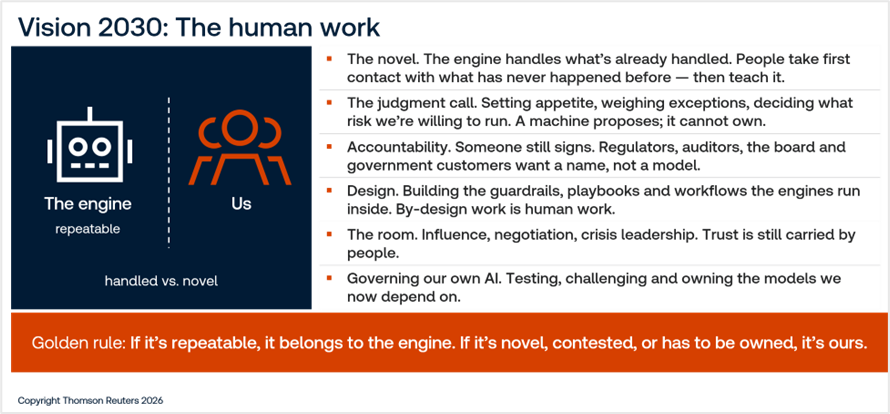
Her answer sorts the work itself rather than the organizational chart. The engine handles what's repeatable; and people own the judgment calls, the accountability, the guardrails, and the trust-based work of being in the room. Thomson’s golden rule is: "If it's repeatable, it belongs to the engine. If it's novel, contested, or has to be owned, it's ours."
This represents a sharper, user-friendly version of the same principle the rest of the leadership team converged on independently: Human review should scale with novelty and risk, not apply as one flat rule.
Jen Ruddick, TR’s Deputy General Counsel for Corporate & Securities, is responsible for Legal Operations and owns the AI strategy for the GCO. She sees potential in scaling proven use cases, recognizing workflows that repeat across the GCO regardless of subject area, such as search and retrieval, review and analysis, drafting and creation, data extraction and structuring, and intelligence and insights. "There are lots of processes in the legal department that are the same, even if they have different contextual background and subject matters," Ruddick says. An NDA review workflow is one example. Once automated for one team, adopting it elsewhere was a repeat, not a new project. It's this build once, use many times thinking that turns the strategy's headline from an ambition into a working method.
How will we know it’s working?
Thomson Reuters’ GCO already uses the Four Spinning Plates to illustrate the value its legal department delivers across four main areas of accountability: Effective, Efficient, Protect and Enable. Applying it also to the AI strategy's metrics made sense because the impact goes beyond efficiency and the measures needed to tell that story.
Five key measures show how the strategy is transforming the GCO’s ability to deliver:
- team engagement
- stakeholder satisfaction
- efficiency (doing more work with less resources)
- holding the standard (less drift from the gold standard), and
- accelerating the pace of the business (using speed as an enabler and helping colleagues act sooner).
What the team loves about these measures is that they tell the story of all the value the GCO delivers, and they avoid the trap of measures built to diminish the legal department through headcount or spend cuts.
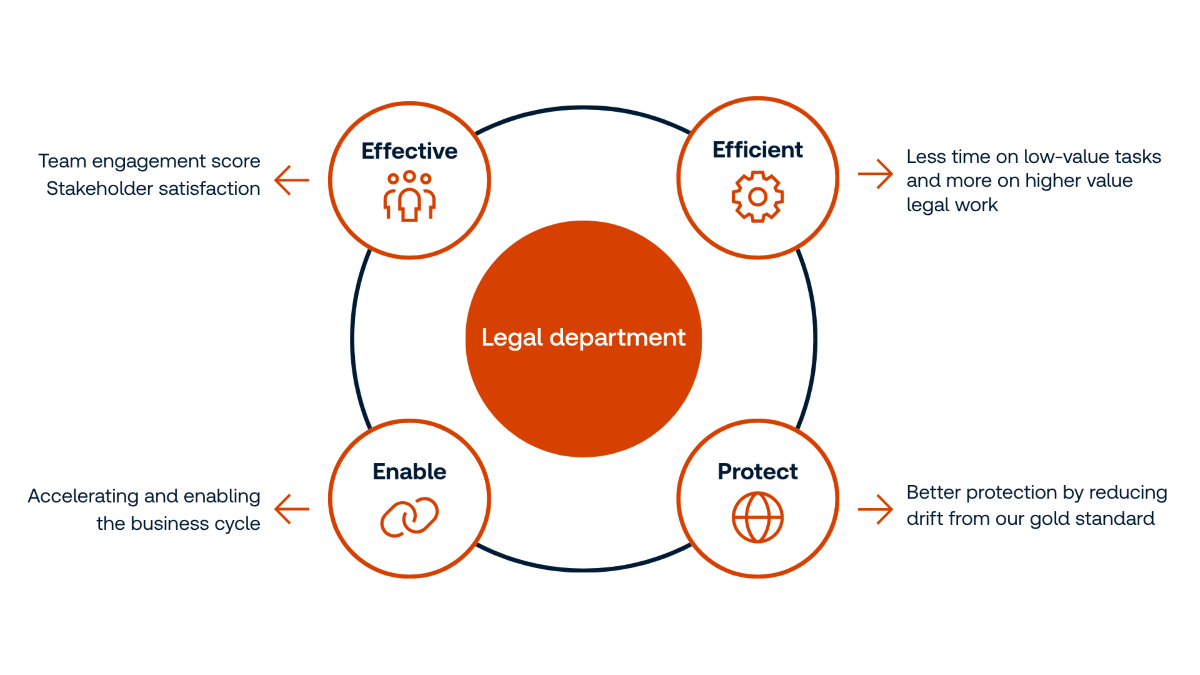
Each initiative's impact and metrics differ, but they should roll up into a department-wide picture, even if no single number tells the whole story.
For example, Project Excelsior’s greatest impact this year will be in efficiency, helping the team handle growing volumes of standard contracts and demand for bespoke ones. While Seamless Integrator, aimed at working more seamlessly with outside counsel, will deliver easier, faster real estate lease agreements and more satisfied internal stakeholders.
For now, easy-to-collect measures beat perfectly precise ones while in time, automated data collection will be built into the workflow.
What are the “no regrets” actions?
Amid all that remains open, the no-regrets actions do not. These moves are worth doing no matter how the talent-model and archetype questions are resolved.
- Train people to use the tools capably and safely.
- Make what the department already knows easier to find and reuse.
- Create the flywheel effect by building a workflow properly for one team and the next team’s version is mostly done.
- Invest in the people doing the work, protect institutional knowledge when someone leaves, and build a clear path for people to grow.
- Lead by example on AI. When the GCO shows how it uses AI in its own work, it earns credibility with its business partners.
Where do we go from here?
A single, exhaustive document nobody reads twice has little value, so three deliverables come out of this work, each with a different job.
- A complete strategy document as the reference point for leaders and those who want the whole picture.
- An execution roadmap setting out milestones, owners, and timing.
- A set of guiding principles to translate strategy into clear expectations for individuals.
Getting all three in front of the department is the start. The real work is folding them into annual planning. After that, the team will advance more use cases to bring the future vision to life.
Want to explore these questions with your own leadership team? The Designing Your 2030 Team exercise, available as part of the Value Alignment Toolkit for Legal Departments, includes a leader worksheet and facilitator guide to help teams challenge assumptions, explore future talent models, and build a shared vision for an AI-enabled legal department.
Follow us on social
Topics
Have questions?

Featured Event
The 2025 Emerging Technology and Generative AI Forum