
The law firm market is accelerating with stronger demand and rising rates, but beneath that momentum is a growing cost structure that’s potentially creating risks that firms cannot afford to ignore.
Key insights:
- Demand and rates are masking structural risks — Strong growth in demand and worked rates are currently offsetting cost pressures, but not all firms are equally prepared if either of those drivers should falter.
- Expenses are rising in tandem — Direct expenses, those attributed to compensation, climbed 8.3% and all other expenses (overhead) rose 7.7% in Q2, forming a rising cost base that is outpacing demand.
- Technology and knowledge management are drivers of overhead growth — Investments in these categories grew 11.6% overall and 8.7% per lawyer, representing a multi‑year investment trend rather than a temporary spike.
As we noted in the Thomson Reuters Institute’s Q2 2026 Law Firm Financial Index (LFFI) report, the second quarter delivered a notable surge in law firm performance that reflects a period in which firms not only maintained momentum but accelerated it. Indeed, demand grew at a pace that, if sustained, would make 2026 the strongest demand year in half a decade, and worked rates themselves are rising at an historic pace.
“The waters haven’t calmed down,” and firms are rowing harder than ever, the report notes.
However, there is some dark water amid all this smooth sailing: Expenses. Both direct expenses (those tied to compensation and staffing) and indirect expenses (basically everything else, commonly called overhead) are also growing together, creating a rising cost wave that could swamp these boats, especially those that may not be prepared for these bills coming due.
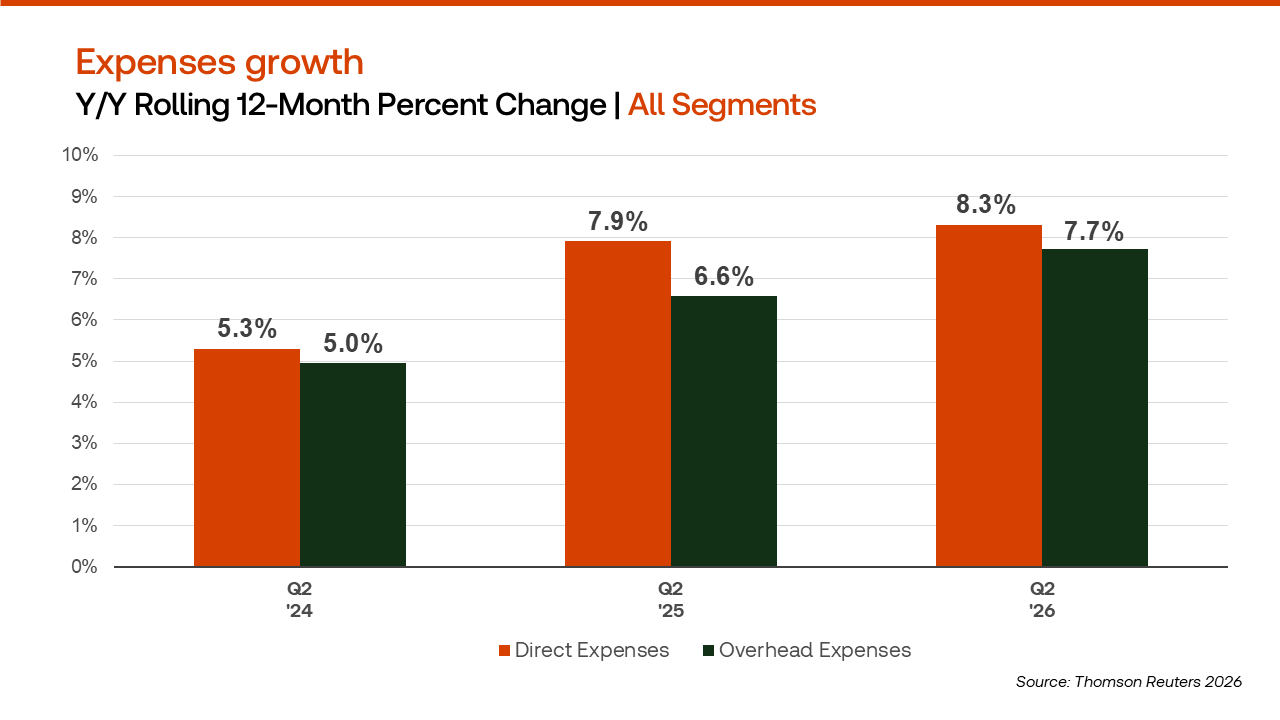
Direct expenses rose 8.3% and overhead costs increased 7.7%, the largest growth figures for both since 2024. These increases are not isolated anomalies; rather, they represent a multi‑year pattern of growing operational heaviness that is becoming an equally defining feature of the law firm market.
Essentially, law firms are moving through the water faster, but each firm is also carrying more weight.
The expense engine: What’s growing and why it matters
The expense story is not simply about inflation or one‑off cost spikes. Instead, it reflects structural changes in how many law firms operate and are planning to in the future.
Direct expenses: Rising along with the workforce
Growth in direct expenses — those tied to compensation and staffing — outpaced demand growth. This is partly driven by the shifting balance of work across job titles. For example, associates saw demand rise 4.3%, and non‑equity partners saw a striking 6.0% increase. Meanwhile, equity partner demand fell 1.2%.
This shift matters because it changes the cost profile of the firm. Associates and non‑equity partners generate strong margins, but they also require sustained investment in compensation, support, and infrastructure. The profitability engine for firms largely depends on leverage — but leverage is expensive to maintain.
Overhead expenses: Technology is in the lead
A major contributor to overhead expenses was technology and knowledge management spending, which combined rose 11.6% overall and 8.7% on a per-lawyer in Q2. This is not a one‑quarter spike; rather, it reflects a renewed emphasis on AI and other technologies, as well as the expertise needed to fully leverage them.

Firms are investing heavily in systems that support workflow, research, automation, and client service. These investments are essential, but they also create long‑term cost commitments. Once a firm adopts a new platform, it must maintain, update, and integrate that platform — and costs will no doubt compound over time.
The masking effect
Taken together, that means the industry’s strong performance in Q2 was real but also uneven, and — more worrisome — the good news may be masking these deeper vulnerabilities brought by expenses and other challenges.
For example, demand is strong, but it’s not evenly distributed and not all law firm segments and practices shared equally in the second quarter growth. Transactional practices grew across all segments, but counter‑cyclical practices showed more modest gains. If economic conditions shift, demand could shift as well, which may rob firms of one of the key drivers of their strong financial performance.
Similarly, the worked rates firms are charging clients continue to rise, but how long can the pace continue? Worked rates climbed 7.1%, a pace that would have been almost unthinkable before the last few years. Rate growth has become a reliable engine for revenue growth, but it has limits. Indeed, clients may tolerate high rate growth during periods of strong demand, but sustained increases could trigger a pushback, a move toward alternative fee arrangements, or other competitive pressures.
The risks ahead
One of the questions posed by the Q2 LFFI report was: “The open question isn’t whether a single ship can move; it’s whether all ships can keep pace with the current.”
If direct and overhead expenses continue to grow at current rates, firms will need sustained demand and rate increases to maintain current levels of profitability. Any slowdown — whether brought by economic, regulatory, or competitive pressures — could expose margin vulnerabilities within many law firms.
This divergence among different law firm segments suggests that larger firms may be better positioned to absorb rising expenses because of their better scale, pricing power, productivity, and leverage. However, the widening gap between segments suggests that not all firms can rely on the same levers — smaller firms may not have the same cushion with which to operate.
Looking toward the need for more expense‑aware strategy
To be clear, despite these drops of rain, the law firm industry is moving ahead, powered by strong demand, rising rates, and a leverage model that continues to deliver strong margins. Yet the cost structure beneath that momentum is growing nearly as fast — and in some cases faster. That, of course, is not sustainable.
The challenge for law firms and their leaders is not simply to maintain speed, but to be prepared for changing conditions. Rising expenses have been manageable simply because demand is strong and rates are rising; however, if either or both of those tailwinds should falter, the picture could quickly change.
That means that law firms should not wait before implementing disciplined expense management — or they may risk being caught by a sudden shift as tailwinds turn quickly into headwinds.
You can access the Thomson Reuters Institute’s Law Firm Financial Index (LFFI) for the second quarter of 2026 here
Follow us on social
Topics
Have questions?