Trade teams are gaining visibility, influence, and resources as they become strategic architects of resilience and growth within their organizations
Key insights:
-
-
-
Trade teams are becoming strategic business partners — Trade is no longer an administrative, reactive function but rather a driver of business strategy and operational resilience.
-
Tariff mitigation strategies — Many organizations are absorbing tariff costs as a tariff mitigation strategy.
-
Technology adoption is surging — Organizations are rapidly adopting automation to improve efficiency and supply chain visibility and are exploring AI and other advanced technologies.
-
-
For decades, corporate trade departments have operated in relative obscurity, being viewed largely as cost centers that manage compliance and transactional paperwork. Over the past 12 months, however, there’s been a dramatic change. Corporate trade departments are emerging as a strategic business function within their organizations, due mostly to the unprecedented wave of tariff volatility that is forcing businesses to fundamentally rethink how they view trade management, according to the Thomson Reuters Institute’s 2026 Global Trade Report.
Jump to ↓
2026 Global Trade Report
As a result, organizations are looking to their trade leaders to analyze, strategize, and execute key realignments of supply chains, markets, operations, facility locations, and more. “The financial burden caused by tariffs led our company to reorganize our supply chain and production footprint in order to reduce tariff exposure and preserve profitability,” notes one trade professional in the report.
From back office to boardroom
For trade professionals, this change represents both validation and opportunity. Indeed, the numbers tell a compelling story, especially for vanguard organizations that are proactively leading the strategic elevation of their trade functions. About 40% of global trade professionals surveyed for the report say they’ve seen enhanced influence over procurement decisions and greater involvement in executive decision-making over the past 12 months. Many also note the increased visibility of their function’s value across the organization as well.
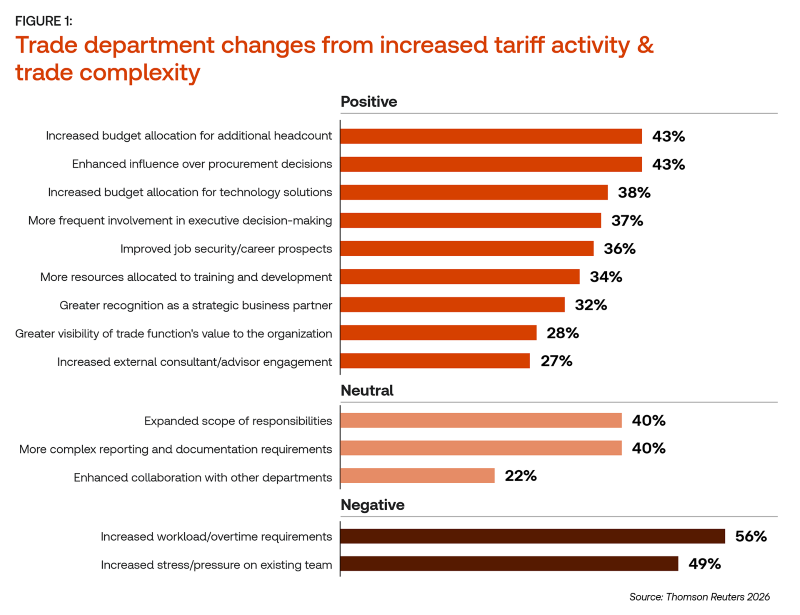
And forward-thinking organizations are backing this shift with more resources. Many survey respondents say their organizations are increasing budget allocation for hiring, technology solutions, and training and development. And survey respondents also report increased cross-functional collaboration with other in-house departments, such as Finance, Operations, IT, and Procurement/Supply Chain.
The tariff reality check
What’s driving this transformation? According to the report, tariffs have fundamentally recast the entire global trade environment. Almost three-quarters (72%) of trade professionals cite US tariff volatility as the most impactful regulatory change they’re facing, which is up dramatically from just 41% who said this a year earlier.
However, it’s not just about the tariffs themselves. The cascading effects of tariffs touch every corner of business operations, leaving companies to grapple with increased regulatory compliance burdens, as well as significant cost pressures on imported materials and components.
One of the most striking findings in the report is the dramatic acceleration in trade departments’ technology adoption, as trade professionals seek to increase efficiency and improve visibility across the supply chain. About 40% of respondents say their departments are exploring emerging technologies like AI or blockchain for trade management, up from just 6% in 2024 — a nearly sevenfold increase.
Even more revealing is that only 2% of trade professionals now consider their department to be in the early stages of technology adoption, a huge drop from 40% previously. It appears the industry has collectively decided that manual processes and legacy systems are no longer viable in today’s volatile environment.
As a result of the tariff disruption, many organizations are scrambling to adopt strategies that will both minimize the immediate impacts of the tariffs and also position them for a global trade environment that has fundamentally shifted long-term.
Particularly sobering is the fact that 39% of respondents say their organizations are absorbing or considering absorbing tariff costs rather than passing them to customers — triple the 13% who said that a year earlier. This dramatic shift speaks volumes about competitive pressures and the threats that tariffs pose to profitability.
Shifting priorities
Not surprisingly, the ripple effects from tariffs have dramatically reshaped strategic priorities. These aren’t routine worries about supply chain optimization — indeed, they represent fundamental concerns about systemic resilience amid volatility that has reached unprecedented levels.
Supply chain management has surged as the top concern for trade professionals, cited by 68% of respondents — nearly double the percentage from a year earlier. Regulatory compliance has similarly intensified. “Customs paperwork and adjustments to tariff categorization are making trade compliance and operational planning more difficult,” explains one trade professional.
The path forward
The opportunity for trade professionals is to capitalize on this newfound influence and operationalize their heightened strategic organizational involvement through formalized processes and policies that create enduring competitive advantages, including more collaboration, leveraging increased boardroom visibility, and more.
As the report shows, trade today is moving beyond simply managing risks from supply chains and compliance and toward becoming increasingly central to strategic business planning. And those organizations that recognize trade as a strategic function worthy of investment and executive attention, and view technology as a force-multiplier for human expertise will gain significant advantages.
The strategic elevation of the trade function is already underway, making the question not whether it will continue, but rather which organizations will take full advantage of it.
You can download
a full copy of the Thomson Reuters Institute’s “2026 Global Trade Report” by filling out the form below: