
Legal teams need to move beyond assumptions to measure and understand stakeholder needs, ensuring that they can deliver true and effective value in the AI era
Key takeaways:
-
-
-
Become truly client-centered — Legal departments claim to be client-focused yet frequently make strategic decisions about effectiveness without systematically understanding stakeholder needs.
-
Decide where to automate — As AI transforms legal services delivery, decisions about where to automate versus where to deploy human judgment require evidence, not assumptions.
-
Build intelligence with continuous feedback — Systematic stakeholder intelligence reveals where speed matters more than depth, which services lack visibility, and where relationships can create differentiated value.
-
-
Today’s general counsels face a fundamental challenge as AI capabilities expand, that of determining where to deploy technology and where to deploy human judgment. Getting this formula right can create irreplaceable value for an organization. Yet many GCs may be making these critical decisions based on assumptions about what stakeholders need rather than evidence.
The paradox is that while corporate legal departments consistently say they want to be effective, client-focused, and responsive partners in service of the business, many are making strategic decisions about how to be that way without systematically measuring or understanding the stakeholder experience they’re trying to optimize. It’s like declaring customer satisfaction as your goal while never actually asking customers how satisfied they are. This blind spot doesn’t just undermine service quality; it undermines one of the four core accountabilities of every legal department which is that of being Effective.
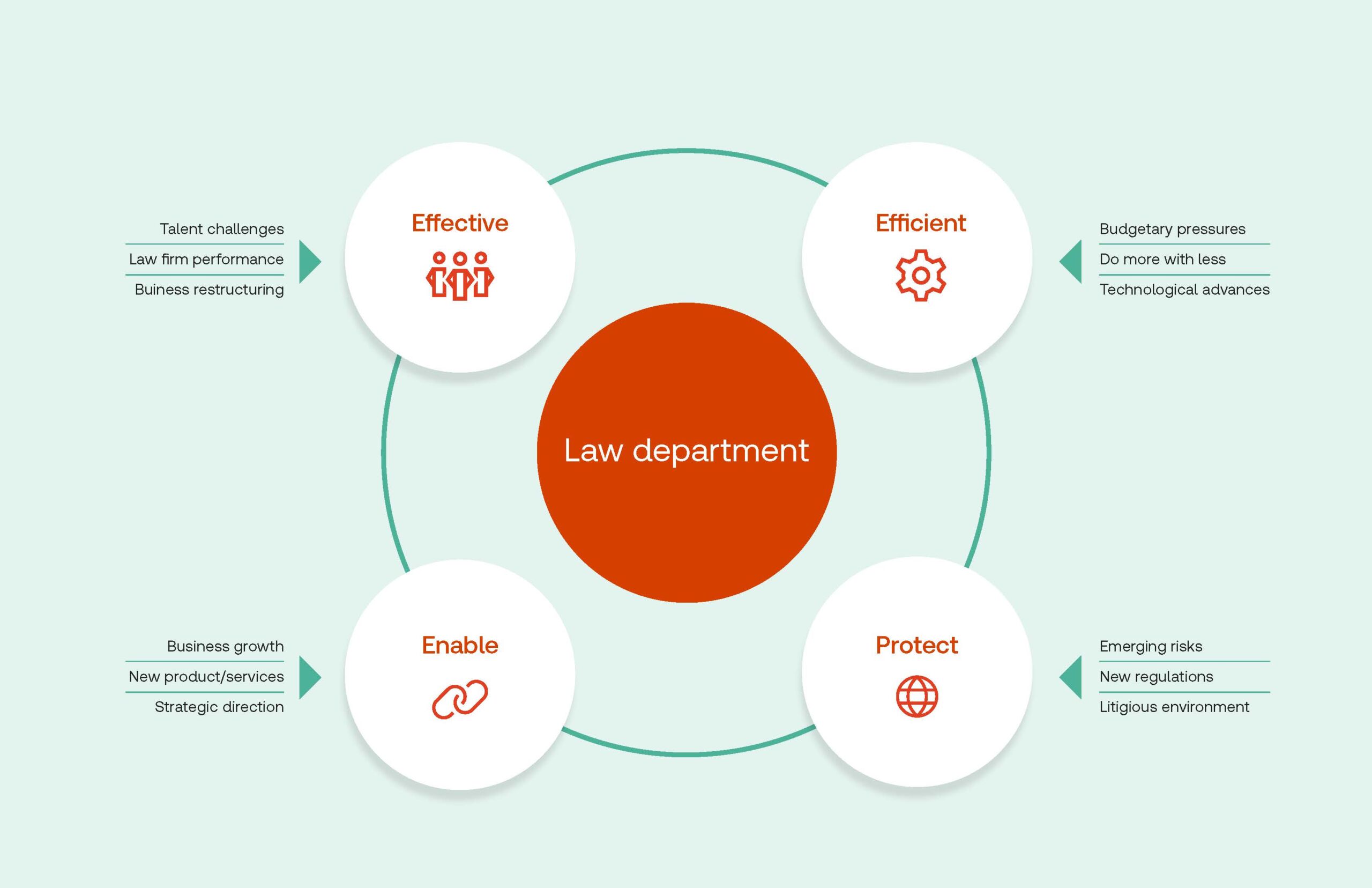
This is the third part of our series on the “Four Spinning Plates” model, which frames the GCs’ evolving responsibilities as:
-
-
- delivering effective advice
- operating efficiently
- protecting the business, and
- enabling strategic ambitions.
-
This article focuses on the Effective plate.
The information gap
Being Effective as a legal department means delivering high-quality, practical legal advice that is responsive to business needs, and this requires knowing what those needs are. Most legal departments rely on hallway conversations, occasional feedback during business reviews, and organic complaints or praise. While these interactions are valuable and should continue, what they lack is systematic intelligence that could be used to determine the best strategic decisions.
Ad hoc feedback is reactive, incomplete, and reflects the loudest voices rather than the broader reality. You hear from the very satisfied or the very unsatisfied, rarely from the middle majority of stakeholders whose experience shapes overall effectiveness.
As AI transforms legal delivery, this information gap becomes more costly. Without understanding which feedback touchpoints stakeholders prefer as human interactions and which they’d rather handle on their own, how can you decide which legal services to automate and where your team’s judgment and relationship-building are essential?
When legal departments systematically gather stakeholder feedback, they uncover patterns that challenge assumptions about what effectiveness means to the business.
Consider response time, for example. Many legal teams pride themselves on providing thorough, carefully crafted advice. However, stakeholder feedback often reveals that the speed of an initial response matters more than depth, at least for the first touchpoint. What lawyers see as diligence, stakeholders may experience as delay. This insight doesn’t mean the legal team should compromise quality; rather, true effectiveness comes from knowing when a quick acknowledgment is sufficient and when an issue demands thorough analysis right away.
Varied responses needed
Of course, different stakeholders have different expectations of responsiveness. For example, sales colleagues working under targets and time pressure need speed to drive momentum in contract negotiations. Understanding different stakeholder personas can help manage expectations and educate junior lawyers about the different business rhythms that the legal department must respond to.
Or, as another example, take service awareness. It’s common to discover that stakeholders simply don’t know the full extent of what the legal team can offer. Business leaders may not realize their legal team provides training, templates, or advisory services that could prevent issues before they escalate. The problem here isn’t service quality, it’s visibility — and that distinction matters enormously when deciding where to invest limited resources.
You can learn more about how the Thomson Reuters Institute’s Value Alignment toolkit allows you to assess your legal department’s strategic positioning here
More importantly, these insights directly inform AI integration strategy for corporate law departments. Routine, high-volume work in which speed matters is a prime candidate for automation and self-service tools. Complex matters in which stakeholders specifically value a lawyer’s business understanding and strategic judgment is where to protect and focus human capacity.
Perhaps the most valuable output of fostering systematic feedback is when that feedback reveals where satisfaction varies across departments or stakeholder groups. A legal department might assume it delivers consistent service, only to discover that one business unit rates the department highly for responsiveness while another complains that it struggles to receive timely answers. These variations point to either inconsistent delivery or improperly communicated expectations. which are exactly the kinds of problems that process standardization, better intervention systems, or technology can address.
Without this type of intelligence, GCs risk automating services that should stay personalized, or maintaining high-touch approaches for work that stakeholders would happily handle themselves through self-service options.
The human value imperative
As AI handles more legal work, the question becomes: What can legal professionals do that technology cannot? The answer lies in the distinctly human elements of legal service such as judgment, knowledge of the business, relationship building, and strategic counsel.
The challenge for corporate law departments, however, is that without first knowing which touchpoints stakeholders value as human interactions, you can’t strategically deploy your team’s capabilities. Systematic stakeholder feedback allows evidence-based decisions on where the legal team’s relationship adds value and where speed or self-service could better serve stakeholder needs.
The question for every General Counsel then becomes: Are you making decisions on the department’s effectiveness based on systematic stakeholder intelligence, or operating with a blind spot that may be costing you more than you realize?
This then becomes critical intelligence for decision-making around resource allocation and restructuring, as well as for demonstrating the legal team’s value to the C-Suite in terms they can recognize. When a GC can articulate not just what their department does but how effectively it serves broader stakeholder needs, they are speaking the same language as the business they support.
This also allows a GC to shift from defending their department headcount based on workload volume to justifying resources based on stakeholder-defined value — and that’s a fundamentally stronger position.
Understanding the Spinning Plates
The Four Spinning Plates model — Effective, Efficient, Protect, and Enable — represents the complete picture of a legal department’s role and value within the organization. Yet research consistently shows a perception gap. For example, C-Suite executives over-emphasize the Effective plate while under-recognizing Protection and Enablement contributions.
This gap exists partly because legal departments lack metrics that capture effectiveness in business terms. They can report cost savings and matter volumes but struggle to demonstrate how well they’re actually serving stakeholder needs. Stakeholder feedback mechanisms bridge this gap by making effectiveness measurable and visible through the lens of those the department serves.
Indeed, it’s not about running surveys for the sake of feedback. It’s about grounding strategic decisions about AI integration, service design, and where to focus human talent, in evidence not assumptions. For those GCs navigating AI transformation specifically, this isn’t optional. Rather, it’s the difference between guessing where to automate and knowing where automation serves stakeholders.
Leading legal departments are already using stakeholder intelligence as their compass for AI transformation, leveraging that intelligence to best determine where to standardize, where to automate, and where human judgment remains irreplaceable.
The question for every General Counsel then becomes: Are you making decisions on the department’s effectiveness based on systematic stakeholder intelligence, or operating with a blind spot that may be costing you more than you realize?
You can learn more about the challenges that corporate GCs face every day