
General counsel must resist the pull of efficiency-only measurement, because in the AI era, what you don't measure is costing you more than you think
Key takeaways:
-
-
-
Efficiency is a means, not an end — Gains from AI only count when you can show what they enabled: better advice, stronger protection, smarter business support.
-
Narrow measurement invites cuts — Legal departments that measure AI value only through cost savings are telling C-Suites that legal costs less, thereby inviting budget and headcount reductions.
-
Measure across all four plates — A framework that captures effectiveness, risk, and enablement alongside efficiency is what shifts perception of the legal department from cost center to strategic asset.
-
-
Your legal department has invested in AI tools, adoption is growing, your team is saving time on routine work and, by most accounts, work operations are running faster. Then your CFO asks a simple question: What has AI delivered for the legal department?
If your answer centers on hours saved and cost reduced, you are not alone. However, you may be leaving your most important value story untold. And in a climate in which legal departments are under more scrutiny than ever to demonstrate the full return on their AI investment, that gap matters.
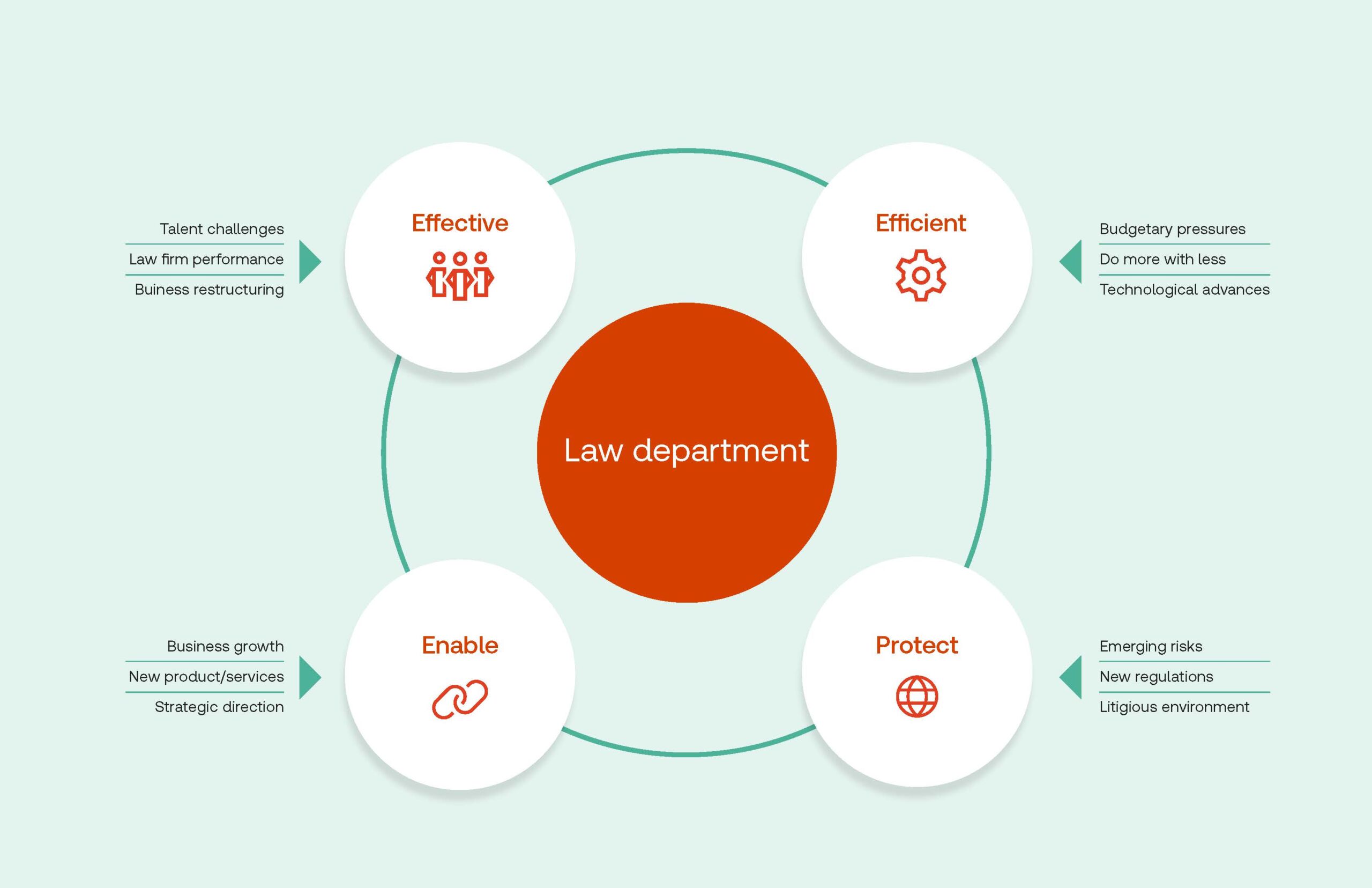
This is the fourth and final part of our series on the “Four Spinning Plates” model, which frames the GC’s evolving responsibilities as:
-
-
- delivering effective advice
- operating efficiently
- protecting the business, and
- enabling strategic ambitions.
-
This article focuses on the Efficient plate and specifically on the risk of letting it do too much of the talking.
The Efficient plate under pressure
For a GC, making the best use of what are often limited resources is a constant pressure. The Efficient plate sits alongside, not above, the other three plates and must be kept always spinning. Right now, however, for many in-house legal teams the Efficient plate is receiving disproportionate attention, and for understandable reasons.
AI adoption in corporate legal departments is accelerating quickly. According to the Thomson Reuters Institute’s AI in Professional Services Report 2026, nearly half (47%) of corporate legal respondents surveyed said their department has already integrated generative AI (GenAI) into their work — more than double the figure from the previous year. A further 18% reported that they’re already using agentic AI, with more than half expecting agentic AI to be central to their workflow within the next two years.
GCs are genuinely excited about what this makes possible. As one GC said in the survey that underpinned the AI in Professional Services Report: “It presents the promise of getting out of low-value work and into higher-value work that supports the business.” Another described their vision of a legal department that is “boldly digital-first, relentlessly innovative, and tightly woven into business priorities.”
Clearly, the opportunity is real, but so is the risk of measuring it badly.
The measurement trap
Our 2026 research found that only one-quarter of legal departments are currently measuring the ROI of their AI tools. That alone is striking given the pace of adoption but the follow-up finding is where the real problem lies — of those departments that are measuring ROI, 80% are tracking it in terms of internal cost savings.
Reducing external spend, automating high-volume processes, and bringing more work in-house are all legitimate efficiency gains and worth reporting, of course. However, when cost reduction becomes the only story being told, two things can happen. Your C-Suite learns to associate your department’s value with how little it costs, a frame that is very difficult to escape once it’s established. And the wider value that efficiency enables in terms of sharper risk identification, faster business support, and higher-quality advice goes unmeasured and therefore unrecognized.
If your metrics only capture time saved and cost reduced, and not what that freed-up capacity actually delivered, you are measuring the means and ignoring the end.
Think about what GCs themselves say they want from AI. As several GCs said in the survey, they’re hoping AI will provide them with “better output on more meaningful tasks,” “proactive, strategic insight,” and “getting out of low-value work.” These are not efficient outcomes, per se; rather, they are effectiveness, protection, and enablement outcomes, made possible by improved efficiency.
So, if your metrics only capture the input (time saved, cost reduced) and not what that freed-up capacity actually delivered, you are measuring the means and ignoring the end. This is the efficiency trap — measuring the plate so narrowly that it starts to work against you.
Reframing how you measure efficiency
Measuring efficiency well does not mean measuring it more. It means measuring it differently, and always in relation to the business you support. A few principles worth applying include:
Present spend in a business context — Legal spend as a percentage of company revenue tells a more credible story than a raw cost figure. It scales with the business and can be benchmarked meaningfully against peers.
Show what technology investment actually delivered — Time saved through automation is a useful starting point, but the stronger case is what the team did with that time. Tracking the shift from routine to strategic work over a period of time is a far more compelling ROI story.
Connect efficiency gains to business outcomes — An efficiency gain that enabled a faster product launch, prevented a compliance risk, or improved stakeholder satisfaction has a value that no cost metric will capture. Build those connections explicitly into how you report the value of the legal department to the C-Suite.
New resources to help
To support GCs in getting this right, the Thomson Reuters Institute has added two new resources to its Value Alignment Toolkit that directly address this measurement gap.
The Metrics Library brings together more than 100 metrics organized across all four spinning plates. It is a practical starting point for GCs to browse, select, and adapt to the specific goals of their departments, making it easier to build a measurement framework that reflects everything departments do, not just the part that appears in a budget line.
The AI Success Metrics guide addresses the AI measurement gap head-on with a best practice guide and a hands-on worksheet designed specifically for legal departments navigating AI adoption and asking: How do we actually know whether this is working? It looks beyond cost savings to capture the fuller picture of AI value including quality, capacity, strategic contribution, and risk.
Getting the balance right
In today’s environment, every GC needs to consider their answer when their C-Suite asks what the legal department delivers. Are your department’s metrics giving them the full answer or just the part that’s easiest to count?
Efficiency is not the enemy of strategic value. A department that runs well, uses its resources wisely, and embraces technology thoughtfully can in turn create the conditions for everything else the business needs from its legal function. However, that case only lands if your metrics measure across all four plates, not just one.
You can explore the new Metrics Library and AI Success Metrics guide, along with the full Thomson Reuters Institute’s Value Alignment toolkit here