
One of a corporate GC’s primary roles is to protect the organization by proactively leading risk management, collaborating across the business, and communicating effectively with senior management
Key takeaways
-
-
-
Business risks are rising — Businesses are seeing elevated risks around trade tariffs, worries of recession, and other uncertainties.
-
GCs must lead strategically — Corporate general counsel need to engage in proactive scenario planning to better anticipate potential risks.
-
Communication and collaboration are key — GCs need to communicate and collaborate both across the business and with senior management for effective risk management.
-
-
Imagine waking up to news that a key supplier’s country has suddenly imposed new export restrictions, or that a regulatory body announced sweeping changes overnight. For many corporate general counsel (GCs), these scenarios are part of the daily reality in today’s volatile global landscape. In this environment, the GC’s role as protector of the business has never been more vital.
Growing economic and geopolitical uncertainty are leaving many businesses struggling to determine their optimal course for moving forward amid rising risks. The volatile trade environment, rising costs, interest rate uncertainty, and economic slowdown concerns are only a few of the factors raising corporate insecurity to new heights.
The Four Spinning Plates Model: Context for the GC’s role
The Four Spinning Plates model frames a GC’s responsibilities as: i) delivering effective advice; ii) operating an efficient legal department; iii) protecting the business from unwanted legal risk; and iv) enabling the company’s strategic ambitions. This article focuses on the Protect Plate and the role of the GC in helping their business navigate uncertainty; and like future parts of this series, it is based on extensive conversations we’ve had with GCs around these issues.
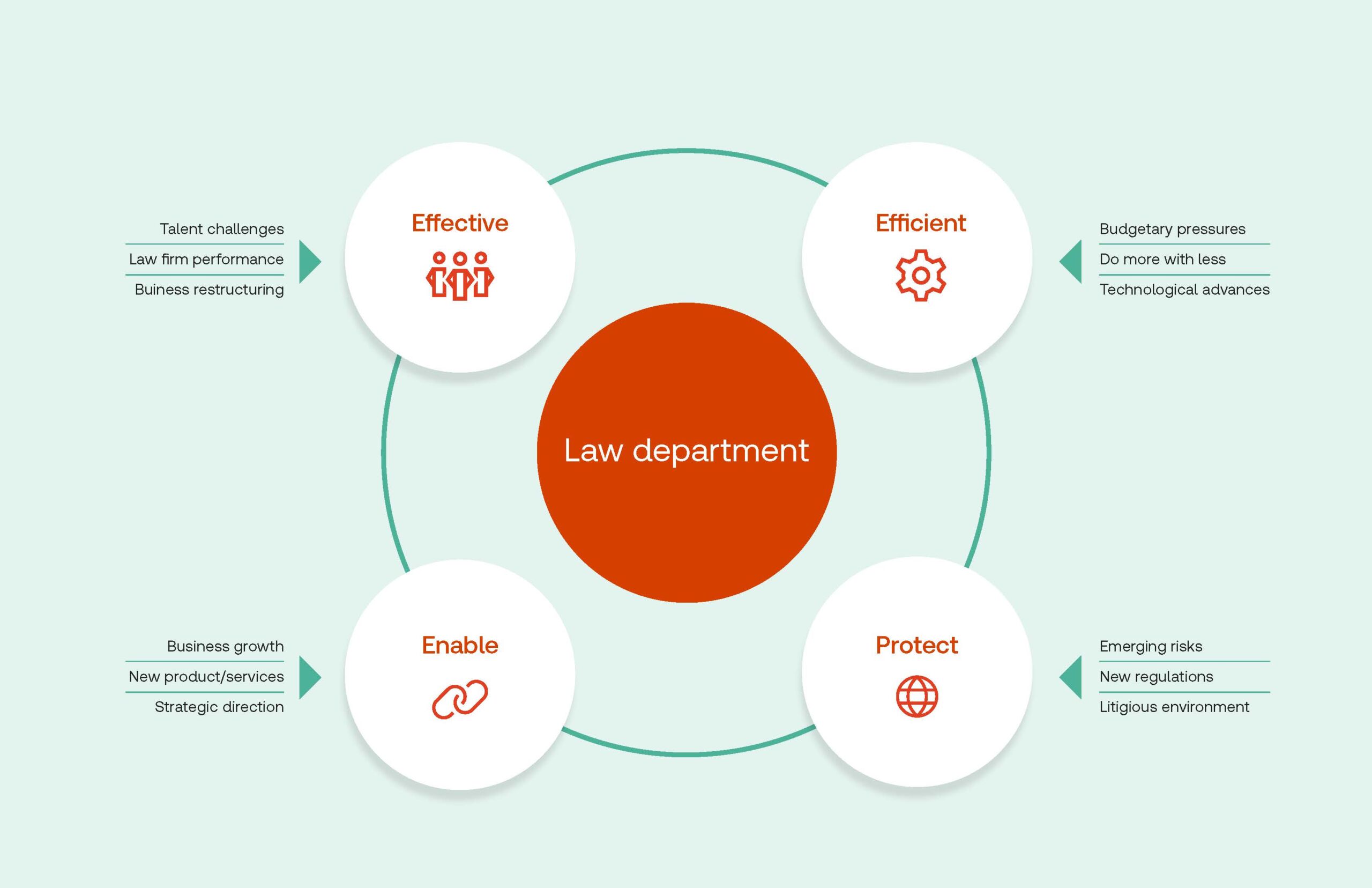
In our discussions with GCs, many point out that the importance of serving as not only legal guardians, but as a key strategic advisor to their organization has never been greater. “The pace of change is speeding up,” one GC noted. “The world is becoming more complex, and it’s becoming less clear what the path forward is.”
The on-going, often-chaotic tariffs situation provides an example of how GCs are currently challenged to develop and execute strategies to manage risk across their organizations. Tariffs impact multinational businesses in a multitude of areas simultaneously. This means that supply chains must deal with potential disruptions and re-examine supplier relationships and contracts based on geography and other factors. And that means that contracts need to be re-assessed for both current flexibility and the potential need for renegotiation or future changes.
Further, production and demand forecasts must be continually adjusted, finance needs to account for volatile pricing and taxation, and regulatory and compliance changes must be continually updated and evaluated.
“It’s increasingly hard to assess what’s going to be different from one day to the next,” one GC recently told us. “Not knowing how to plan even two or three quarters ahead has been very difficult for companies and legal teams.” And tariffs are only one of the myriad of risk drivers that organizations are currently facing across the global economic and regulatory environment. And as other recent events — such as conflict in the Ukraine and the COVID-19 pandemic lockdowns — have shown, disruptive global events can erupt at any time.
Consider a recent instance in which a multinational manufacturer’s operations were disrupted by new tariffs that were suddenly imposed. The GC’s team quickly convened a cross-functional task force across the organization’s legal, supply chain, finance, and operations to assess contract exposures, renegotiate terms with key suppliers, and advise the board on immediate and long-term risk mitigation. As a result, the organization managed to avoid millions of dollars in potential losses and emerged with stronger, more resilient processes in place. This is the kind of real-time leadership GCs are now expected to deliver on a daily basis.
Risk management in turbulent times
Many of the GCs with whom we’ve spoken emphasize that they must be able to lead strategy discussions for their organizations and not merely react to external conditions. Lawyers’ skills at scenario planning can be a strategic asset that goes well beyond any notions that they are merely helping their organizations’ hedge their risks. “Lawyers possess a trained skill set of how to keep moving forward in ambiguous environments,” a GC explained.
One of the keys, according to GCs, is understanding that it is not essential to initially know or immediately provide an answer, but rather to enable the frameworks, processes, and resources to help the business expeditiously arrive at an answer. And it is often not a single answer but a series of flexible or potential options for effectively dealing with various scenarios amid fluid, unpredictable environments.
Collaborate across the business
In our discussions, GCs have emphasized that their in-house legal departments are most effective when they serve as a central hub for the collection and synthesis of risk intelligence across the entire organization. This means gathering input from all sections of the business to thoroughly understand both the macro issues facing the company as well as the varied viewpoints of organizational leaders in assessing and strategizing against those risks.
“The key is to use that hub to efficiently share the information that’s needed to get to the right answer,” according to one GC.
Effective communication is key
Open dialogue between legal and operational teams can help identify emerging or non-obvious risk vectors — such as regulatory shifts, contractual risks with critical vendors, or cross-jurisdictional tax impacts — before they escalate into crisis. Stress tests can similarly help identify potential vulnerabilities; and scenario planning sessions and regular updates or risk roundups can help ensure that planning is current with fast-moving market conditions.
All of this needs to be communicated regularly to other senior management. Processes need to be implemented in which the legal department delivers timely, concise, forward-looking risk updates directly to key executives, focusing on immediate threats — such as tariffs, regulatory changes, and litigation exposure — while tying their potential impact to the organization’s strategic business initiatives.
Measurement and metrics
There is an inherent irony in that if GCs are doing an excellent job of risk management, successful outcomes mean the avoidance or mitigation of situations and events that could have been potentially damaging to the company. So, unlike other business metrics, these represent not what was necessarily achieved, but what was prevented — which, quite naturally, can be very challenging to quantify, measure, and document.
This makes it all the more important that GCs establish regular and effective communications with other senior leadership in the business. Establishing risk models can help clearly communicate the legal department’s risk management goals, which in turn can be regularly reviewed to evaluate success or adjusted as needed. Risk parameters and events, such as litigation cases or supply chain disruptions, can be measured and compared with previous time periods.
Actionable takeaways
There are several steps that corporate GCs can take to better protect their organization from risk, including:
-
-
- Develop playbooks for likely risk events and ensure cross-functional teams are ready to meet quickly and act decisively
- Establish scenario-planning as a regular discipline, not just a crisis response
- Create regular risk roundtables with leaders from operations, finance, compliance, and technology to identify emerging threats and align organizational responses
- Develop a risk dashboard or regular executive briefings that translate legal risks into strategic context that highlight potential business operational impacts
- Work with finance and risk management to develop risk-avoided metrics and then share examples of near-misses or successful interventions with the board and C-suite
-
As the pressures of uncertainty intensify, organizations are increasingly looking to their GCs to provide a steady hand and reasoned counsel to guide the business through turbulent times. However, the most successful GCs go further, embedding themselves as strategic business leaders who not only protect but also enable and empower their organizations to thrive amid change. By mastering the Protect Plate, today’s GC can be poised to become tomorrow’s indispensable business leader.
You can download a copy of the Thomson Reuters Institute’s 2025 C-Suite Survey Report here