
How can practical use of AI cut manual effort, sharpen KPIs, and elevate indirect tax from a back-office obligation to strategic business partner?
Key takeaways:
-
-
-
AI carries benefits — Leveraging AI allows tax departments to free up capacity, improve accuracy and timeliness, and enable indirect tax teams to shift from manual processing to strategic advisory roles.
-
Undertaking pilot initiatives — Small, well-governed pilot projects with clear metrics can prove value quickly and unlock budgets while strengthening risk and audit controls.
-
Translating between tax and tech — Upskilling as a tax-technology translator accelerates your team’s influence and helps deliver cross-functional insights that drive business outcomes.
-
-
If your corporate tax department’s indirect tax team feels buried under filings, reconciliations, and ever-shifting rules, you’re not alone in that feeling. Most indirect tax teams today are stretched thin, measured on accuracy and timeliness, and consumed by manual work.
The good news is that AI is now practical enough to change that equation. And it won’t replace your team’s expertise — it will amplify it. With the right approach, AI can free capacity, improve core metrics, and position the indirect tax team as a strategic advisor across the business.
The force multiplier: How can AI help?
AI is a force multiplier that unlocks time for tax professionals to pursue higher-value work. Traditionally, the most labor-intensive indirect tax tasks are structured, repeatable, and rules-based, such as data preparation, reconciliations, exception handling, return preparation, and document management.
Fortunately, that makes these ideal for AI-driven automation. Document intelligence, for example, can extract and validate invoice and exemption certificate data at scale. Machine learning-driven anomaly detection can identify outliers before they become costly errors. And automated workflows can route exceptions, log decisions, and maintain auditable trails.
Given all these capabilities, late-night crunches and fire drills diminish, and more time is reclaimed by professionals that they can devote to planning, scenario modeling, and business partnering.
Importantly, AI directly improves the key performance indicators (KPIs) that leadership cares about most. Accuracy rises when automated validations and tolerance checks reduce manual keying errors, or when anomaly detection flags misapplied rates and address mismatches, and when classification models standardize tax codes and product mappings. Timeliness improves as straight-through processing, automated approvals, and intelligent routing shorten cycle times, while pre-close checks can further reduce month-end rework.
Given all these capabilities, late-night crunches and fire drills diminish, and more time is reclaimed by professionals that they can devote to planning, scenario modeling, and business partnering.
Eventually, the cost to comply drops because there is less manual preparation, fewer penalties, and lower rework. Productivity increases as generative AI (GenAI) assistants draft memos, summarize rulings, and prepare audit responses, allowing each tax department professional to produce more without the department having to increase headcount.
As AI takes on more processing, your role can shift from transactional to strategic. AI-enabled analytics make it easier to connect tax to business outcomes in concrete ways. You can forecast VAT/GST cash flows to inform treasury and working capital planning. You can model the tax effects of pricing changes, promotions, and channel shifts to guide commercial strategy. You can quantify audit exposure by country, product, and customer segment, then focus remediation where it matters most.
Taking the first steps
And perhaps the best part is that you do not need to boil the ocean to begin. Today, most organizations are in and early adoption phase with AI, according to the Thomson Reuters Institute’s 2025 Indirect Tax Report — and if this includes your department, you can start small and still deliver credibility.
AI can help you manage regulatory complexity rather than simply coping with it. Rule changes are accelerating by country, state, and industry. Horizon scanning can monitor tax authority sites, rulings, and news feeds, and then summarize changes by jurisdiction and topic. Impact assessments then can map rule changes to products, channels, and systems, flagging configuration updates and data dependencies. These practices enable a proactive stance that reduces compliance risk and reworks.
Elevating your profile
It’s no surprise that upskilling is the winning career move in this environment. The Indirect Tax Report also found that many companies will upskill existing staff rather than hire more new professionals, creating an opportunity for individuals to stand out. You do not need to be a data scientist, but you should become a translator between tax and technology, allowing you to move between the two and explain complex solutions to leadership. For GenAI tools, you should learn how to structure prompts, request citations, and verify your outputs against authoritative sources.
Fortunately, timing is in your favor today because technology budgets are shifting toward AI investment, and expectations for improved tools and solutions are rising. Early movers who pilot initiatives, measure outcomes, and tell a clear story constantly and consistently will become the faces of transformation.
You do not need to wait for a large program or a new budget cycle, since a focused pilot program with well-defined controls can unlock funding even in constrained environments.
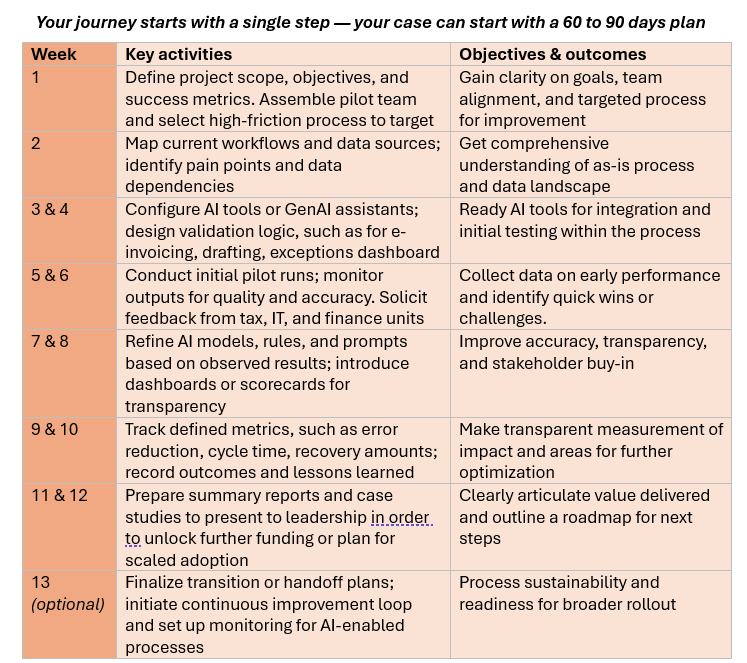
Of course, it’s critical to remember that risk, control, and audit readiness are non-negotiable. AI does not mean a black box; rather you build confidence with transparent rules and explainable models for critical determinations. And when controls are in place — such as maintaining versioned prompts and model outputs for GenAI, including citations to source material; enforcing segregation of duties and approval workflows for changes to tax logic; running regular sampling of AI decisions; and preserving continuous improvement loops with documented findings — you protect the integrity of your processes while gaining the speed and scale benefits of AI.
Again, AI is not going to replace your team’s expertise, but in this way, it will amplify it. AI can create the space and the platform for your team to operate at its fullest professional potential. Indeed, this is a uniquely favorable moment for your tax professionals to step forward, shape the roadmap, and become the tax-technology translators your business needs.
You can download a full copy of the Thomson Reuters Institute’s recent report, Managing Change in Indirect Tax & Compliance here