
Following up last year’s insights, our latest research reveals how corporate tax departments in Brazil are shifting from early planning to active adaptation as they prepare for the operational and strategic challenges of the country’s planned tax reform
Key takeaways:
-
-
-
Technology leads the way — Companies are prioritizing system upgrades and digital tax management tools to meet new compliance demands under the 2025 reform.
-
Strategic planning is key — Early adopters are integrating reform into their business strategies, while others risk disruption by delaying action.
-
Talent development follows infrastructure — Workforce training is expected to grow as organizations solidify their systems and prepare for long-term success.
-
-
Corporate tax departments in Brazil are responding to the country’s sweeping tax reform in myriad ways, upgrading their abilities in both talent and infrastructure, according to a new report from the Thomson Reuters Institute. This reform, approved by Brazil’s National Congress in late-2023, marks a significant departure from the country’s historically fragmented tax system and aims to simplify compliance and improve efficiency across federal, state, and local levels.
Jump to ↓
Brazil Tax Reform for Corporate Professionals 2025
At the heart of the reform is the introduction of a dual Value-Added Tax (VAT) structure — comprising the Goods and Services Tax (IBS) and the Contribution on Goods and Services (CBS) — alongside a new excise tax (IS) targeting products with health or environmental implications. These changes are expected to reshape how companies manage tax obligations, credits, and incentives, particularly as the reform phases in between 2026 and 2032.
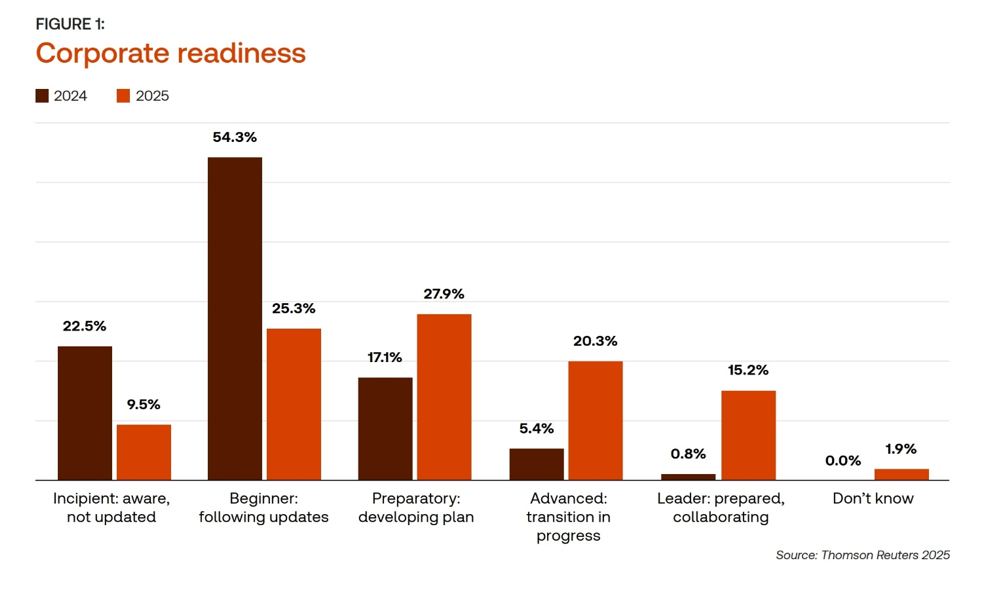
This new report draws on survey responses from professionals in corporate tax departments across Brazil, offering a snapshot of how organizations are preparing for the transition. While some companies remain in early planning stages, others have already begun adapting their systems and strategies. The report’s findings suggest a growing awareness of the reform’s potential impact and a shift from passive observation to active preparation.
Corporate response in motion
One of the most consistent themes across the report is the prioritization of technology. As Brazilian companies prepare for new tax structures and digital compliance requirements, many are investing in system upgrades and modern tax management solutions. These efforts include refining enterprise resource planning (ERP) systems and their ensuring infrastructure can accommodate new electronic tax documentation formats. The report shows that technology is not just a support function — it’s emerging as the backbone of reform readiness.
Also, the report highlights a clear divide between organizations that are proactively preparing and those that are still waiting for greater regulatory clarity. Early movers are integrating reform considerations into their strategic planning and positioning themselves to turn regulatory change into competitive advantage. Meanwhile, companies that delay action may face higher costs, operational disruption, and even legal risks as deadlines approach.
You can access a full copy of the Thomson Reuters Institute’s “Brazil Tax Reform for Corporate Professionals 2025” in Portuguese here
While talent development is acknowledged as important, it currently trails behind technology and strategy in most organizations’ reform plans. Companies appear to be focusing first on system upgrades and compliance frameworks, suggesting workforce training is expected to follow once foundational changes are in place. However, there is growing recognition that skilled personnel will be essential for sustaining success under the new tax regime. The report suggests that nurturing in-house talent — rather than relying solely on external hires — will be key to the long-term resilience of corporate tax functions and their organizations.
Preparing for transition
Brazil’s sweeping tax reform is reshaping the priorities and operations of the country’s companies and their corporate tax departments. As organizations prepare for the transition, tax professionals across the industry are focusing on strategies that combine regulatory awareness, technological modernization, and strategic investment.
As departments seek to upgrade their tax systems, refine financial planning, and gradually expand their talent development initiatives, they are positioning themselves to navigate the reform with confidence. By aligning internal capabilities with external expertise and embracing automation, our research shows that many corporate tax teams are taking a structured, forward-looking approach that will be essential to ensure compliance, minimize disruption, and unlock long-term efficiencies in Brazil’s evolving tax landscape.
You can download
a full copy of the English-language version of the Thomson Reuters Institute’s “Brazil Tax Reform for Corporate Professionals 2025” by filling out the form below: