
A new report finds that closing the C‑Suite visibility gap requires GCs to strengthen internal relationships, communicate legal work in terms of business outcomes, and move from basic AI literacy to true AI fluency
Key insights:
-
-
-
A significant visibility gap persists between legal departments and the C‑Suite — Most general counsel believe their legal department contributes strategically, yet senior executives often fail to see or understand that value.
-
Strong internal relationship‑building is critical (and often underdeveloped) — This capability enables legal teams to spot risks earlier, stay embedded in decision‑making, and make their work more visible across the business.
-
Closing the gap requires communicating legal’s value and increasing true AI fluency — For legal teams to be seen as proactive, strategic partners rather than task executors, communication and strong AI fluency are essential.
-
-
General counsel (GCs) have spent years doing more with less, tightening their legal spend, and aligning the law department’s priorities with the wider business. And yet, despite all of this effort, a striking visibility gap persists. While 86% of GCs believe their department is a significant contributor to overall organizational objectives, only 17% of the C-Suite agrees, according to the 2026 State of the Corporate Law Department Report, from the Thomson Reuters Institute, which was based on more than 2,300 interviews with corporate general counsel. Meanwhile, 42% of C-Suite executives say the legal function contributes little or not at all to company performance.
The challenge for GCs is whether their staff have the skills and capabilities to make their work visible, relevant, and understood by the business at large. To address this perception gap in 2026, every GC needs to prioritize building richer internal relationships with business leads, moving from task-based to outcome-focused messaging, and improving the team’s collective AI fluency.
Empower teams to build internal relationships
Nearly half of all GCs surveyed for the report cited staffing and resource constraints as the top barrier to delivering additional value, a concern that has remained stubbornly consistent for years. Beyond headcount, the report underscores that the deeper challenge facing legal departments is relational.
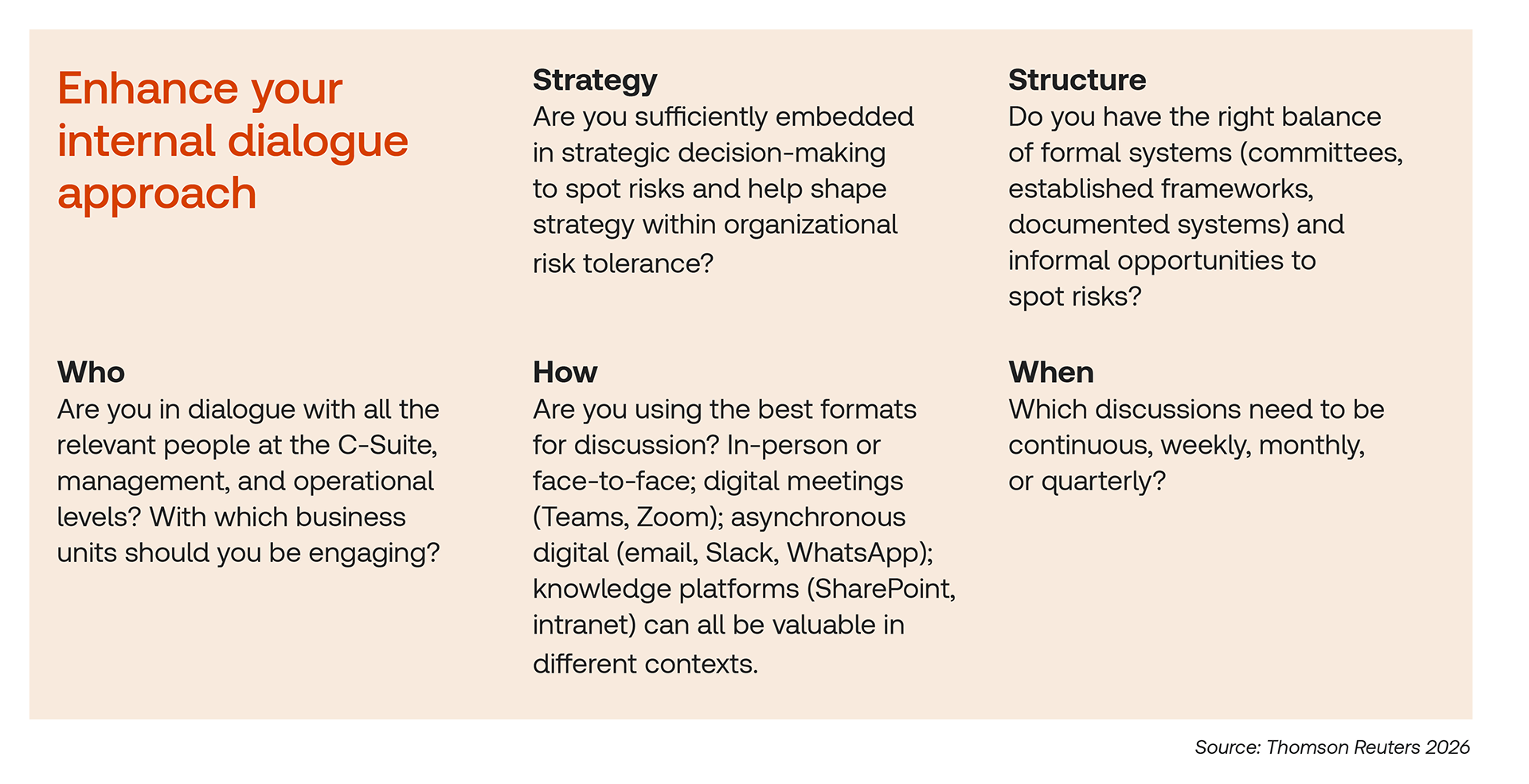
Internal relationship-building is one of the most critical and underrated people skills in a legal department’s collective skill set. Indeed, 68% of GCs rate internal dialogue as their most valuable source of information about emerging risks. In fact, the most successful GCs use a deliberate combination of formal and informal methods to build connections with the internal business units that they serve.
You can learn more about how to assess your legal department’s strategic positioning with the Thomson Reuters Institute’s Value Alignment toolkit, here
Some run structured weekly face-to-face sessions with business departments, complete with schedules, plans, and frameworks. Others rely on walking the halls, open-door policies, and ad-hoc conversations that keep the corporate law department visible and accessible on a human level.
The report offers a five-dimensional framework to help GCs audit where, with whom, and how often legal is in dialogue with other parts of the business.
Use communication tactics that focus on business outcomes
Even when legal departments are doing excellent work, they often describe it in the wrong language. Many in-house lawyers categorize their contributions in task-based terms — such as “We support M&A” or “We analyze contracts” — rather than in value-creating terms.
Some in-house legal leaders have progressed to stakeholder-level framing, such as, “We protect the company from competitive threats” or “We support new business opportunities.” Still, neither of these levels truly communicates value to a C-Suite audience, the report shows.
To effectively align the law department’s priorities with business goals, in-house attorneys need to develop the skill of communicating through a business lens. For example, one GC states that the primary goal of the law department is to “find the fastest and most compliant way for the sales department to sell products.” This response reframes the legal function’s activities as much more business fluent and value-added.
Legal teams are not always good at touting their accomplishments, however, and this is a challenge when a lot of the work can be categorized as invisible. For example, when protecting the company is done right, threats are eliminated before they occur and no one notices. When efficiency is unlocked through process improvement, the C-Suite only sees the outcome if someone connects the dots explicitly. This is why surfacing invisible value is now a business imperative for corporate law departments.
Advancing from AI literacy to AI fluency
The most significant skills challenge facing legal departments in 2026 is how to best use AI strategically. Mentions of AI as a strategic priority among GCs have doubled in the past year, according to the report. In fact, almost half of all GCs now reference AI in their survey interviews. Yet the report draws a sharp distinction between being AI literate and being AI fluent, with most departments being the former but not the latter.
To close that gap, the report recommends a six-layer model covering learning, empowerment, ownership, accountability, usage, and expectations.
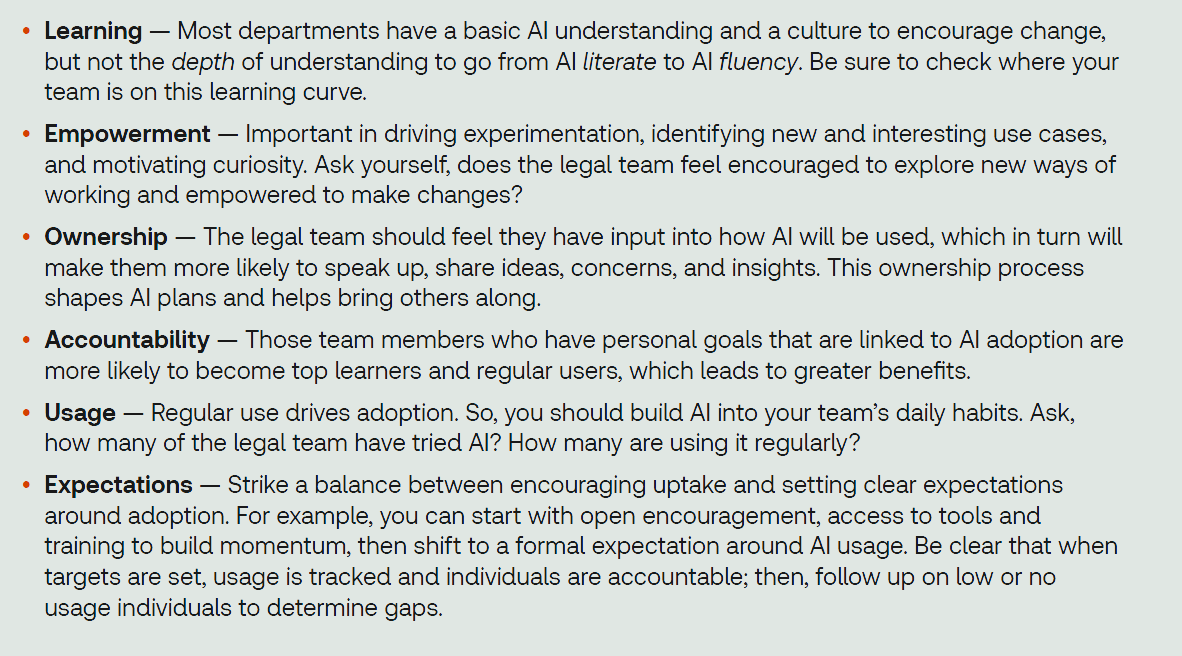
At its core, the model asks GCs to start with open encouragement and access to AI tools to build momentum, then shift toward more formal expectations around adoption to make AI use a daily habit.
You can download a full copy of the Thomson Reuters Institute’s 2026 State of the Corporate Law Department Report here