
Corporations face key obstacles in their desire to push toward greater digital transformation; and corporate departments need to play a more significant role in driving toward corporate objectives, but siloed structures and increasing volumes of data still pose challenges
Key insights:
-
-
-
Digital transformation among top priorities — C-Suite leaders have identified enabling digital transformation, improving operational efficiency, and exploring the potential of AI as their top priorities for 2025.
-
Challenges for corporate functions — Corporate functions face significant constraints, including time-consuming compliance tasks, lack of risk alignment, difficulty keeping up with legislative changes, and ineffective data flows.
-
Opportunities for improvement — To enhance the contribution of corporate functions, C-Suite leaders suggest they focus on simplified compliance and reporting, technology and automation, and risk management and mitigation.
-
-
Corporate C-Suite leaders have been pretty clear about their priorities for their businesses. Indeed, business leaders have made digital transformation, improving operational efficiency, and exploring the potential of AI their top priorities for 2025, according to the 2025 C-Suite Survey, published recently by the Thomson Reuters Institute.
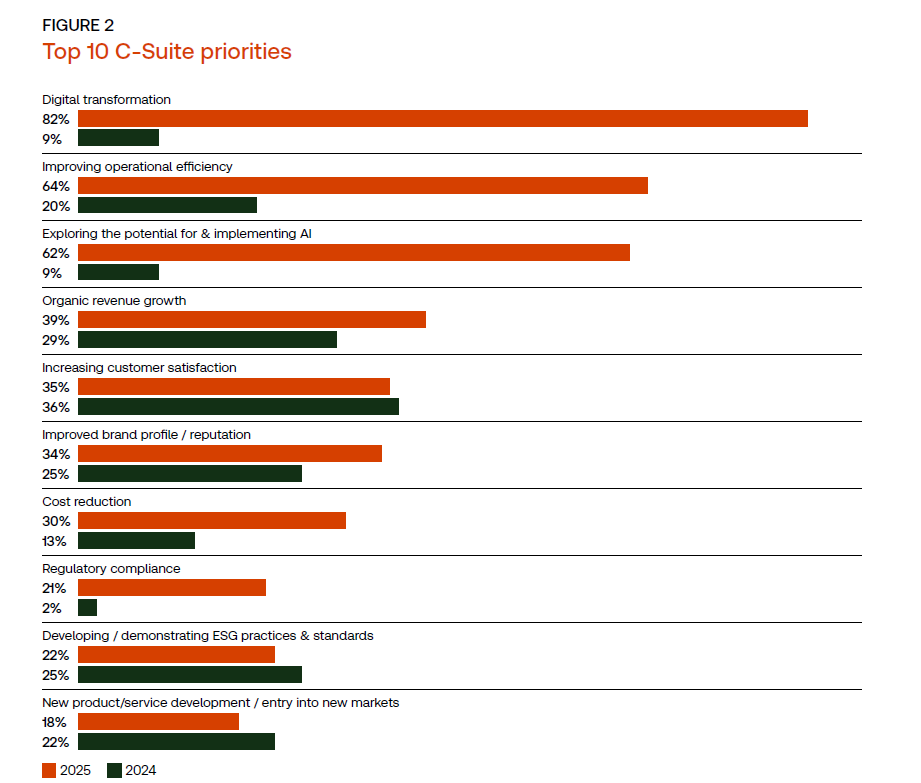
Almost two-thirds of these same leaders (62%) identified the rise of AI and generative AI (Gen AI) as the most likely transformational trend for today’s businesses. However, even with a clear vision of the potential for AI to be transformative, and indeed, a strong desire to drive digital transformation within their businesses, C-Suite leaders are not fully convinced their corporate functions are up to the task and able to contribute strongly to the corporation’s overall objectives.
The role that corporate functions play today
Corporate functions, sometimes called enabling functions are the support operations that keep businesses running and encompass everything from customer success and supply chain management to tax, audit, and legal departments.
Some of these enabling functions have already begun to play a significant role in driving business objectives.
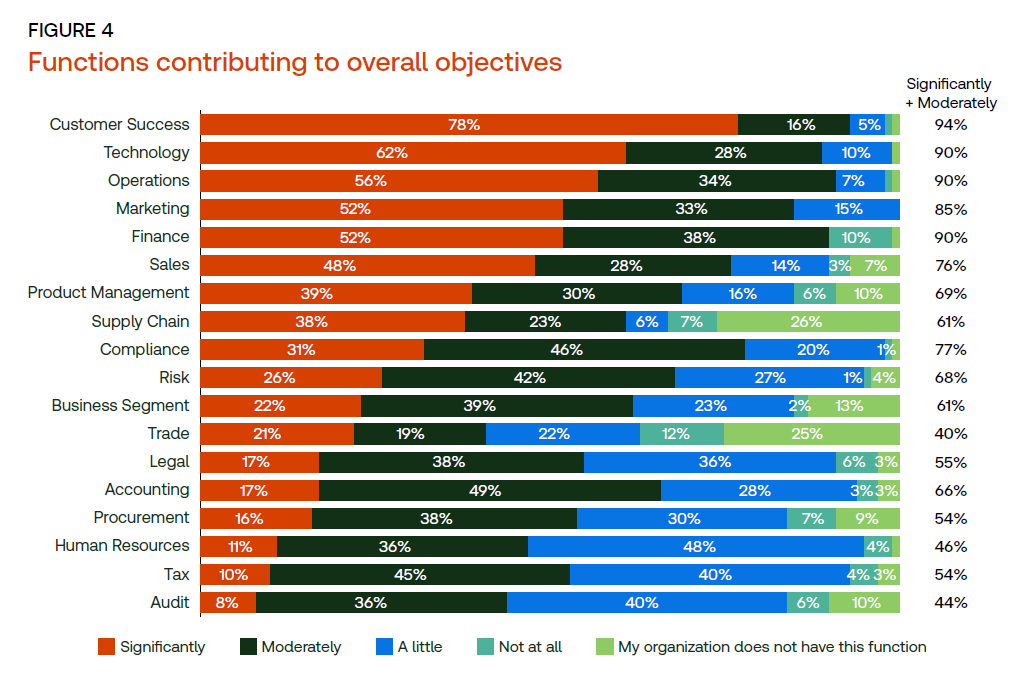
More than half of C-Suite leaders surveyed said that their customer success, technology, operations, marketing, and finance functions have significantly contributed to overall business objectives. In fact, as one respondent stated: “Our support functions, especially in technology and operations, were instrumental in driving a digital shift that improved organizational workflows and overall customer satisfaction.”
Obviously, leaders of every enabling function would love to hear such statements made about the teams or departments they oversee.
A sliding scale of contribution
However, there is a general perception that enabling functions are generally not as effective as they could be, nor able to contribute significantly to the overall objectives of their organization. For example, only 17% of C-Suite leaders said that their internal legal function had played a significant role in attaining overall business objectives; and 42% of C-Suite leaders said that their legal function had contributed to the organization’s overall objectives only a little (36%), or worse, not at all (6%).
This is concerning, not only for the overall organization and its top-level leaders, but for the leaders of these specific internal functions; and it raises questions about the alignment of priorities and communication within the business.
There is a general perception that enabling functions are generally not as effective as they could be, nor able to contribute significantly to the overall objectives of their organization.
Yet, a few different explanations may exist simultaneously. First, the lack of apparent contribution of any given enabling function to broader business goals may be simply a lack of effective communication. In reality, the function may be completing many of the objectives it needs to do to drive the organization forward, but the function’s leaders may not be doing a good job of informing top leadership of their efforts.
Alternatively, C-Suite leaders may not be quite as clear about stating their desired objectives as they think they are, leaving function leaders with less guidance than needed for the team or department to otherwise meet their objectives. Another possibility is that there is, in fact, genuine misalignment between functions’ priorities and those of the C-Suite.
This is likely far from an exhaustive list of potential reasons why enabling functions may not be doing an effective job of contributing to the organization’s objectives, and many of these reasons likely exist simultaneously. There is, however, some insight into what might be constraining the effectiveness of these enabling functions.
What is getting in the way?
C-Suite leaders identified four key areas that have either a moderate or significant constraining effect on their enabling functions, including:
-
-
- Time-consuming compliance and reporting tasks that leave little time for value-add work (with 68% of C-Suite leaders surveyed saying this)
- Lack of alignment around the organization’s risk appetite (58%)
- Difficulty keeping abreast of legislative and regulatory change and emerging risks (54%)
- Ineffective data and information flows between enabling functions (52%)
-
Interestingly, that last point was actually the most frequently cited as placing a significant constraint on enabling functions with 21% of respondents saying that a lack of effective data and information flow was hampering their enabling functions.
This is not a new concern. CEOs have long decried the existence of silos within their businesses; however, with the increasing volume of data generated by businesses and the acceleration of the business cycle, the impact of these silos can easily be magnified. For this reason, it is not surprising to see the long-time frustration around information silos rising to the level of the most significant impediment to enabling functions’ contributions.
What can be done
C-Suite leaders have identified three key opportunities to improve how their enabling functions contribute to overall business objectives:
-
-
- Simplified compliance and reporting
- Technology and automation
- Risk management and mitigation
-
These are important goals, to be sure. However, they fail to confront the silos that C-Suite leaders say are the biggest challenge to their enabling functions.
To effectively push toward a digital transformation, C-Suite leaders will need to find effective ways to improve data and information flows. This presents a bit of a double-edged sword. On the one hand, improved technology creates greater opportunities to improve inter-function collaboration and communication. And while all major business software suites have collaboration and sharing functions integrated into them, creating opportunities for teams to interact in ways they have not been able to before is critical.
To effectively push toward a digital transformation, C-Suite leaders will need to find effective ways to improve data and information flows.
On the other hand, those same technologies create even greater volumes of data and information for corporate functions to manage. By simply adopting a technology tool without making meaningful efforts to more successful integrate the new tool into existing team workflows, businesses run a real risk that technology intended to solve a problem could actually exacerbate it.
That word of caution, however, should not be seen as a reason for corporations to avoid pushing toward digital transformation. As discussed, C-Suite leaders see the digitization of their businesses as a key priority, and broader market indicators are proving them correct. The insights shared here around the challenges for enabling functions should not dissuade them of that notion.
Rather, leaders should be keenly aware of the potential pitfalls and incorporate solutions to these existing and potential problems into their tech rollout and adoption plans as they push into a digital future.
Successfully navigating digital transformation requires more than new technology — it demands intentional change management efforts to break down silos and improve information flow. Leaders who acknowledge these challenges upfront and build solutions into their transformation strategies will be best positioned to unlock their enabling functions’ full potential.
You can download a copy of the Thomson Reuters Institute’s recent 2025 C-Suite Survey here