
As today’s general counsel are becoming increasingly concerned with how they capture and deliver value to the businesses they serve, they should be mindful of how effectively their in-house legal teams are operating and how improvements there can create additional operational value for the business
Key insights:
-
-
-
Managing resources is key — The effectiveness of a legal department depends on how internal and external resources are managed, coupled with the quality and commerciality of the advice provided.
-
Strategic resource allocation needed — Using the right resources for the type of task is critical for GCs who are looking to create operational value in their legal departments.
-
Providing quality legal advice is a differentiator — GCs are looking to their outside law firms to provide commercially relevant legal advice that will help the in-house legal department drive value creation.
-
-
Today’s corporate general counsel (GCs) find themselves juggling a challenging load of responsibilities. Frequently in the past, the Thomson Reuters Institute (TRI) has talked about the four spinning plates that today’s GC must monitor — effectiveness, efficiency, protection, and enablement of business growth.
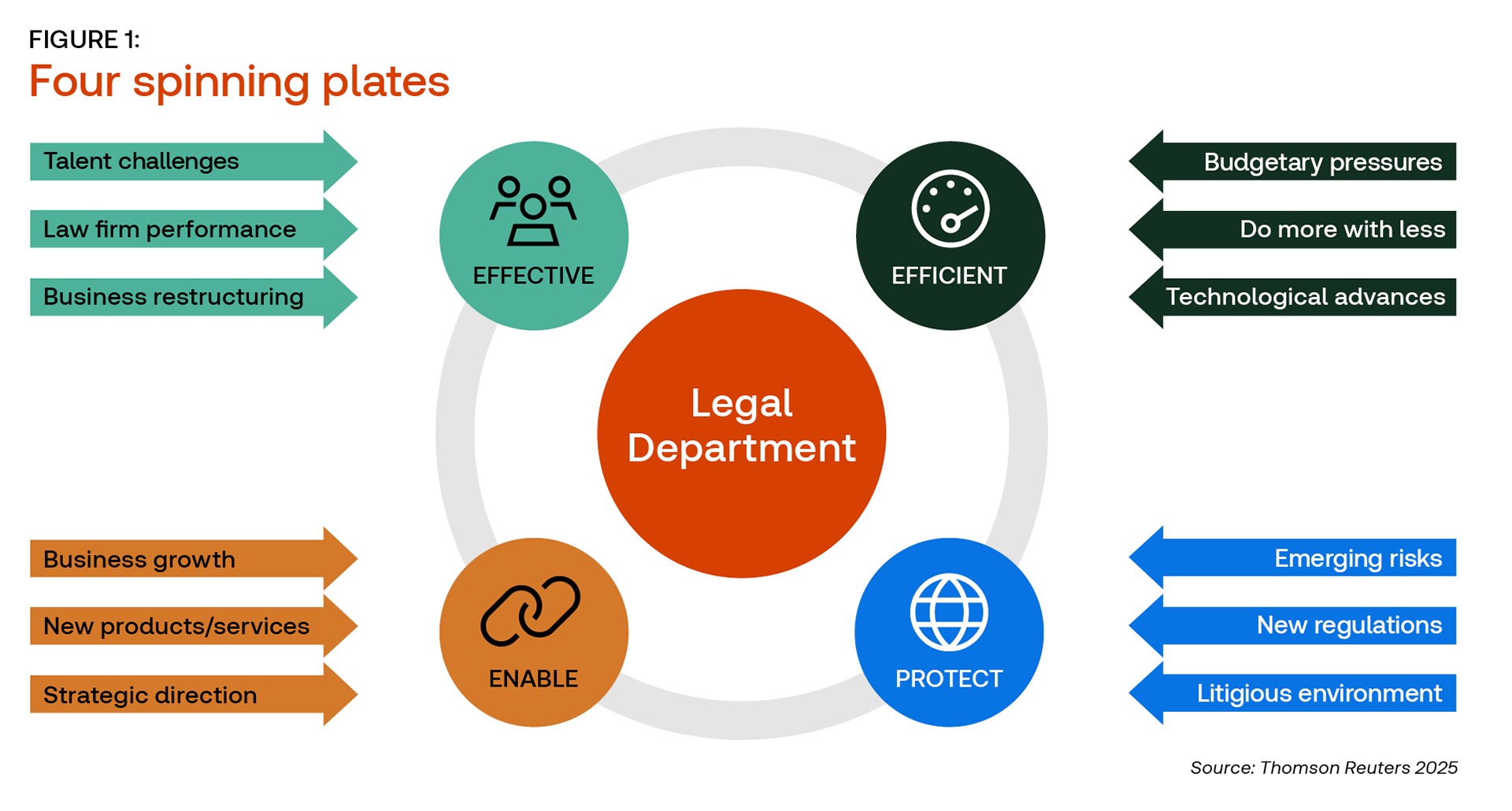
Previously, we described the first of these plates, effectiveness, as an area in which frequently the expectations of C-Suite leaders about their GCs’ office are slightly out of alignment with the daily reality of many GCs.
This misalignment does not mean that business leaders overemphasize operational effectiveness or that GCs neglect this priority; rather, this misalignment is most likely due to the differing perspectives each group has on the operations of in-house legal departments. Within each organization, the C-Suite rightly expects its GC to be operating its enabling function as effectively as possible — it’s a baseline expectation. However, because it is a baseline expectation, it can easily become table stakes for the GC in terms of day-to-day focus. It’s not that effectiveness isn’t top of mind, it’s that focusing on the effectiveness of the department has become business as usual.
However, TRI’s 2025 State of the Corporate Law Department report provides a new lens through which to view the effectiveness of the legal team. As covered extensively in that report, GCs have demonstrated a rapidly increasing focus on extracting value from their team. GCs are looking to bring their teams into alignment with the business’s enterprise-wide value system, attaining greater value from their external legal spend and generating greater value for the business — all while working to protect the value the business itself has created.
Generating value for the business
The idea of generating greater value for the business can be a challenging one for GCs to deliver. The legal team isn’t tasked with product development, lead generation, or sales, so how is the team supposed to generate value?
As discussed in the recent Corporate Law Department report, one way that GCs can create value for the business is by creating greater operational value. This relies on how effectively the in-house team operates, adding a new label to the now-familiar effectiveness plate that GCs are already spinning.
But how does that kind of value-generation work in practice?
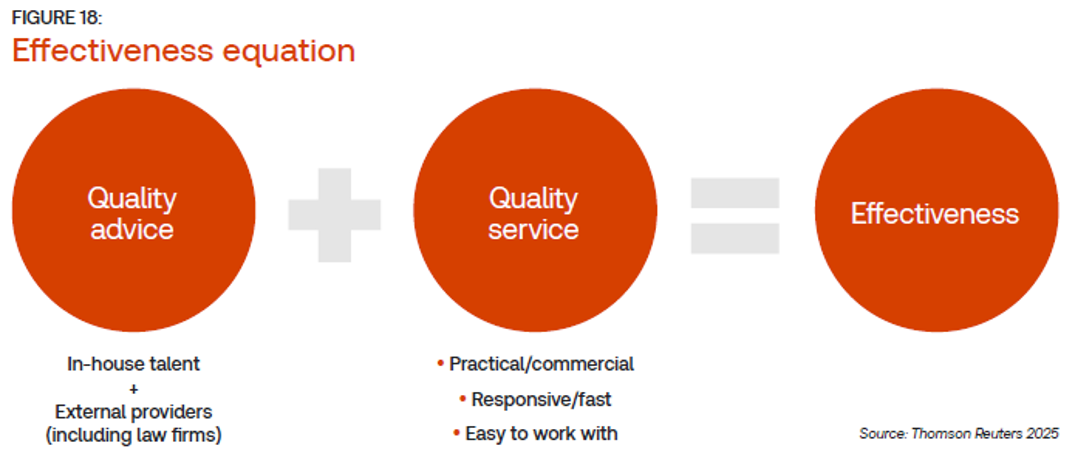
This effectiveness equation provides a handy framework to which GCs can refer when trying to optimize the effectives of their operations. In sum, how GCs manage their resources and talent, coupled with how they provide advice and service, equates to how effectively their team operates.
Which resources to use and when
The first component of the equation deals with striking a balance between internal and external resources. GCs tend to look primarily to internal resources for day-to-day and core types of work as well as matters that require a greater sense of the commercial interests of the business. They also favor their in-house teams when cost is a factor, an increasingly common consideration.
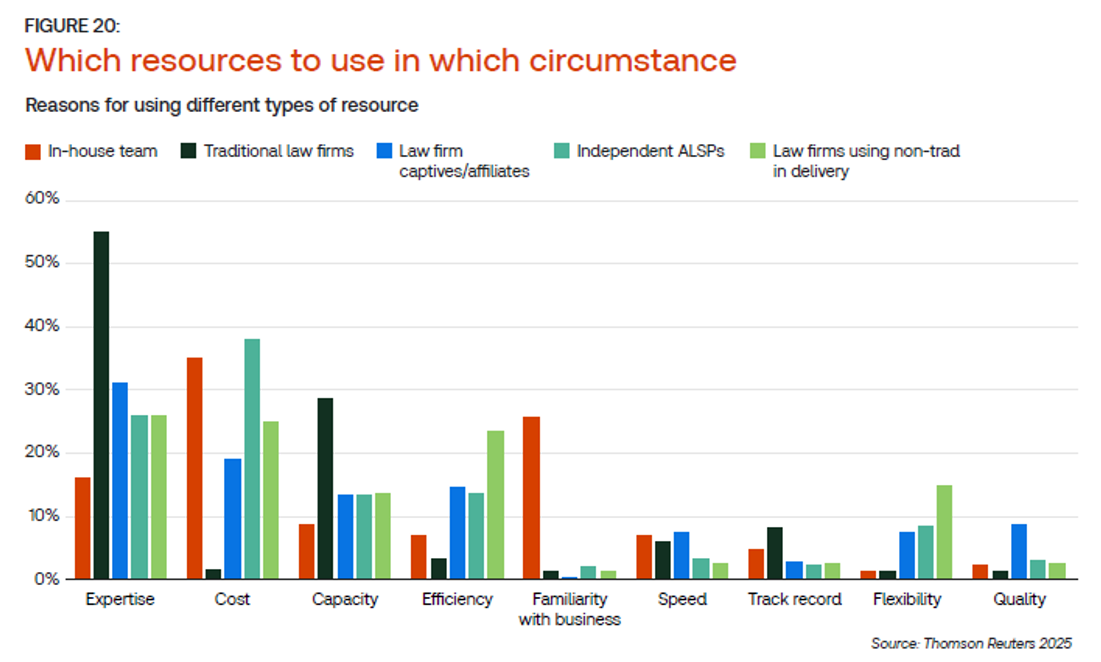
Further, GCs tend to look to law firms for help when they need specialized expertise or a boost to their in-house capacity. Many GCs describe themselves as Swiss Army Knives, that are adept at doing a little bit of a lot of things. However, when a matter requires deeper expertise, GCs will then turn to their specialized toolbox, which means outside law firms or, occasionally, alternative legal service providers (ALSPs). Another common area in which GCs will leverage outside law firms deals with issues of capacity. GCs frequently report dealing with increasing matter volumes while managing flat to declining internal attorney headcounts and budgets. External law firms can provide much needed pressure relief, but such relief often comes at a cost.
Ensuring quality of service
Even as GCs strive to strike a balance on the first portion of the effectiveness equation, they must be mindful of the quality of the service they are providing. The Corporate Law Department report made the point that corporate law departments do not operate effectively or efficiently as ends in their own right. Rather, all of the law department’s activities must be done in service to the broader commercial interests of the business.
This applies not only to the advice the in-house lawyers provide but also to external counsel, whether that be a law firm or an ALSP. Legal advice, no matter how correct or thorough, will be of little ultimate value to the business if it bears no relation whatsoever to the commercial realities of the business. Likewise, advice that is not responsive or timely to the end stakeholder’s needs, or which is so complex as to be unusable, does little to help demonstrate the effectiveness of the legal team.
As a result, GCs are increasingly making it a priority to ensure that their in-house lawyers provide advice that is timely, responsive, and understandable for stakeholders across the business, and increasingly, they expect their outside counsel to do the same.
When the component parts of this effectiveness equation come into balance, it not only helps the GC demonstrate the effectiveness of their team, but it also helps to service broader interest in growing the business and providing strategically relevant counsel to leadership.
Keys to driving business objectives
Another TRI report — the recent 2025 C-Suite Survey — discussed how business leaders do not generally view their enabling functions as making significant contributions to the ability of the business to achieve its overall objectives. For GCs looking to improve the perception of their in-house legal teams, how effectively their team operates in the creation of operational value can be key.
For starters, GCs looking to enhance operational value should:
-
-
- constantly evaluate when to keep work in-house, when to outsource, and which type of outside resources are most appropriate to GCs’ specific needs;
- explore whether technological enhancement could create additional capacity to keep work in-house, mitigating the need to seek outside counsel;
- ensure that the advice their teams offer is commercially attuned to the needs of the business and responsive to the stakeholders; and
- hold outside counsel and ALSPs accountable to the same standards of commerciality.
-
While the discrete goals and key results of the business may vary from year to year, GCs must always be attentive to how effectively their legal department is operating. Frameworks such as the effectiveness equation can prove to be useful reference tools for GCs who are trying to identify what metrics they should be monitoring.
Not surprisingly, C-Suite leaders have high expectations for the leaders of their enabling functions. The good news for GCs is that they have plenty of options at their disposal to demonstrate how effective their departments can be in improving organizations’ ability to meet their goals.
You can download a full copy of the Thomson Reuters Institute’s 2025 State of the Corporate Law Department report here