
Corporate legal departments have embraced value, AI, and data-driven strategies to better align with their organizations’ overall business goals, but a new report reveals a disconnect: C-Suite leaders want clearer proof of legal's impact on business success
Key takeaways:
-
-
-
Disconnect between legal departments and C-Suite perceptions — While many general counsel believe their departments are significant contributors to business success, most C-Suite executives do not share this view. Fully 86% of GCs say they believe their department is a significant contributor, but only 17% of C-Suite executives agree.
-
A need to find new ways to demonstrate value — Legal departments are under increasing pressure to do more with less, as nearly half of GCs surveyed cite staffing and resource constraints as their top barrier to delivering additional value. Despite these limitations, expectations from the C-Suite continue to rise.
-
AI adoption accelerates, business strategy comes next — Legal departments are rapidly embracing technology to improve efficiency, manage resources, and address cost pressures. Not surprisingly, the proportion of GCs calling AI a strategic imperative has doubled.
-
-
Over the past several years, general counsel and corporate law departments at large have transformed their operations. Many have become more efficient enterprises, leveraging technology, in particular AI, at an increased pace. GCs have adjusted their hiring practices to conform with the modern corporation, taking new ways of working into account. And they have embraced data-driven decision-making, evaluating outside counsel and their own operations alike with a wider suite of new metrics and KPIs.
But do you know who hasn’t yet realized the fruits of that labor? The corporate C-Suite.
Jump to ↓
2026 State of the Corporate Law Department Report
The 2026 State of the Corporate Law Department Report, released today by the Thomson Reuters Institute, reveals a disconnect between how GCs and their corporate law departments view their own alignment to the wider business, and what C-Suite executives believe the legal department contributes. Within this gap, the message is clear: GCs not only need to align with their organizations’ overall business strategy, they need to learn how to prove that alignment to the rest of the company.
Indeed, when asked how they view legal’s contribution to the rest of the business, 86% of GCs surveyed said they viewed the legal function as a significant contributor. However, only 17% of other C-Suite executives said the same — and 42% said legal contributes little or not at all.
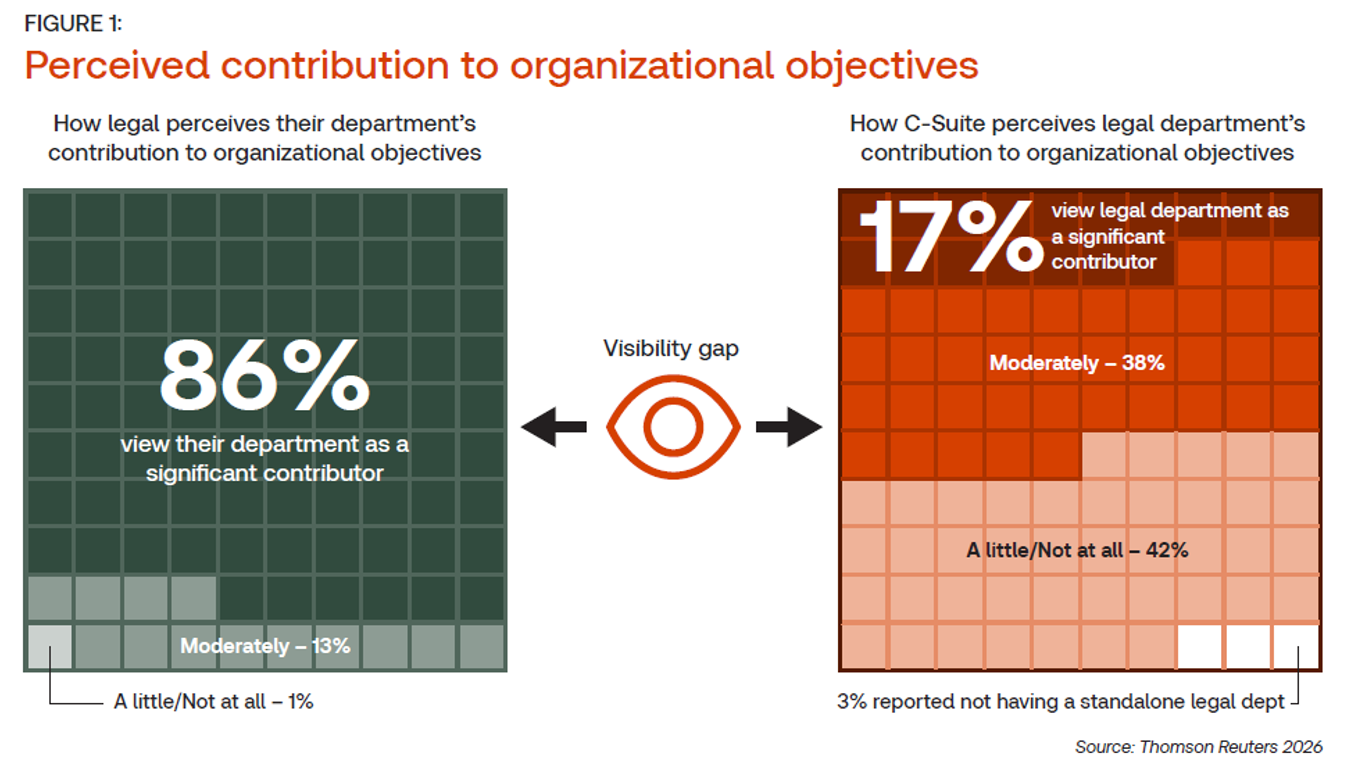
As the report explains, this disconnect lays the inherent groundwork for the tension facing many GCs today. While they are increasingly aiming to align to business standards, the rest of the organization is not recognizing those actions. Instead, many C-Suites are looking for even more out of today’s legal departments to prove their contributions to organizations’ business imperatives.
As in past years, many in-house legal departments are being tasked to do more with less. Nearly half of GCs cited staffing and resource constraints as the top barrier they face to delivering additional value. Indeed, many said they expected outside counsel spend in some key areas — such as regulatory work and mergers & acquisitions — to remain high. As of the fourth quarter of 2025, more than one-third (36%) of GCs said they expect to increase overall spend on outside counsel over the next year, while only 20% said they plan to decrease their spend.
Despite legal departments’ gains, their C-Suites are looking for them to take the next step, turning operational excellence into business success.
Not surprisingly, many GCs said they view technology as one of the primary ways they have to combat these resourcing and cost issues. In fact, the proportion of GCs mentioning technology as a strategic priority entering 2026 doubled over the year prior. Legal departments have begun to feel positive effects of AI in their own organizations, the report notes, such as increased efficiency or time feed up for strategic work.
Despite these gains, C-Suites are looking for are looking for their legal functions to take the next step, turning operational excellence into business success. This can take a number of different forms, such as explicitly tying advice to client business objectives, presenting legal spend in the context of the business by showing it as a percentage of revenue, or approaching risk management with the goal of aiding business imperatives. “When we have a risky legal subject, the company never prefers just to see the legal opinion,” said one retail GC. “They’re also requesting you to drive them how to make a decision.”
AI and technology should also be approached in this same way, the report argues. Although almost half of all corporate legal departments have some type of enterprise-wide GenAI tool, according to the survey, very few are collecting success metrics around AI’s implementation or linking its use to business revenue. Put a different way, many legal departments are focused on unlocking capacity, rather than deploying capacity in a business-centric way — much to the chagrin of their C-Suites.
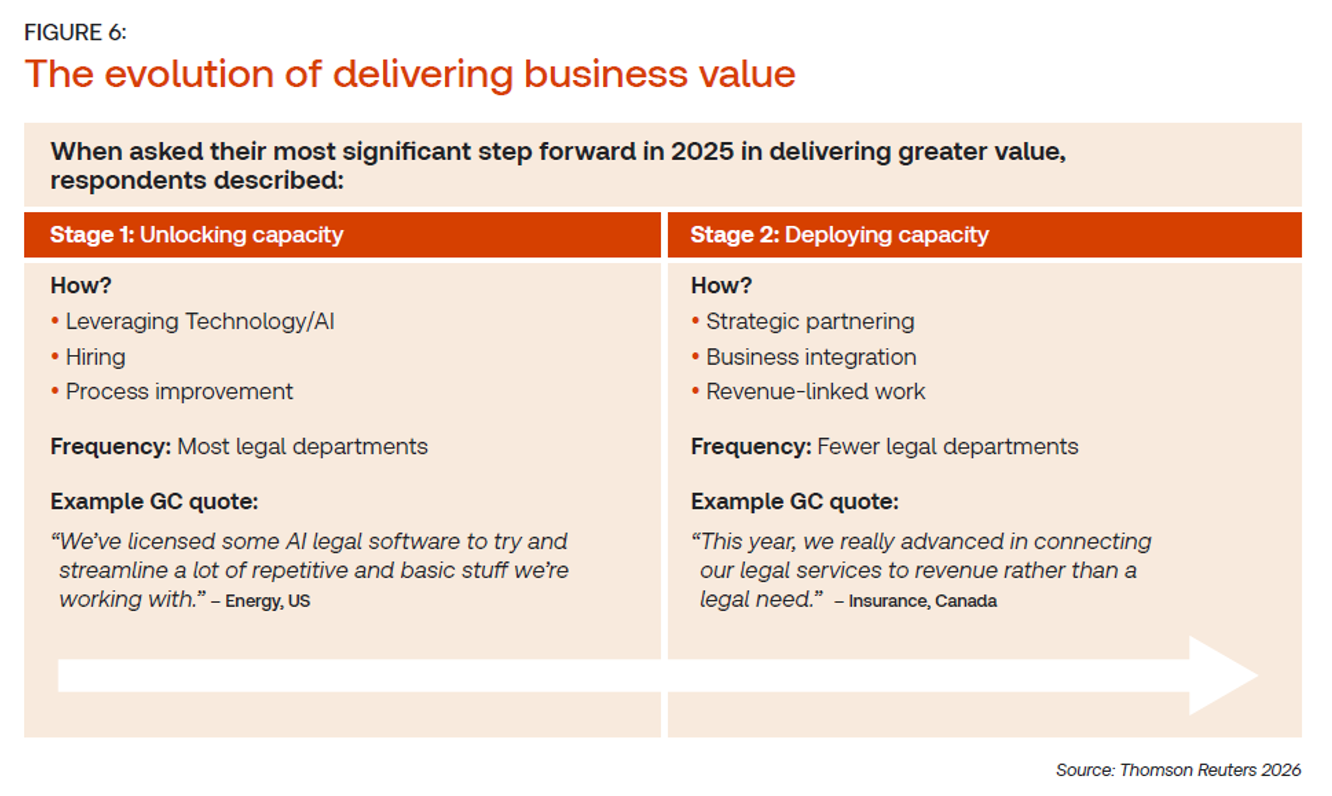
Although legal departments have established a solid foundation upon which a business can stand, ultimately, C-Suites don’t want just a foundation. They want help building the entire house, the report shows, directly enabling the services that companies provide to customers. In that, GCs and legal departments have more work to do, not only tying strategy to overall business initiatives but actively communicating how the legal function’s work aids the company as a whole.
You can download
a full copy of the Thomson Reuters Institute’s “2026 State of the Corporate Law Department Report” here