Amid growing trade and tariff volatility, corporate trade departments are rapidly increasing their use of automated tools; however, as trade complexity continues to grow, organizations are struggling to keep up in certain key areas
Key insights:
-
-
-
Tech adoption is rising, but critical gaps remain — Adoption of technology has surged over the last year but several important trade functions are still not widely automated.
-
Satisfaction levels with technology remain low in some areas — Trade leaders are generally satisfied with the gains they see from their use of technology, but lack of integration is hindering supply chain visibility efforts.
-
Organizations are increasing their technology investments — Technology budgets are expected to continue to grow this year.
-
-
The recently published 2026 Global Trade Report, from the Thomson Reuters Institute, discussed how the use of technology is rising across corporate trade departments, with trade professionals much more likely this year to report that their departments have deployed automated tools. In addition, many were even exploring the use of advanced technologies such as AI and blockchain.
In the report, the percentage of trade professionals that characterized their departments as being early adopters or behind the curve (meaning they’re still using manual systems) dropped significantly.
However, amid the rapidly growing adoption of technology, key challenges and gaps remain, the report showed.
Urgency to improve efficiency
Increasing efficiency in trade operations is a high priority, as workloads continue to increase. More than half (56%) of respondents said that workloads and overtime requirements have grown over the last year as a result of increased tariff activity and trade complexity. Respondents also cite more complex reporting and documentation requirements. And an even higher percentage said they expect those pressures to increase over the next year. As a result, nearly half (49%) of trade professionals surveyed report increased stress on their teams.
In addition, trade departments are taking on a more strategic role in their organizations, as detailed in the report, which noted that with the heightened trade and tariff volatility, trade professionals are more involved in executive decision-making and are expanding their scope of responsibilities, including having greater influence over procurement decisions. However, these added roles and responsibilities also mean that trade departments must take on additional workflows.
Fortunately, technology can be a critical force multiplier to help manage these changes. While about half of respondents said they expect increased budget allocations to hire additional staff over the next year, trade departments are increasingly looking to technology to help automate workflows and increase efficiency. In addition, automating routine tasks for compliance and reporting can free up staff time to focus on more complex tasks such as using advanced analytics and engaging in strategic planning.
It’s not surprising then, that while most respondents (52%) anticipate more budget for additional headcount this year, an even higher percentage (65%) said they expect more resources to be budgeted for technology solutions. This positions trade departments to reap the best of both worlds — more staff and greater use of technology to improve efficiency across the department.
Continuing technology gaps
Most trade departments, according to respondents, have now adopted trade and supply chain data analytics, automation for enterprise resource planning, supply chain management, and supply chain visibility. However, significant technology gaps remain, with relatively few respondents saying their departments have deployed tools and platforms to allow for global trade management (32%), managing tariff changes (7%), and managing classification changes (4%).
As a result, satisfaction with tech capabilities often remains modest at best. Fewer than one-in-five respondents report being very satisfied with the impact of technology on workflow efficiency for trade and supply chain management, keeping up with regulatory changes, or improving their ability to glean insights from trade data in order to drive business decisions.
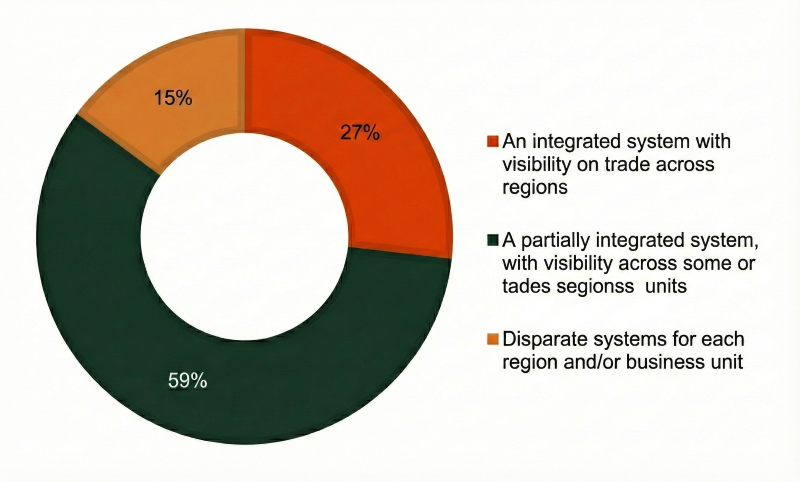
One major contributing fact is that four-in-ten respondents said they are not yet satisfied with their organization’s level of technology integration. This lack of integration hinders the ability of the trading team to maximize their use of existing systems to track and analyze data across various functions and geographies. This is increasingly important as businesses seek to improve visibility across their entire supply chain.
Thus, it’s not surprising that system integration is the top technology investment priority for the next year. An overwhelming 83% of respondents said this is a high- or medium-priority to help support informed decision-making.
Only about a quarter of trade departments have visibility across regions
— Thomson Reuters Institute, 2026 Global Trade Report
Modernizing trade technology
With 40% of organizations exploring emerging technologies such as AI and blockchain, and satisfaction levels remaining modest across currently deployed capabilities, a significant technology transformation opportunity exists. However, successful technology deployment requires strategic focus rather than adoption of the latest technologies simply for their own sake.
Trade leaders should focus their technology investments in several key areas:
Supply chain visibility platforms — Real-time tracking enables proactive rather than reactive management. Automated exception alerting, comprehensive visibility across multi-tier supply chains, and integration with other systems can create a solid foundation for data-driven decision-making.
Data analytics and predictive capabilities — The jump from 8% to 58% in the last year in respondents saying their organizations adopted and used trade and supply chain data analytics indicates widespread recognition of data’s strategic value. Organizations should invest in platforms that not only collect data but generate actionable insights through advanced analytics and machine learning. Predictive capabilities can anticipate disruptions before they occur, enabling preventive action rather than damage control.
AI-assisted product classification — Product classification is time-consuming, error-prone when done manually, and yet, critical for compliance. AI systems have the potential to dramatically improve both efficiency and accuracy while freeing trade professionals to focus on more strategic work rather than routine tasks.
More technology investments ahead
The recent surge in technology adoption is positioning corporate trade departments to increase efficiency and expand their capabilities. Despite numerous gaps depending on specific technology use, about half of trade leaders indicate they are already at least somewhat satisfied with the overall gains they are seeing because of their use of technology.
Despite the recent gains, however, significant gaps in technology adoption still remain. Fortunately, organizations are recognizing the importance and urgency of increasing their investments in technology, coupled with adding to trade department headcount.
While workloads and pressures continue to grow, the elevation of the trade department as a strategic partner to the business — along with growing involvement in decision-making at the executive level and increasing recognition of the trade function’s value to the business — suggests that organizations are likely to continue accelerating their investments in technology as an integral part of their growing commitment to supporting their in-house trade professionals.
You can download a full copy of the Thomson Reuters Institute’s 2026 Global Trade Report here