
Legal departments must move beyond cost metrics to align and demonstrate their full strategic value in an era of rapid transformation
Key insights:
-
-
-
Value perception gap persists — Most corporate legal departments still measure and report primarily on cost, obscuring their broader strategic contributions.
-
Value alignment toolkit — A new value framework exists for legal departments to close the gap in the perception of their value to the organization.
-
-
-
-
-
AI accelerates urgency — The rise of AI makes comprehensive value measurement essential in order to safeguard legal department budgets and resources.
-
-
As many General Counsel continue to elevate their position as strategic leaders in their business, they are often constrained by cost-focused narratives. Despite their success in delivering high-quality legal advice, managing complex risks, and enabling business growth, many corporate legal departments remain trapped in a narrow perception defined almost entirely by spend metrics.
The disconnect is clear. While legal departments support strategic goals across multiple dimensions — delivering effective advice, operating efficiently, protecting the organization, and enabling business strategy — most measure and report only on cost and time. And when leadership sees only budget and time metrics, this unfortunately reinforces the cost center narrative and hides the real value of the legal department.
The perception gap: What gets measured gets seen and valued
Research from the Thomson Reuters Institute (TRI) reveals a troubling pattern: While 90% of legal departments now use formal metrics — up from 75% eight years ago — very few align those metrics to the full range of their strategic goals. Indeed, nearly half of all metrics currently in use relate to spend factors, while only about one-in-four measure quality, and even fewer capture how legal departments protect enterprise value or enable business strategy.
This creates what TRI calls a perception gap. When C-Suite executives describe in what areas they expect their legal departments to focus, they consistently over-emphasize efficiency while under-recognizing contributions such as business protection and strategic enablement. As a result, many legal departments struggle to secure resources for risk management initiatives, their strategic contributions go unnoticed and unrecognized, and their efficiency efforts are viewed as mere cost-cutting rather than value optimization.
The root cause of this misalignment lies in measurement itself. A legal department cannot manage what doesn’t get measured, and more importantly, it cannot demonstrate value for what remains invisible.
The 4 spinning plates: A complete picture of legal value
Through extensive analysis of strategic priorities across hundreds of legal departments, TRI identified four core areas of responsibility that remain evergreen regardless of changing business environments, regulatory shifts, or technological disruption.
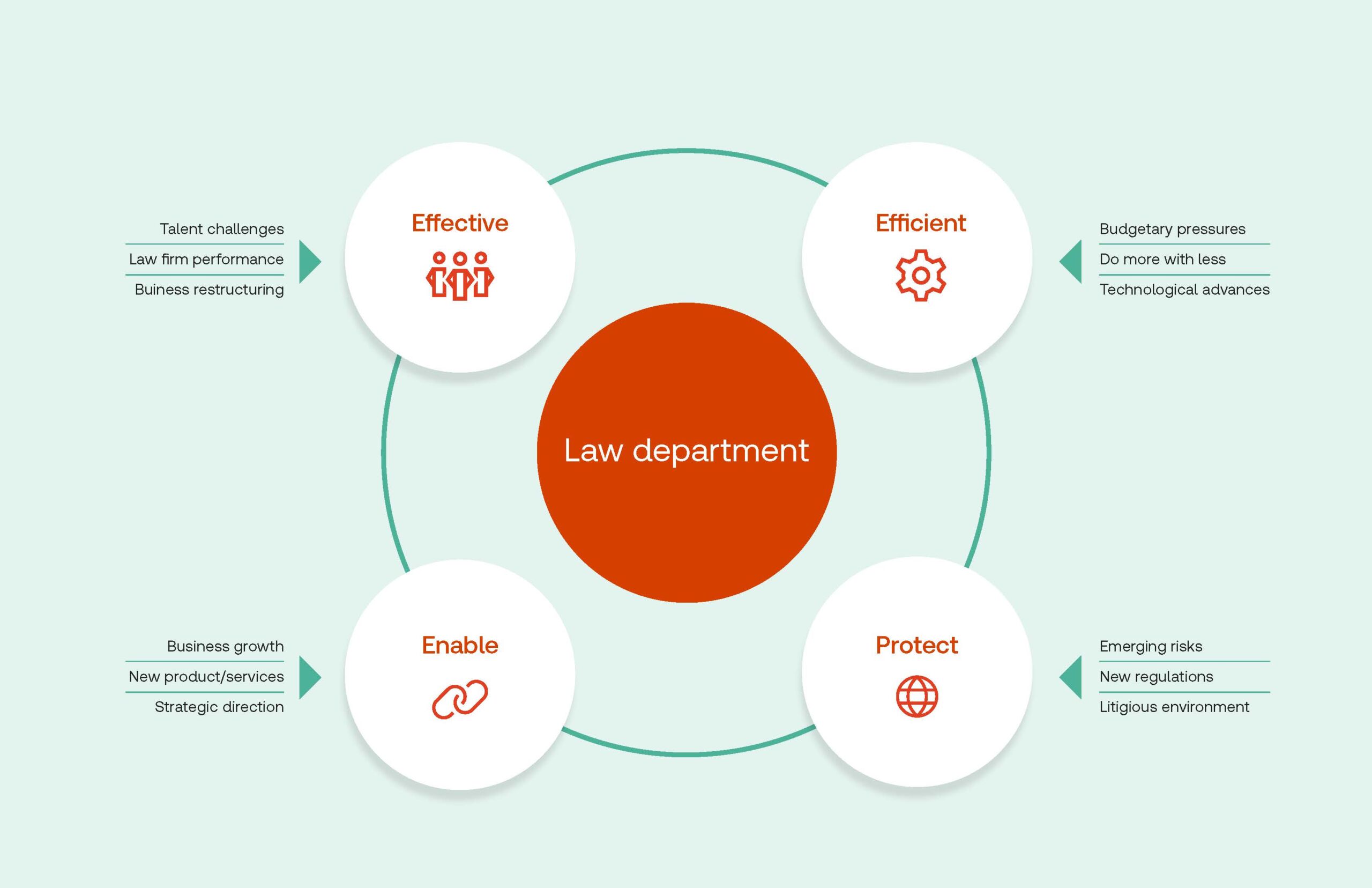
The four spinning plates model captures these perpetual responsibilities — effective, efficient, enable, and protect — in a deliberate metaphor. Like a performer keeping multiple plates spinning simultaneously, GCs must maintain constant attention across all four areas. They are fundamentally interconnected — efficiency gains can enable strategic work, while strong risk management builds the trust necessary for bolder business strategies.
Yet when metrics are focused primarily on cost and time, they tell only a fraction of this story. Many legal departments have built their measurement framework around the Efficiency plate alone, leaving the other three plates far less visible to enterprise leadership and limiting their understanding of legal’s comprehensive roles and strategic influence.
Closing the gap: the value alignment toolkit
TRI has spent years conducting research, developing frameworks, and facilitating strategic planning sessions with legal department leaders on this challenge. Now, it is making this expertise broadly accessible through a comprehensive new resource: the Value Alignment Strategic Toolkit.
This free online resource center provides practical, immediately actionable guidance to better define, measure, and communicate a corporate legal department’s full value to the organization. The toolkit is built on benchmark data from hundreds of legal departments along with proven strategic frameworks and expert insights that all is organized into six interconnected sections that guide users from foundational clarity to strategic execution. These six sections include:
-
-
- Define your department’s strategic goals — Establish business-connected objectives with clear ambitions
- Design metrics that matter — Select measurements that demonstrate value creation, not just cost
- Strengthen your data — Build robust collection and analysis methods, including feedback involving the voice of the stakeholder
- Tell your value story — Develop compelling narratives that resonate with enterprise leadership
- Review, refine & advance — Implement continuous improvement processes
- Maximize your impact — Scale success across all four spinning plates of value
-
Each section includes practical resources, including assessment tools, templates, checklists, framework guides, and real-world examples. The metrics masterclass features more than 50 legal department metrics aligned to the four-plate framework, including 12 recommended core metrics that span all four strategic areas.

For example, a GC preparing for a quarterly check-in with the CFO could use the appropriate templates, guides, best practices, and the recommended metrics to create a one-page dashboard. The dashboard would provide customized metrics to align with their CFO’s priorities, such as deals accelerated, risks avoided, or initiatives supported.
The AI imperative: Why better metrics matter more than ever
Not surprisingly, the emergence of generative AI (GenAI) adds new urgency to this work, presenting both opportunity and vulnerability. On one hand, AI holds significant potential to enhance legal department capabilities by automating routine tasks, accelerating research, improving contract analysis, and freeing lawyers to focus on higher-value strategic work. At the same time, however, if legal departments continue to be viewed primarily through an efficiency lens, advances in AI that reduce time and cost could conceivably threaten department resources and headcount.
Comprehensive value measurement can help legal departments demonstrate enterprise value that cannot be replaced by AI. When legal departments can clearly articulate how they protect enterprise value, enable faster time-to-market for new products, strengthen board confidence through proactive governance, and maintain high stakeholder satisfaction scores, they establish their strategic necessity regardless of technological advancement.
The Value Alignment Toolkit provides frameworks and tools to build this comprehensive measurement approach, ensuring legal departments are positioned to leverage AI’s benefits, while at the same time demonstrating the irreplaceable value that the legal department provides, including:
-
-
- Quantifying strategic legal department contributions that AI cannot replicate, such as judgment, relationship-building, business counsel, risk navigation, and more
- Demonstrating value beyond efficiency to justify budgets and resources
- Identifying high-impact opportunities in which legal department expertise can best leverage AI to address the most pressing business needs
- Assessing ROI of specific AI use cases to prioritize where to adopt and scale, and conversely, areas that are not ready yet
-
Moving from cost center to strategic partner
For a corporate legal department, the transformation from cost center to strategic partner requires more than aspiration, it requires data-driven evidence. It demands a systematic approach to measurement that captures the complete picture of the department’s contributions and then communicates that value in clear business language.
The Value Alignment Strategic Toolkit enables legal departments to shift from reporting simple cost metrics, such as:
We reduced outside counsel spend by 15%
to telling a more complete story:
We delivered value by maintaining 90% stakeholder satisfaction while handling 25% more strategic matters, reducing costs through technology and process improvements, preventing potential regulatory exposure through proactive compliance programs, and accelerating product launch timelines through innovative legal structures.
This is not merely reframing — it’s revealing what was always present but had remained largely invisible. This enables strategic conversations about the department’s complete contribution rather than defaulting to discussions solely around cost.
The path forward
Many corporate legal departments today create enterprise value every day across multiple dimensions by providing sound advice, managing risk exposure, and enabling growth. Yet too often, that value remains unrecognized simply because it isn’t being measured or communicated effectively.
At a moment when business transformation is accelerating, regulatory complexity is increasing, and technology is reshaping legal service delivery, continuing to rely on cost and time metrics alone isn’t just insufficient, it actively undermines a legal department’s strategic position.
The complete value story of legal departments deserves to be told. It’s time to move from defending budgets to demonstrating impact, from reporting costs to revealing value, and from being seen as a necessary expense to being recognized as an essential strategic partner. Better frameworks and tools can shift the conversation from cost center scrutiny to strategic leadership discussions about how GCs and their teams enable business growth.
Transform how your legal department demonstrates value by accessing the free frameworks, metrics, and strategic guidance in the Value Alignment Strategic Toolkit