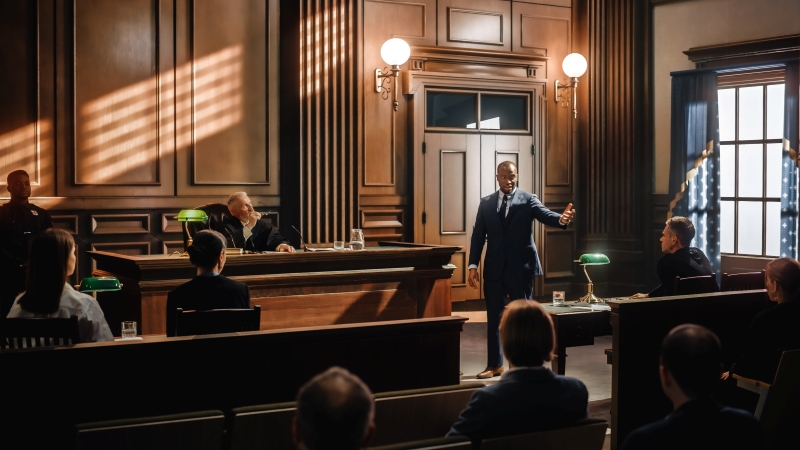
During the recent Legalweek 2026 event, four federal judges took the stage. They weren't there to talk about AI, but rather something much more dire
Key takeaways:
-
-
-
Violence against judges is escalating — Targeted shootings, coordinated harassment campaigns, and threats that now routinely follow judges to their homes and families.
-
The rhetoric driving the escalation is coming from the highest levels of government — The absence of any public denunciation from the Department of Justice is highlighting the source of the problem.
-
Will the violence itself become part of judicial rulings? — The endgame of judicial intimidation isn’t that judges stop ruling, it’s that the threat of violence becomes a silent presence in the deliberation itself.
-
-
NEW YORK — Those attendees who came to the recent Legalweek 2026 to talk about AI, agentic workflows, and the business of legal technology, also were treated to a session that will likely stay with attendees and had nothing to do with AI.
In that session, four federal judges took the stage; but they were not there to talk about pricing models or AI adoption. They were there to talk about staying alive.
Setting the stage
Jason Wareham, CEO of IPSA Intelligent Systems and a former U.S. Marine Corps judge advocate, introduced the session — a panel of four sitting United States District Court judges — by speaking of how the rule of law once seemed resolute, yet how that faith in that has been shaken, year after year. He worked hard to frame his observations as nonpartisan, a matter of institutional fragility rather than political allegiance. It was a generous framing, but it was one that would not survive the weight of the ensuing discussion.
The Honorable Esther Salas of the District of New Jersey said that the reason she was there has a name. On July 19, 2020, a disgruntled, extremist attorney who had a case before her court arrived at her home during a birthday celebration. He shot and killed her twenty-year-old son, Daniel Anderl. He shot and critically wounded her husband. She has spent the years since on a mission to protect her judicial colleagues from the same fate.
The new normal
Next, the Honorable Kenly Kiya Kato of the Central District of California described what has changed. Judges’ rulings are still based on the Constitution, on precedent, and on the facts; but what’s different is the small voice in the back of a judge’s head. That voice, often coming after a judge issued a decision that they now have to fight against, asks: What will happen after this? It is now expected, Judge Kato explained, that a high-profile order will bring threats. When two colleagues in her district issued prominent decisions, her first thought was for their safety. That is not how it has been historically.
The Honorable Mia Roberts Perez of the Eastern District of Pennsylvania asked how we got here, pointing to language from the highest levels of government: judges called monsters, a U.S. Department of Justice declaring war on rogue judges, and recently politicians bringing justice’s families into the conversation.
Judge Salas pushed even further. She acknowledged the instinct to frame the problem as bipartisan, but said the current moment is not apples to apples. It is apples to watermelons. The spike in threats since 2015, she argued, traces directly to rhetoric from political leaders using language never before deployed against the bench.
The federal judiciary is looking to break annual records for threats [against judges], and there is an absence of any public denunciation from the Attorney General or the DOJ.
The evidence is not abstract, nor are the victims, and the panel walked through it. Judge John Roemer of Wisconsin, zip-tied to a chair and assassinated in his home. Associate Judge Andrew Wilkinson of Maryland shot dead in his driveway while his family was inside. Judge Steven Meyer of Indiana and his wife Kimberly, shot through their own front door after attackers first posed as a food delivery, then returned days later claiming to have found the couple’s dog. Judge Meyer has just undergone his fifth surgery since the attack.
All of these incidents happened at the judges’ homes.
Judge Salas then played a voicemail, one of thousands that federal judges receive. It was less than 30 seconds long, but it did not need to be longer. While names had been redacted, what remained was a torrent of threats and obscenities, graphic, sexual and violent, delivered with the confidence of someone who does not expect consequences. Some judges receive hundreds of these after a single ruling, often from people with no case before them at all.
The shadow over the courts
Throughout the session, there was a presence the panelists circled but rarely named directly. A shadow that shaped every observation about escalating threats, every reference to rhetoric from the top down, every mention of language never before used by political leaders, of action or inaction the likes of which would have been unthinkable just several years ago. The specifics were spoken. The name, largely, was not.
It didn’t have to be.
Judge Kato said that what was perhaps the most disheartening aspect of all this is that these threats are getting worse. The people who know better are not doing better. Indeed, she said her children think about these problems every day. What will happen to mom today? Will someone come to the house? These are questions children should not have to carry. They did not sign up for this, and neither did the judges.
In 2026, Judge Salas noted, the federal judiciary is looking to break annual records for threats. She also noted the absence of any public denunciation from the Attorney General or the DOJ. The silence, she said, says a lot.
Not surprisingly, the implications extend beyond the judges themselves. As Judge Salas noted, if judges have to weigh their safety alongside the law, ordinary people don’t stand a chance. If one party is stronger, better funded, or more willing to threaten, then the scales tip.
That is the endgame of judicial intimidation. It’s not that judges stop ruling, but that the violent and the powerful — indeed, the people least fit to hold the scales — can tilt them at will.
That concern echoed an earlier warning from Judge Karoline Mehalchick of the Middle District of Pennsylvania. Judge Mehalchick said that judicial intimidation feeds on misunderstanding. When the public no longer grasps why judges must be insulated from pressure or conversely, mistakes independence for partisanship, the threat environment becomes easier to justify, easier to ignore, and harder to reverse.
What is perhaps the most disheartening aspect of all this is that these threats are getting worse, and the people who know better are not doing better.
In his 2024 year-end report, U.S. Supreme Court Chief Justice John Roberts identified four threats to judicial independence: violence, intimidation, disinformation, and threats to defy lawfully entered judgements. The panel discussed this report as prophecy fulfilled. Public confidence in the judiciary has plummeted since 2021, and the reasons are complex. The judges insisted they are still doing their jobs the right way, but the violence is spreading anyway.
What survives
Judge Salas asked the audience to watch their thoughts. Are they negative and destructive, or positive and uplifting? Can we start loving more? She ended by sending love and light to everyone in the room.
The judges were visibly emotional on the stage.
The words were beautiful. They were also, in the context of everything that had just been described — the killings, the voicemails, the zip ties, the pizza deliveries masking a threat under a murdered son’s name — resting in a shadow that no amount of love and light could fully dispel on their own.
The room responded with a standing ovation.
Thousands of people came to Legalweek 2026 to talk about the future of legal technology. For one morning, four judges reminded them that none of it matters if the people charged with administering justice cannot do so safely.
So, while the billable hour may survive and the associate will adapt, the harder question, the one that should keep the legal industry awake at night, is whether the bench will hold.
You can find more of our coverage of Legalweek events here