Nov 05, 2025 | AI and product innovation
From TechCrunch Disrupt: How Thomson Reuters Is Driving AI Innovation at Scale
November 2025
The Future of Work Isn’t Coming. It’s Already Here.
At TechCrunch Disrupt 2025, the buzzword wasn’t “AI.” It was scale. How do you take technology powerful enough to transform billion-dollar industries and make it trustworthy enough to run them?
That’s the challenge Thomson Reuters has been solving in real time.
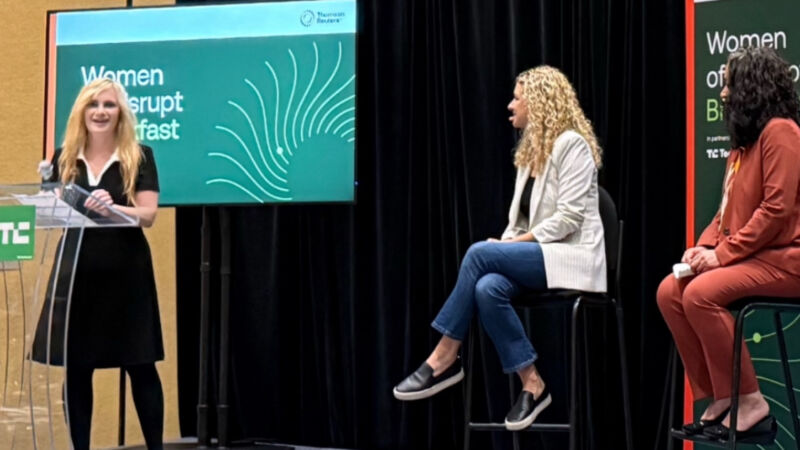
At the Women of Disrupt Breakfast: From Vision to Velocity, Women Driving AI Innovation at Scale, Laura Safdie (Head of Legal Innovation, Thomson Reuters, and former co-founder of Casetext) and Kirat Sekhon (Head of Engineering, Thomson Reuters) joined Martine Paris, Forbes and BBC AI reporter, for a conversation on building agentic AI that doesn’t just assist professionals, but collaborates with them.
From Startup Grit to Global Infrastructure
Laura Safdie knows what it means to build from scratch. Before joining Thomson Reuters, she co-founded Casetext, the legal AI startup that created CoCounsel, the world’s first GenAI legal assistant.
“When GPT-4 launched, we knew the ground had shifted,” Laura said. “The world, and our profession, would never be the same.”
Within a week, Casetext rewrote its roadmap and shipped a working product that redefined legal work. Months later, Thomson Reuters acquired Casetext, turning that same startup innovation into the foundation for a professional-grade AI ecosystem now used across legal, tax, and corporate domains.
Today, CoCounsel powers workflows for hundreds of thousands of professionals worldwide, combining the speed of machine learning with the rigor of human judgment.
The Next Evolution: AI as the Junior Professional
Forget chatbots. The next era of AI is here, and it looks a lot like your most capable new hire.
In law, that means systems that can draft, review, and analyze complex documents with context and accuracy. In tax and accounting, it means interpreting new regulations, scanning data sets, and preparing the groundwork for filings at lightning speed.
“The human is still the strategist,” Kirat explained. “But the AI is that relentless team member who never tires, never loses focus, and helps you get to the insight faster.”
This isn’t automation. It’s augmentation. It’s about freeing people to do the creative, analytical, and human work that truly moves the needle.
Why Trust Is the Killer Feature
In high-stakes industries, accuracy isn’t optional. “Close enough” doesn’t cut it.
That’s why trust has become the new measure of technical excellence. Thomson Reuters builds AI that shows its work, with authoritative citations, verifiable sources, and a full digital audit trail.
Whether it’s a contract analysis or a tax interpretation, professionals can trace every step. Transparency isn’t an add-on; it’s the architecture.
In a world where hallucinations can tank credibility, professional-grade AI earns trust one verified line at a time.
Building Fast Without Breaking What Matters
Innovation moves at a blistering pace. Models update weekly; frameworks shift overnight, and what’s state-of-the-art today can feel dated tomorrow.
That’s why Thomson Reuters has engineered adaptive architecture. A flexible layer that lets teams integrate new large language models, swap them out, and test emerging capabilities with precision and control.
Every model passes through a rigorous evaluation framework that measures accuracy, speed, and relevance. Engineers even collaborate directly with model developers, shaping future releases with real-world performance data.
But speed isn’t just about shipping code. It’s about changing how people think and work. “This is the most energizing moment in many people’s careers,” Laura said. “But it takes a mindset shift. Change management is as important as the technology itself.”
Resilience as the Invisible Superpower
When cloud providers falter or networks crash, professionals still expect their tools to perform. That’s why resilience is built into every layer of the Thomson Reuters AI stack.
The company’s systems are multi-cloud and multi-model by default. If one model slows, another takes over. If a provider fails, others stay live. It’s a design built for continuity, transparency, and trust in motion.
Reliability is no longer a technical metric. It’s a brand promise.
The Human Edge
Thomson Reuters is hiring AI engineers and data scientists who want to build the future of agentic systems. AI that collaborates, learns, and adapts alongside professionals.
The goal isn’t to replace human expertise. It’s to elevate it.
The future of professional work will belong to teams that combine computational intelligence with human judgment, creativity, and integrity. AI isn’t just transforming how we work; it’s transforming how we lead.
The Takeaway
The companies that win in this new era won’t just move fast. They’ll build right.
The next wave of AI innovation will be defined by systems that scale, teams that adapt, and leaders who build with trust and purpose.
As Laura and Kirat reminded the audience at TechCrunch Disrupt, the goal isn’t just smarter technology. It’s a smarter, more human future for professionals everywhere.