
ESG efforts remain a core responsibility of the corporate trade function and are evolving to be more structurally embedded in trade management
Key insights:
-
-
-
ESG is becoming more operationalized — ESG is being conducted with a lower public profile while also playing an increasingly strategic role in supplier governance frameworks.
-
Data collection remains widespreadand robust — Companies continue to collect comprehensive ESG data from their suppliers.
-
Technology usage in ESG is increasing — Greater investment in automation demonstrates continuing commitment to effectively managing ESG.
-
-
Environmental, social and governance (ESG) issues have played an increasing role in global trade operations in recent years. As the United States government sharply pulled back its role in encouraging ESG in global trade in 2025, concerns were raised over whether that would impact ESG efforts globally.
However, ESG-related efforts in global trade have not diminished, although they are evolving in form and positioning, according to the Thomson Reuters Institute’s recent 2026 Global Trade Report. In fact, the report’s survey respondents said that ESG data collection from suppliers is now largely structurally embedded in trade operations, although at the same time, it is being carried out with a lower public profile than in previous years.
ESG management remains a core trade function
Managing ESG remains one of the most widespread responsibilities among trade professionals. Almost two-thirds (62%) of those surveyed said their role includes ensuring ESG compliance throughout the supply chain. That represents a higher percentage than for other responsibilities, such as procurement and sourcing, supplier management, trade systems management, risk management, customs clearance, and regulatory compliance. The only more widespread role being done by those global trade professionals surveyed is business strategy for global trade and supply chain.
More importantly, ESG remains integral and nearly universal when it comes to the supplier selection process. All respondents in the Asia-Pacific region (APAC), Latin American and the European Union-United Kingdom, as well as 99% of US respondents, report that ESG considerations remain moderately important, important, or very important in influencing their decisions around using a supplier. And overwhelming 78% say it is an important or very important consideration.
Clearly, as the report demonstrates, ESG remains a core component of the trade function for most businesses.
ESG moves toward structural governance frameworks
Only a very small proportion of respondents — 3% in the US and 4% globally — said they stopped ESG-related data collection entirely in 2025. Meanwhile, ESG data collection has increased across several major metrics.
As companies move to embed ESG expectations directly into their supplier governance frameworks, they are shifting these efforts from being a publicly declarative initiative to becoming operationalized as a permanent compliance and sourcing discipline alongside other operational considerations.
Businesses are focusing on supplier information in areas that have direct operational relevance. For example, companies collecting data on Free Trade Agreement (FTA) eligibility status for ESG purposes can also leverage the data to reduce costs, ensure supply chain security through Customs Trade Partnership Against Terrorism (CTPAT) participation, and better maintain compliance with country-of-origin requirements. Similarly, Country of Origin (COO) and Authorized Economic Operator (AEO) status are both classified under ESG but are also highly trade operations specific. These metrics merge the lines, representing areas in which ethical considerations intersect with practical trade strategy.
Supplier data collection is shifting to operational relevance as well. Indeed, the scope of supplier data being gathered remains broad and reflects a holistic view of the supply chain. The most common areas for ESG data collection in 2025 were: i) environmental metrics, such as water usage, waste management, energy management, and carbon emissions, including Scope 3 emissions; ii) social metrics, such as health and safety, labor standards, human rights including modern slavery or indentured service, and diversity in employees; and iii) governance and compliance, including data privacy, business ethics, and anti-corruption.
Data collection from suppliers
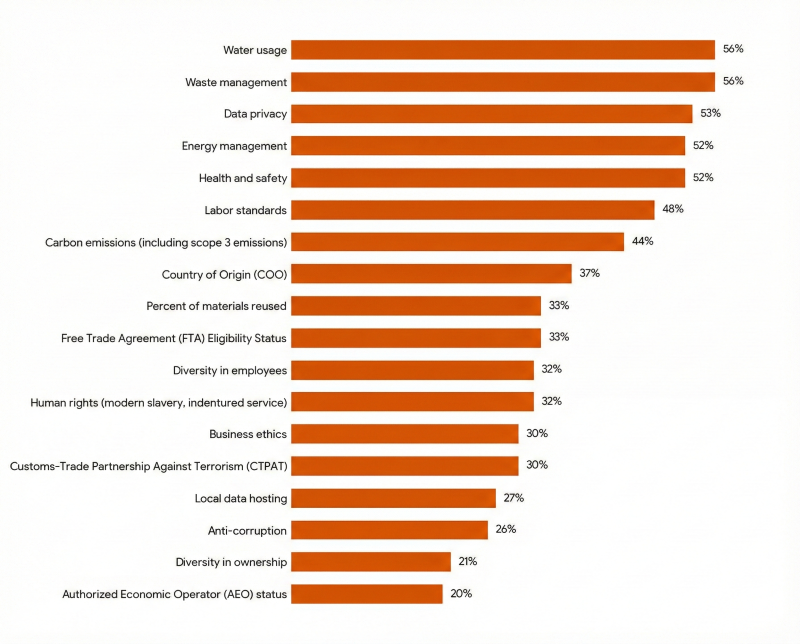
Meanwhile, ESG data collection has been scaled back in areas such as trade evaluation, AEO/CTPAT status in some jurisdictions, diversity in ownership, and anti-corruption assessments. The most cited reason for the pullbacks was insufficient cost-benefit return for collecting data in areas in which customer scrutiny was minimal. This trade-off reflects a rational reprioritization: companies are focusing their ESG diligence in areas in which regulatory risk is more material rather than reputational.
Integrating ESG into broader trade workflows
The report also shows that businesses are leveraging ESG to make it more operationally effective, drive greater efficiency, reduce costs, and add greater value for the organization. ESG is becoming less of a marketing and brand building exercise, and more of a compliance and sourcing discipline that factors into strategic decision-making — it is subject to the same analytical rigor as financial or operational risks.
To this end, organizations are less prone to make a string of bold public goals and commitments, or issue standalone ESG reports, updates, or scorecards that tout their progress. Instead, ESG data is being seamlessly embedded into supplier evaluation and selection alongside non-ESG business metrics and other considerations. As such, organizations are using ESG to quietly build the structural frameworks, data infrastructure, and management approaches they’ll need for more strategic planning.
ESG is shifting to strategically supporting business growth and away from reputational focus
Helping this shift along, the report shows, is that the use of technology to manage ESG has accelerated significantly in 2025. One-third of respondents said their organizations use automated ESG solutions, a major increase from only 20% in 2024. This provides a clear indication that more organizations are not only continuing but strengthening their commitment to effectively managing ESG.
And this provides a boost, because greater automation can improve the efficiency and ability of trade professionals to manage ESG efforts, further enhancing the integration of ESG data into other operational workflows as organizations incorporate ESG data to drive greater value.
What lies ahead for ESG
ESG practices and organizations’ embrace of them remain near-universal across trade operations. This continuation presents a clear indication that there is no widespread retreat from ESG management. For trade professionals, ESG is here to stay and is evolving into an operational discipline to help grow their business.
For organizations to have continued success in this evolving ESG environment, they should take several steps that require strategic thinking, including:
-
-
- Identify which metrics truly matter — Connect ESG metrics that affect trade operations, particularly those that impact supply chain cost, efficiency, and reliability.
- Invest in the technology infrastructure — Improve efficiency in tracking and analyzing key ESG metrics.
- Articulate ESG value — Develop the ability to demonstrate the value of ESG to the trade function and communicate it in business terms to senior management.
-
The shift of ESG towards operational trade management may represent a more sustainable long-term path forward than the earlier wave of ESG enthusiasm — embedding ethical considerations into core business processes rather than treating them as separate compliance exercises. By focusing on metrics that genuinely matter to business operations, companies are building practices that will persist regardless of any political winds or public relations trends.
Those corporate trade departments that can skillfully navigate this evolving environment will be positioned to more effectively leverage ESG considerations as a strategic asset and competitive differentiator. And in an increasingly complex and volatile global trading landscape, they will find themselves playing a more central role in their organizations’ success.
You can download a copy of the Thomson Reuters Institute’s 2026 Global Trade Report here