
The future of professional services, and particularly legal services, is already feeling the impact of AI, not only on how services are delivered but also how they are priced; and law firms looking to keep up to speed on this rapid evolution need to be tracking developments in several critical arenas
Key insights:
-
-
-
New methods of managing revenue — Changing technologies will require new ways of looking at revenue management beyond traditional methods of cost recovery
-
The rise of non-hourly billing — The shift to value-based billing or alternative fee arrangements will be almost inevitable as continued reliance on billable hours could prove detrimental in light of technology’s promises of increased efficiency
-
Looking for efficiencies and ROI — Law firms have readily available opportunities to demonstrate a return on their investments in AI by looking at places where revenue is currently being lost to write down, turning otherwise lost time into new potential revenue streams.
-
-
While the recently released 2025 Future of Professionals report, published by Thomson Reuters, provides in-depth coverage of many of the changes that business professional anticipate or are already experiencing due to the rising influence of AI, the report did not really dive into issues of how AI may impact some of the business management aspects of professional services firms — specifically around how the pricing of legal services may be impacted by an AI-powered future.
Fortunately, the Thomson Reuters Institute has been closely examining this very issue for some time as part of an ongoing body of work dedicated to the pricing of AI-driven legal services.
This article is intended to serve as a compendium of a few of those pieces to help provide starting points for strategic discussions among law firm leaders around how to develop or adapt strategic plans to meet evolving realities in an increasingly AI-driven legal market.
Focusing on new methods of cost recovery
Law firms are increasingly reliant on advanced technologies, but those technologies can come with fairly significant costs. Traditionally, law firms would seek to recover those costs from their client through various billing mechanisms. However, client resistance and ethical considerations will create challenges for those law firms looking to apply such traditional methods to these new tech tools. Instead of focusing on how to offset the cost of technology, firms should instead be exploring ways that these advanced tools can create new mechanisms to drive revenue.
Indeed, a large component of that exploration will include more experimentation with value-based billing arrangements or alternate fee arrangements (AFAs). Currently, most legal work is billed based on the amount of time the work took to complete. However, as technology increases the speed with which work can be completed, the continued strong reliance on billable hours could have a detrimental effect on law firm billings.
That said, just because the outcome was delivered much more quickly does not mean it necessarily offers less value to the client and therefore should be dramatically cheaper. Law firms will need to pivot to different models to capture and then demonstrate that value. Firms that resist these changing market forces likely risk having their revenue streams fully dependent on their hourly inputs alone. And ultimately, those firms that lag behind risk losing out to more proactive firms that have made strides toward delivering higher levels of service.
Leveraging AI to reclaim lost revenue
Compounding this challenge is the fact that many law firms face a hidden cost due to inefficient workflows. The result of that inefficiency can be seen in the amount of time lawyers worked on behalf of clients but ultimately didn’t bill them for their services — a metric commonly known as write-downs.
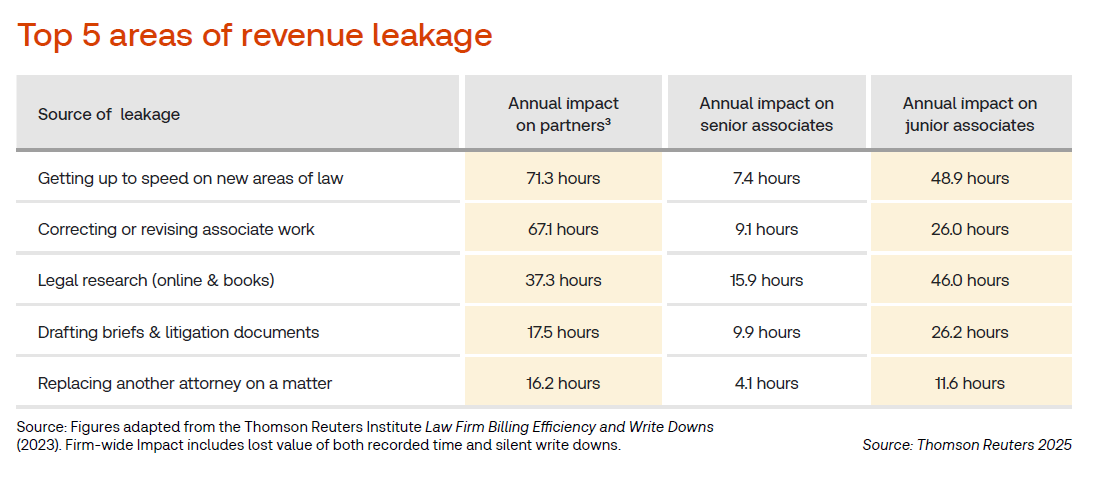
Indeed, the average law firm partner loses approximately 300 hours of their own time every year due to tasks like correcting associates’ mistakes or getting up to speed on legal questions. The cumulative effect of these write-downs can quickly climb into the millions of dollars. Often times, lawyers are correct that clients would not want to be billed for this time; but the challenge, then, becomes how to not spend time on those tasks.
Clearly, AI can help law firms address this problem quickly. Once areas of potential revenue and time leakage are identified, law firms can more readily apply AI solutions targeted to these specific challenges, creating a more direct path to a return on a firm’s AI investment, and ultimately pushing the firm in a more productive direction.
You can keep current on how AI will impact law firm business model here