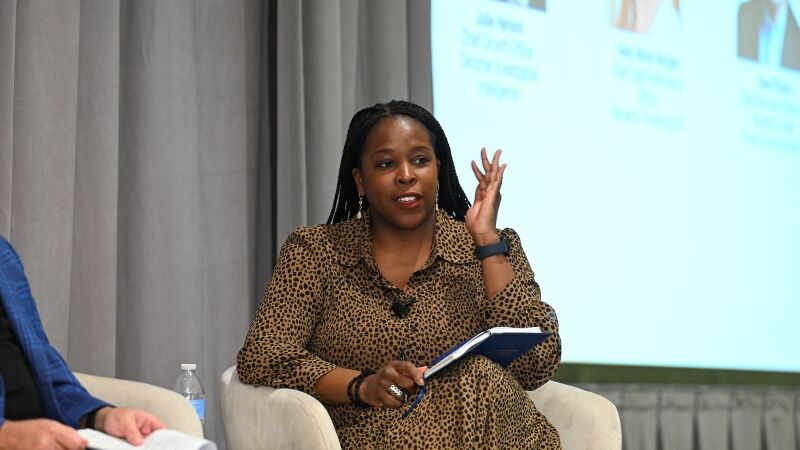
Law firms need to rethink talent as a strategic priority, according to a recent panel, by focusing on emotional intelligence, culture, and effective lateral integration, in order to strengthen teams and remain competitive
Key insights:
-
-
-
EI is emerging as a critical strategic capability — Stronger emotional intelligence can enable law firm leaders to build trust, navigate complex relationships, and strengthen both internal collaboration and client engagement.
-
Culture is now the defining factor in retaining top talent — As professionals increasingly expect transparency, purpose, and human‑centered leadership rather than traditional top‑down structures, law firms need to adapt.
-
Successful lateral integration requires coordination — Firms need to provide consistent messaging and fulfill their commitments to ensure that new hires feel aligned, supported, and positioned to contribute meaningfully.
-
-
AMELIA ISLAND, Fla. — If you’ve spent any amount of time inside a law firm, you already know that the people stuff is often the hardest part of the job. Sure, the work is complex, the clients are demanding, and the deadlines are relentless — but navigating human dynamics? That’s where things get really interesting.
During the Thomson Reuters Institute’s recent 33rd Annual Chief Marketing & Business Development Officer Forum (formerly the Marketing Partner Forum), three panels zoomed in on law firm talent: how to attract it, how to integrate it, and how to keep it. And while the themes ranged from emotional intelligence to lateral hiring to long‑term culture building, one takeaway stood out loud and clear: Those law firms that want to succeed have to start thinking about talent as a strategic engine — not an administrative task.
EI is not just a soft skill, it’s a strategic power skill
Emotional intelligence (EI) is having something of a renaissance inside law firms, and frankly, it’s overdue. As several panelists emphasized, EI isn’t about being warm and fuzzy — it’s about navigating relationships effectively, especially in a high‑pressure, fact‑driven environment like law.
Stronger EI, especially among firm leadership, will enhance everyone’s ability to perceive, understand, and manage their own emotions and relationships. Emotionally intelligent professionals are better able to motivate themselves, read social cues, and build stronger relationships. And because it requires being aware of emotions in oneself and others, it can positively impact internal collaboration and external client relationships.
You can find out more about next year’s Chief Marketing & Business Development Officer Forum 2027 here
For example, one panelist explained, if your go‑to opener with clients is still, “How’s it going?”, don’t expect anything more insightful than a polite shrug. Lawyers should use intentional conversation starters and even simple prompts, such as sharing the “top 10 things clients say we can do better,” the panelist explained.
Of course, EI isn’t always easy for lawyers because they are trained to trust facts, not feelings. That means firm leaders often need to dig deeper especially when someone seems resistant. It’s crucial for law firm leaders to remember that EI isn’t emotional fluff. It’s how firms build trust, lead through uncertainty, and strengthen both internal teams and client relationships. It’s a differentiator, panelists said, and one that law firms can no longer treat as optional.
In retention, culture is the whole game
Indeed, so much around talent hinges on the workplace culture, and as another panel discussed, that it has become the linchpin for successful hiring and retention of top talent. Indeed, in today’s environment, even the best firms may have trouble hiring and keeping top talent in a market where expectations, especially after the pandemic, have changed dramatically.

“It’s just changed so much since the pandemic where people just did their jobs and were expected to do so,” said one panelist. “Now, they want to feel valued and want to feel like they are making a difference.”
Several panelists agreed, pointing out that top talent is harder to hire than ever, largely because client demands have increased and the talent pool hasn’t expanded at the same pace. However, culture is where firms either win or lose the long game, they concurred.
Today’s employees want to feel valued, engaged, and connected to meaningful work — not just completing tasks in the background. They want transparency, authenticity, and involvement in strategy, panelists said. “People need to want to be part of your team, they need to feel prized once they’re there,” said another panelist. “They want leaders who are human first, and executives second.”
While this cultural tightrope may seem daunting, when a firm gets it right, recruiting becomes significantly easier. People want to work in environments in which they can be themselves, questions are encouraged, and their participation actually shapes outcomes, another panelist explained. “Keeping great people isn’t about perks or ping‑pong,” they said. “It’s about trust, clarity, and connection.”
The strategy behind making lateral integration work
Another aspect of the talent discussion, lateral hiring, has become a cornerstone of modern law firm growth, according to another panel. But to be honest, several panelists argued, even firms that recruit great laterals often fail to integrate them properly.
This can be a critical failure, they added, because lateral integration isn’t a task — it’s a firmwide commitment. When done well, it accelerates growth; but when done poorly, it creates churn, skepticism, and reputational risk.
Panelists stressed that laterals need clear messaging from everyone in the firm about how they fit into the broader business strategy. That means offering them consistent narratives and articulated opportunities, as well as stories of client wins, proof points about firm strengths, and external endorsements — all of which can help build credibility, they said.
Further, laterals need structured opportunities to showcase their expertise — such as CLEs, webinars, client events, internal spotlights. “These aren’t just marketing activations,” one panelist noted. “They are culture‑building moments that signal, ‘You’re part of this team, and we want people to know what you bring.’”
On-boarding laterals, especially lateral teams, often can be a fraught proposition, and ideally one person should coordinate the entire process on the firm’s behalf. Otherwise, the new partner ends up drowning in inconsistent communication and duplicate requests. “Nerves are very high during this time — worries about whether the lateral made the right choice, whether support staff is being accommodated, and, most critically, whether clients will come over too — and all that has to be managed,” a panelist said.
However, the most important thing firm leadership can do when it comes to laterals is to simply deliver on their promises. Few things sour a lateral’s experience faster than broken commitments, another panelist offered.
Overall, the thread throughout all these panels on talent challenges within law firms showed that law firms need to evolve not just how they manage work, but how they manage people. Whether leveraging EI to power leadership and motivate teams, unifying communication to drive successful lateral integration, or fostering a culture in which top talent wants to stick around, firms would be wise to invest in human‑centered strategies.
Indeed, the potential payoff is massive: More engaged teams, stronger client relationships, and a more resilient future. And for those firms that don’t make this shift? Well, talent always has other options.
You can read the full Executive Summary of the Thomson Reuters Institute’s 33rd Annual Chief Marketing & Business Development Officer Forum here