
This year's report finds law firms celebrating record profits while standing on increasingly unstable ground as warning signs suggest that the very forces driving today's success may be setting the stage for tomorrow's correction
The performance of law firms in 2025 can be summed up in a single tension, that the year’s exceptional results are built on uncertain foundations. The average law firm achieved 13% profit growth, demand surged to its best year of growth since the Global Financial Crisis, and worked rates shattered records with 7.3% growth. Yet beneath these headline numbers, fault lines have formed that should give every firm leader pause.
Jump to ↓
2026 Report on the State of the US Legal Market
As the data underpinning the just-released 2026 Report on the State of the US Legal Market — published jointly by the Thomson Reuters Institute and the Center on Ethics and the Legal Profession at Georgetown Law — makes clear, the industry is experiencing its own tectonic moment. Fundamental forces such as shifting client power, economic instability, and technological disruption are pushing some firms to extraordinary heights while leaving others on increasingly unstable ground.
This year’s report examines how the legal market’s current elevation came to be, why it may not last, and what firms can do now to prepare for the inevitable shift.
Key findings in the report
Some of the key findings discussed in this year’s report include:
-
-
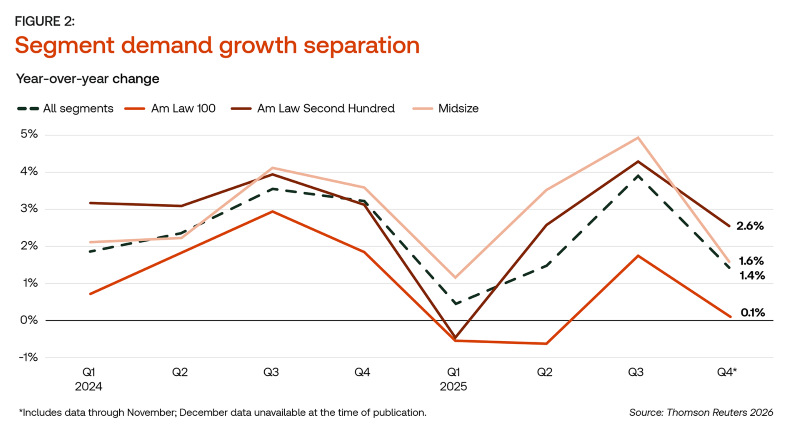
- Unprecedented demand surge amid market redistribution — The US legal market experienced some of the strongest demand growth in more than a decade, driven in part by regulatory shifts and geoeconomic instability. Critically, smaller firms captured the lion’s share of growth as clients moved demand from the most expensive firms to lower-cost alternatives.
- Intense expense growth — Technology spending and talent costs are rising rapidly, with firms aggressively investing in AI capabilities while simultaneously expanding headcount. This dual arms race is sustainable only so long as demand and rate growth can be maintained as well.
- Structural business model conflict — The industry remains trapped between transformative technology and outdated billing structures. Despite heavy AI investments that will fundamentally alter how legal work is performed, 90% of legal dollars still flow through hourly billing arrangements that may no longer reflect the value delivered.
- Deteriorating buyer sentiment — Many corporate general counsels (GCs) are signaling that they are considering significant spending pullbacks ahead, with Net Spend Anticipation dropping to levels not seen since the pandemic. Financial forecasts increasingly point to contraction by mid-2026.
- Historical warning patterns — Today’s legal market dynamics (represented by booming demand amid instability, runaway expenses, and universal optimism) closely mirror the conditions that preceded previous industry downturns in 2007 and 2021.
-
As the report makes clear, the challenges ahead are significant. The same forces creating today’s peaks are simultaneously undermining the ground beneath them. The surge in demand stems not from economic health but from chaos — trade wars, regulatory upheaval, and geopolitical tensions — all while GCs face stagnant budgets and intensifying pressure to demonstrate value.
While much of this is outside firms’ control, however, their response to it is not. The report clearly shows that those firms that use the current boom to reinforce their footing by modernizing pricing models, strengthening client relationships, and deploying technology in ways that deliver measurable value rather than marketing gloss will be best positioned for what comes next.
As this year’s report illustrates, 2025 was less a summit than an inflection point. The firms that treat elevation as permanence may find, as countless mountain ranges have over geologic time, that height is not a promise — it’s a phase.
You can download
a full copy of “2026 Report on the State of the US Legal Market,” published jointly by the Thomson Reuters Institute and the Center on Ethics and the Legal Profession at Georgetown Law, by filling out the form below: