
New market research from the Thomson Reuters "Future of Professionals 2025" report shows that lawyers in the UK have a keener insight into the technological change that AI will bring to the legal profession
Key insights:
-
-
-
UK lawyers see the future first — 87% of UK legal professionals predict AI will significantly impact the profession within five years, significantly higher than the global average of 79% and positioning British lawyers as particularly prescient about technological change affecting legal practice.
-
Individual AI fluency is becoming the new professional differentiator — Legal professionals who regularly use AI report better work-life balance, accelerated skill development, and enhanced client value delivery, while those who don’t risk falling behind in an increasingly competitive market.
-
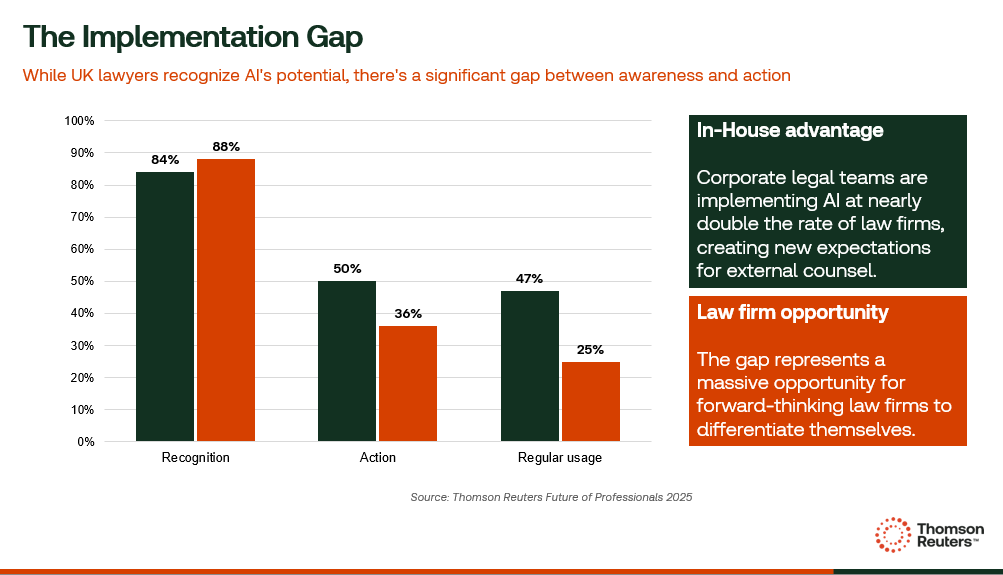
The client relationship is evolving rapidly — UK corporate legal teams are pioneering AI automation, with 50% expecting high or transformational change in their own departments within 12 months, creating new expectations for external counsel and reshaping how legal services are delivered and valued.
-
-
An exclusive preview for Practical Law survey respondents
Being a lawyer in the United Kingdom today means being part of a profession that’s in the midst of its most significant transformation in generations. While the legal industry has always been defined by precedent and tradition, today’s modern legal professional must also be defined by adaptability, technological fluency, and a willingness to reimagine how excellent legal work gets done.
New market research from the Thomson Reuters Future of Professionals 2025 report reveals that British lawyers are not just witnessing digital transformation — they’re leading it. The report surveyed 172 UK legal professionals as part of a broader study of 2,275 professionals globally across legal, tax, audit, accounting, and risk & compliance sectors. However, the recent research also exposes a crucial gap that every UK lawyer needs to understand: While they perhaps can see the future more clearly than their global peers, many of them aren’t yet equipped to thrive in it.
UK legal professionals lead global AI adoption despite implementation gaps
UK legal professionals have consistently demonstrated a pattern of embracing technological developments and new ways of working faster than their counterparts in other regions, particularly North America. The latest data shows this trend continuing, with 87% of UK legal professionals saying they believe AI will have high or transformational impact on the legal profession within five years. This outpaces their American legal counterparts at 75% and Canadian legal colleagues at 70%.
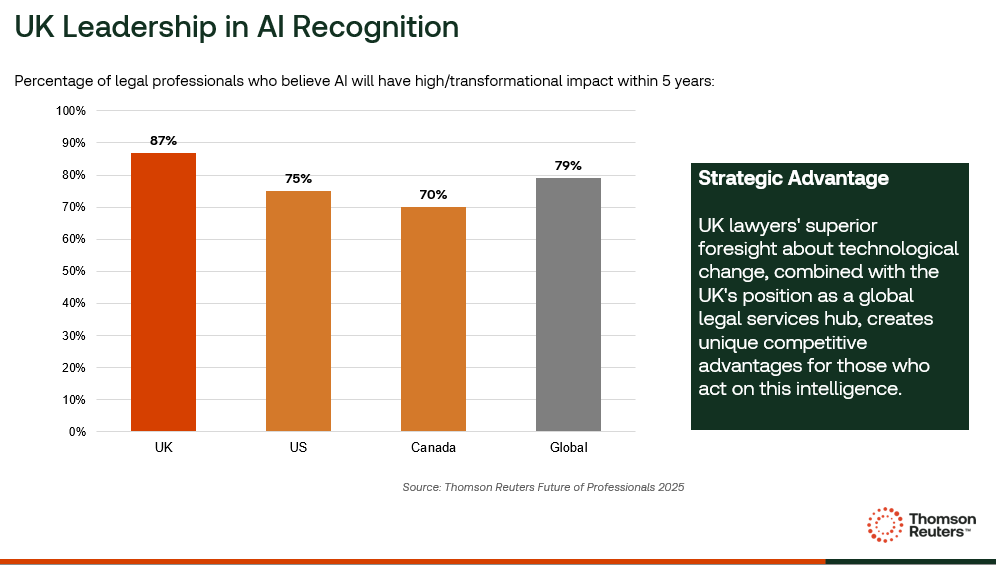
This deeper understanding of technological change isn’t just academic — it’s practical intelligence that’s already reshaping how the most successful UK lawyers approach their careers. Those who understand what’s coming are making different choices about skill development, client relationships, and career positioning. Yet, the research also reveals that while UK legal professionals are quicker to recognize this potential transformation, only 38% say they expect to see transformational change in their own organizations this year. This gap between recognition and implementation creates both opportunity and risk for individual professionals.
What separates tomorrow’s leaders from today’s
The research underpinning the Future of Professionals 2025 report reveals a fundamental truth about the modern legal profession: Individual AI proficiency is rapidly becoming the new differentiator between excellent lawyers and average ones. This isn’t about replacing legal judgment with technology, it’s about augmenting human expertise with tools that enhance accuracy, speed, and strategic insight.
UK lawyers who are already incorporating AI into their daily practice report significant benefits, including:
-
-
- Enhanced productivity without burnout — UK legal professionals expect to free up around 150 hours per year within 12 months. This represents enormous value that can be used to achieve greater volumes of work, or be redirected toward higher-level strategic work, business development, or simply better work-life balance.
- Accelerated professional development — AI tools are enabling lawyers to handle more complex matters earlier in their careers by providing sophisticated analysis, precedent research, and document review capabilities that traditionally required years of experience to develop.
- Improved client relationships — Lawyers using AI consistently report better client satisfaction through faster response times, more thorough analysis, and the ability to provide innovative solutions that purely traditional approaches couldn’t deliver.
-
In-house teams are changing the game
Perhaps nowhere is the transformation more evident than in UK corporate legal departments. The research shows that 50% of UK corporate legal professionals expect high or transformational change within their own departments this year, compared to just 36% predicting the same level of change within UK law firms. And almost half (47%) of UK corporate legal professionals surveyed say they are now regularly using AI-powered tools to start or edit their work — about double the rate within UK law firms.
“We are using chatbots and AI to automate routine operations with a goal to increase efficiency,” says one UK-based respondent from a financial services company. However, it isn’t just about internal efficiency — AI is set to fundamentally change the relationship between in-house counsel and external law firms.
Indeed, the implications for all UK lawyers are significant:
-
-
- For in-house counsel — You’re at the forefront of legal innovation, with opportunities to demonstrate strategic value by implementing AI solutions that drive business outcomes. Your role is evolving from legal advisor to strategic innovator.
- For law firm lawyers — Your corporate clients are increasingly sophisticated AI users who expect their external counsel to match or exceed their technological capabilities. The law firms and individual lawyers who can’t demonstrate AI fluency risk becoming less valuable to these forward-thinking clients.
-
The skills that matter now
The modern UK legal professional needs to develop competencies that didn’t exist five years ago. Based on the research findings and emerging best practices, several skills are becoming essential, including:
-
-
- AI tool fluency — Understanding how to effectively use AI for legal research, document analysis, contract review, and strategic planning is crucial. This isn’t about becoming a technologist, it’s about becoming a more effective lawyer.
- Quality control expertise — As AI handles more routine tasks, the premium skill becomes knowing how to review, refine, and monitor the quality of AI outputs to ensure they meet professional standards.
- Strategic application — The ability to identify which legal tasks benefit from AI assistance and which require purely human judgment. This discernment is becoming as important as traditional legal analysis skills.
- Client education — Modern lawyers must be able to explain AI capabilities and limitations to clients, helping them understand how technology enhances (rather than replaces) legal expertise.
-
The global Future of Professionals research reveals concerning gaps in AI adoption across different professional demographics. For example, Millennials are adopting AI at nearly twice the rate of Baby Boomers, creating potential competitive advantages for younger lawyers while leaving experienced professionals at risk of being perceived as outdated.
Age isn’t destiny, however. The lawyers thriving in this environment, regardless of career stage, share common characteristics, such as a curiosity about new tools, willingness to experiment, and focus on how technology can enhance client or business value rather than simply reduce effort.
Practical steps for the modern UK lawyer
Whether you’re a newly qualified solicitor or a senior partner, certain actions can position you advantageously, including:
-
-
- Understanding security and appropriate use first — Before using any AI tool, you should understand the critical distinction between public AI platforms and secure, professional-grade solutions. Tools like ChatGPT may be suitable for general research or educational queries, but they should never be used with confidential client data, privileged information, or sensitive commercial details. Always check your firm’s policies and ensure any AI tools you use meet professional confidentiality and data protection requirements.
- Starting to experiment safely — Once you understand the security parameters, begin exploring AI tools relevant to your practice area, starting with non-confidential applications. The lawyers who will lead tomorrow are those who are learning today, but they’re doing so responsibly.
- Focusing on client and business impact — When evaluating AI tools, you should ask how they enable you to deliver better outcomes for clients or for your business, not just how they make your work easier.
- Developing quality standards — You should create personal protocols for reviewing and validating AI outputs. This expertise will become increasingly valuable as AI use becomes ubiquitous.
- Staying professionally current — It would be smart for you to join discussions, attend seminars, and engage with peers about AI developments in legal practice. Professional competence now includes technological awareness.
- Documenting your learning — You need to keep track of how AI tools improve your work quality and efficiency. This evidence will be valuable for your career advancement and client development conversations.
-
Professional identity shift
Being a modern legal professional in the UK means embracing a fundamental shift in professional identity. The lawyers who will thrive are those who see themselves not just as legal experts, but as legal problem-solvers equipped with cutting-edge tools.
This doesn’t diminish the importance of traditional legal skills, such as analytical thinking, advocacy, client counseling, and ethical judgment remain fundamental. Rather, it enhances these capabilities with technological tools that amplify human expertise.
The research suggests we’re moving toward a legal profession in which AI fluency becomes as expected as legal research skills or professional writing ability. The lawyers who embrace this evolution early will shape the profession’s future and enjoy competitive advantages throughout their careers.
The choice ahead
Today, every UK lawyer faces a choice about how to respond to this technological transformation. The research reveals that those who engage proactively with AI tools — learning their capabilities, understanding their limitations, and applying them strategically — report higher job satisfaction, better client relationships, and more optimistic career prospects.
Those who wait, hoping the transformation will slow or somehow bypass them, risk finding themselves increasingly disadvantaged in a market in which AI-enabled colleagues can deliver superior results more efficiently.
The modern legal professional in the UK has an unprecedented opportunity. British lawyers’ superior foresight about technological change, combined with the UK’s position as a global legal services hub, creates unique advantages for those willing to seize them.
The future belongs to lawyers who can seamlessly blend traditional legal excellence with technological sophistication — professionals who understand that in tomorrow’s legal marketplace, the question isn’t whether to embrace AI, but rather, how quickly and effectively you can learn to use it in service of your clients, your business, and your career.
This transformation is happening now. So, UK lawyers need to ask themselves: What kind of legal professional will I choose to become?
You can download your copy of the 2025 Future of Professionals Report here